Water Refilling Station vs. Bottled Water Delivery: Which Is Actually Sulit in the Philippines? (2026 Guide)
Sulit verdict: For most households, walking your own container to a nearby refilling station is the cheapest way to get drinking water — often four to seven times cheaper per container than ordering brand-name delivery. But “cheapest” only holds if the station you’re using actually has a current sanitary permit and tests its water on schedule. Skip that check to save a five-minute walk, and you’re gambling with the one household expense that’s supposed to be about safety, not just price.
Almost every Filipino household buys drinking water from somewhere other than the tap, and the two default options are the corner refilling station and brand-name delivery (Summit, Absolute, Wilkins, and similar). What rarely gets asked is whether the cheaper option is actually held to the same safety standard as the pricier one — and, separately, whether delivery is ever worth the premium it charges.
As of September 2026, here’s what refilling stations and delivery services actually charge, what the law requires a refilling station to do before it can legally sell you water, and a real 2026 case that shows what happens when nobody checks.
The Real Cost Comparison
A quick note on terms first: when Filipinos say “isang galon” at a refilling station, they almost always mean the round 5-gallon (about 18.9-liter) container, not a literal 1-gallon jug. That’s the unit used throughout this guide.
| Option | Price (5-gallon container) | What’s included | Catch |
|---|---|---|---|
| Local refilling station (bring your own container) | Roughly ₱25–₱40 for purified/mineral water, up to ₱65 for alkaline, per pricing reported by Moneymax | Refill only — you bring an empty, already-owned container | Quality depends entirely on that specific station’s permit and testing — this is not standardized nationwide |
| Summit Natural Drinking Water — refill only (bulk/office delivery) | ₱175 per container, per Summit’s own published pricing | Refilled into containers you already own, delivered | 10-container minimum order, Metro Manila only, delivered roughly every 1–2 weeks — not built for a small household’s monthly needs |
| Summit — refill + new container (first order) | ₱385, per Summit’s own published pricing | Water plus a container you keep | One-time cost for the container; still subject to the same 10-unit minimum for reorders |
| Absolute Distilled Water — refill + new container (first order) | ₱425, per Asia Brewery’s own published pricing | Water plus a container you keep | Same bulk-order structure as Summit |
| Hot-and-cold water dispenser (one-time purchase) | Roughly ₱6,800–₱11,200 for a bottom-load unit, per Robinsons Appliances’ current listings | The appliance itself — works with either refilled or delivered water | Separate from your water source decision; adds its own electricity cost for the hot/cold function |
Sulit Tip: Brand-name delivery isn’t actually priced for a typical household — it’s priced for offices and buildings that can hit the 10-container minimum. If you only need 6–8 containers a month, forcing yourself into that minimum order is the opposite of sulit, even before you compare the per-container price.
Why Not Every Refilling Station Deserves Your Container
Refilling stations in the Philippines aren’t an unregulated free-for-all — they’re covered by the Supplemental Implementing Rules and Regulations of Chapter II (“Water Supply”) of the Sanitation Code of the Philippines (Presidential Decree No. 856), enforced through the local city or municipal health office. On paper, a legally operating station needs:
- A Sanitary Permit from the city or municipal health office, renewed annually and valid only until December 31 of the year it was issued.
- A Certificate of Potability of Drinking Water, based on actual lab testing rather than just equipment specs.
- Monthly bacteriological testing at minimum, plus physical and chemical testing at least every six months, with samples submitted to a DOH-accredited laboratory.
- DOH certification of any water treatment equipment before it’s used to sell water to the public.
- Health certificates for every employee handling the water or containers, renewed annually.
- A Sanitary Clearance posted on any delivery vehicle, if the station also delivers.
Local health offices are supposed to inspect stations at least every three months. In practice, enforcement varies a lot by city — which is exactly why the next section matters.
Heads Up: None of this is optional paperwork the station can skip if it’s “just a small neighborhood shop.” A station without a current permit isn’t a budget option — it’s an unregulated one, and you have no way to know from the outside whether its water has actually been tested this month.
The Baguio Wake-Up Call
This isn’t a hypothetical risk. In July 2026, Baguio City’s local government — acting on Mayor Benjamin Magalong’s directive after a City Water Resources Board meeting — announced stricter enforcement against water suppliers that fail quality tests, effective July 20, 2026, per the Philippine Daily Inquirer. Under the new enforcement push, a station that fails a water quality test once gets a cease-and-desist order and must fix the problem before reopening; a second failure means closure. Nine water refilling stations that had been operating without business permits at all were scheduled for closure in the same sweep, and repeat violators face fines of ₱5,000 on top of possible shutdown.
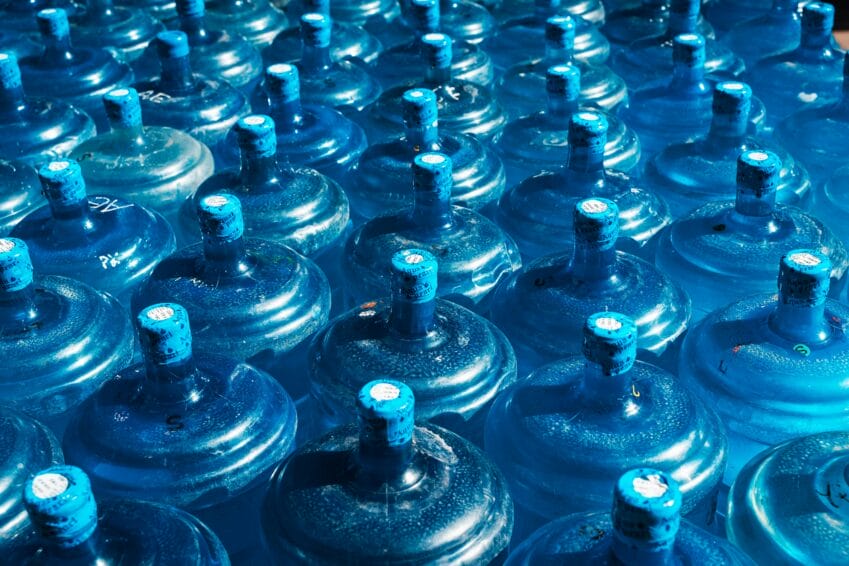
Baguio isn’t uniquely bad — it’s just a city that’s actively enforcing the rules other cities also have on the books. The lesson for the rest of the country is the same either way: “the water refilling station down the street” isn’t a single, uniform product. Some are fully compliant. Some are running without a permit at all. From the outside, both look like a shop with a filtration setup and a line of blue containers.
How to Verify a Refilling Station Before You Trust It
You don’t need to be a health inspector to do a basic check before switching to a new station, or sticking with one you’ve never actually looked at closely:
- Ask to see the current Sanitary Permit. It should be posted and dated for the current year — remember, these expire every December 31.
- Ask when the water was last tested and whether they can show or describe the result. A station that can’t answer this at all is a red flag.
- Look at the container-washing area. DOH rules require containers to be washed and sanitized with a chlorine solution before refilling — a visibly dirty or absent washing station is a bad sign regardless of what the permit says.
- Check that treatment equipment looks maintained, not improvised or clearly past its filter-change schedule.
- If in doubt, ask your city or municipal health office directly whether a specific station is currently permitted — this is public information they’re required to maintain.
Good to Know: A lower price at a station you haven’t verified isn’t actually cheaper water — it’s the same price gamble as buying medicine from an unlicensed seller. The station’s price has nothing to do with whether it’s compliant.
When Brand Delivery Actually Makes Sense
Paying the delivery premium isn’t automatically a bad decision — it’s just a different trade than most households need. It tends to make sense when: several households or an office can pool orders to comfortably clear the 10-container minimum; you specifically want a distilled or alkaline product a nearby station doesn’t offer; or you’ve checked the refilling stations in your area and genuinely can’t find one with a current permit and a testing routine you’re comfortable with. In any of those cases, paying roughly four to seven times more per container for a known brand, in exchange for consistent sourcing and quality control you don’t have to personally verify, is a defensible sulit call — just go in knowing that’s the trade you’re making.
Worked Scenario: A Family of Four Choosing Where Their Water Comes From
Say a family of four uses about two 5-gallon containers a week for drinking and cooking — roughly 8 containers a month. At a verified local refilling station charging ₱30 per container, that’s about ₱240 a month. Trying to switch that same family to Summit’s bulk delivery means either over-ordering to hit the 10-container minimum (₱1,750 for water they don’t need yet) or buying individual refill-and-container orders at ₱385–₱425 each, which for 8 containers works out to roughly ₱3,080–₱3,400 a month — 12 to 14 times what the same family would pay at a properly permitted local station.
That gap is the entire reason this decision is worth thirty seconds of due diligence rather than defaulting to whichever station is physically closest. The math only favors the refilling station if it’s actually compliant — the moment you can’t verify that, the “savings” stop being real savings and start being an unpriced risk.
Another recurring household exchange decision worth checking: our new LPG tank vs. palit-tangke exchange guide walks through the same cost logic for cooking gas, plus how to spot a tampered or underfilled tank.
Also Worth Checking
If you’re weighing this alongside other household appliance and utility decisions, our guide to whether budget appliance brands are worth it in the Philippines covers a similar “cheaper option, but check the safety marks first” trade-off for appliances. If a dispenser or filtration unit you already own is on its last legs, our breakdown of when it’s actually worth repairing versus replacing an appliance walks through the same kind of cost math used above. And if you’re building out an energy-efficient kitchen setup that includes a water dispenser, our guide to energy-efficient kitchen appliances is a useful next read. If you’re wondering whether it’s time to stop refilling altogether and just buy your own filtration unit, our home water purifier worth-it guide breaks down the real cost and the health claims worth ignoring. For more of this kind of value-first breakdown, head back to more sulit finds.
Quick Answers
Is refilled water actually safe to drink in the Philippines? It can be — but only from a station that currently holds a valid Sanitary Permit and actually follows the required testing schedule under the Sanitation Code. Safety isn’t automatic just because a station is operating; it depends on that specific station’s compliance.
How do I check if a water refilling station has a valid permit? Ask to see the posted Sanitary Permit and confirm it’s dated for the current year, since permits expire every December 31. If it isn’t posted, your city or municipal health office can confirm whether that specific station is currently permitted.
Is bottled water delivery worth it for a small household? Usually not on price alone — brand delivery services like Summit require a 10-container minimum order built for offices, and per-container costs run several times higher than a verified local refilling station. It can still be worth it if you specifically want a brand’s distilled or alkaline product, or can’t find a compliant station nearby.
Do I need a water dispenser if I already refill containers? No — a hot-and-cold dispenser is a separate, one-time appliance purchase that works with either refilled or delivered water. It doesn’t change which water source is cheaper; it just adds convenience and its own electricity cost.
Verified Sources Used
Supreme Court E-Library (DOH Supplemental IRR of PD 856): Confirmed the Sanitary Permit, Certificate of Potability, testing frequency (monthly bacteriological, semi-annual physical/chemical), DOH equipment certification, and local health office enforcement requirements for water refilling stations.
Philippine Daily Inquirer: Confirmed Baguio City’s July 2026 enforcement crackdown, including the two-strike closure policy, the ₱5,000 fine for repeat violators, and the nine unpermitted stations ordered closed.
Moneymax: Confirmed the typical ₱25–₱65 per-container retail price range charged by local refilling stations depending on water type.
Asia Brewery / Summit: Confirmed Summit’s own published pricing for refill-only and refill-plus-container orders, the 10-container minimum, and Metro Manila-only delivery.
Asia Brewery / Absolute: Confirmed Absolute Distilled Water’s own published refill-plus-container pricing.
Robinsons Appliances: Confirmed current retail pricing for bottom-load hot-and-cold water dispenser units.