Complete Beginner’s Guide to Energy-Efficient Kitchen Appliances in the Philippines
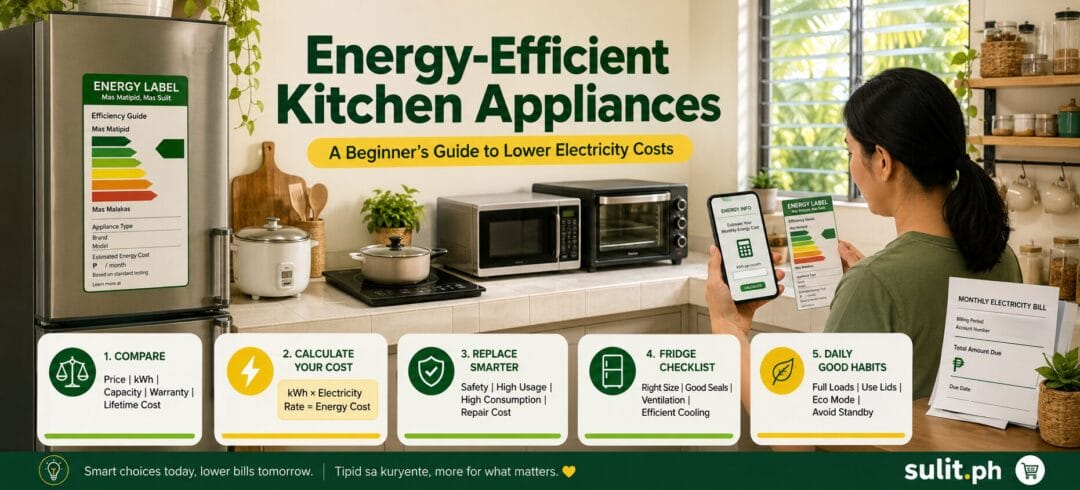
Energy-efficient kitchen appliances use less electricity to perform the same household tasks as comparable models. For Filipino households, the smartest buying strategy is to compare the appliance’s capacity, Philippine energy label, estimated electricity consumption, expected lifespan and actual usage pattern, not simply the purchase price or an “inverter” sticker.
A refrigerator that costs more upfront can become the cheaper choice when it runs continuously and consumes significantly less electricity. A rarely used blender, toaster or coffee maker has far less influence on the monthly bill, so replacing it purely for energy savings rarely makes financial sense.
The goal is not to build a futuristic kitchen packed with expensive gadgets. It is to identify which appliances consume the most energy in your home, replace them in the right order and use every appliance efficiently.
Quick answer: Start with appliances that run for long periods, especially your refrigerator or freezer. Check the Philippine Energy Labeling Program information, compare energy consumption in kilowatt-hours and calculate the lifetime cost before buying.
This guide follows the practical decision framework outlined in the supplied content brief, including label interpretation, replacement priorities, installation, daily habits and return-on-investment calculations.
Sulit Energy-Efficient Kitchen Appliances at a Glance
| Appliance | Energy impact | What to prioritize | Replace first when |
|---|---|---|---|
| Refrigerator | High | Correct capacity, energy label, efficient compressor, good insulation | It runs continuously, struggles to cool or consumes far more than a comparable new unit |
| Freezer | High | Right size, tight seals, efficient cooling system | Frost buildup, damaged seals or excessive consumption cannot be corrected |
| Electric oven | Medium to high | Suitable cavity size, insulation, convection mode | Used frequently and inefficient heating causes long cooking times |
| Induction cooker | Medium | Appropriate wattage, pan compatibility, power control | You cook electrically every day and your current cooker wastes heat |
| Rice cooker | Medium | Correct capacity, efficient keep-warm mode | It remains on for many hours daily |
| Dishwasher | Medium | Eco cycle, load sensing, water efficiency | Used frequently and the existing unit consumes excessive water or electricity |
| Microwave oven | Low to medium | Correct size, straightforward controls | Replace for damage, safety or performance, not small efficiency differences |
| Air fryer | Low to medium | Capacity matched to household size | It can replace frequent full-size oven use for small portions |
| Blender, toaster and coffee maker | Low | Durable design and low standby consumption | Replace mainly when broken or unsafe |
What Are Energy-Efficient Kitchen Appliances?
An energy-efficient appliance performs a required task while consuming less electricity than a comparable conventional product under similar conditions.
That does not mean the appliance uses no electricity. It means it produces more useful work from each kilowatt-hour consumed.
Examples include:
- A refrigerator that maintains safe cooling temperatures with lower daily electricity consumption
- An induction cooker that transfers heat directly to compatible cookware
- A dishwasher that adjusts its water and electricity use according to the load
- A rice cooker with a better-insulated cooking chamber and controlled keep-warm function
- An oven that circulates hot air to cook food more evenly and, in suitable recipes, more quickly
The Department of Energy’s Philippine Energy Labeling Program, or PELP, establishes a national labeling system based on the energy performance of covered energy-consuming products. Refrigerating appliances are among the product categories included in current PELP registration and energy-label issuance records.
Why energy efficiency matters in a Filipino kitchen
Kitchen appliances affect household expenses in three ways:
- Purchase cost: The amount paid at the store.
- Operating cost: Electricity, water, consumables and maintenance.
- Replacement cost: The expense of repairing or replacing the unit later.
The lowest-priced appliance is not automatically the cheapest appliance to own.
A ₱20,000 refrigerator that costs ₱9,000 per year to operate can become more expensive than a ₱27,000 model costing ₱6,000 per year after only a few years. The exact result depends on the models, household usage and local electricity rate.
Energy efficiency also reduces the amount of electricity that must be generated for everyday household activities. The environmental benefit grows when the appliance is used frequently or continuously.
Understanding Energy Labels and Efficiency Ratings
The content brief recommends teaching readers how to compare certification labels, estimated usage and real household behavior. In the Philippines, the Philippine energy label is more directly relevant than relying exclusively on labels designed for other countries.
How to read a Philippine energy label
The exact presentation can differ by product category, but useful information can include:
- Product type and model
- Rated capacity
- Energy-efficiency rating
- Star rating or performance indicator
- Estimated energy consumption
- Test conditions
- Label or registration control information
The DOE maintains records of approved or issued labels for covered products. Individual refrigerating-appliance records can show details such as refrigerator type, control number and energy consumption.
When comparing two appliances, make sure they have:
- Similar capacities
- Similar configurations
- Similar functions
- Comparable testing conditions
- The same unit of measurement
Comparing a small single-door refrigerator with a large side-by-side model produces a distorted conclusion. The larger appliance can consume more electricity overall even when its cooling technology is efficient.
What does kWh mean?
A kilowatt-hour, written as kWh, is a unit of electrical energy.
A 1,000-watt appliance running continuously for one hour consumes:
1,000 watts ÷ 1,000 × 1 hour = 1 kWh
For appliances with thermostats, compressors or variable power, the calculation is more complicated because they do not necessarily draw their rated power continuously.
A refrigerator compressor switches or adjusts according to temperature, ambient heat, door openings, stored food and control settings. This is why a tested energy-consumption figure is usually more useful than multiplying the refrigerator’s maximum wattage by 24 hours.
How to estimate the electricity cost
Use this basic formula:
Electricity cost = Energy consumption in kWh × Electricity rate per kWh
Example:
- Appliance consumption: 30 kWh per month
- Household electricity rate: ₱12 per kWh
- Estimated monthly cost: 30 × ₱12 = ₱360
- Estimated annual cost: ₱360 × 12 = ₱4,320
The ₱12 figure is only an example. Use the effective rate shown on your latest electric bill because electricity charges change over time and differ by distribution utility.
Meralco’s Appliance Calculator estimates appliance consumption by hour, day, week and month based on usage information and Power Lab data. Households outside the Meralco service area can use the same calculation principle with their local utility’s effective rate.
If your appliances are already efficient but your bill is still high because of overall household consumption, it may be worth asking a bigger question — see our guide on whether solar panel installation is worth it in the Philippines for real 2026 costs, honest payback periods, and net metering rules.
Philippine label versus ENERGY STAR
ENERGY STAR is a United States Environmental Protection Agency certification. Products earning the label must meet efficiency specifications established by the US EPA. Its covered appliance categories include refrigerators, freezers, dishwashers and electric cooking products.
ENERGY STAR information can help explain technologies and international product performance. It should not replace checking the Philippine model number, voltage, warranty, service support and applicable DOE label.
For Philippine shoppers, use this order:
- Confirm the exact model sold locally.
- Check the Philippine energy label where applicable.
- Compare energy consumption and capacity.
- Confirm 220–240-volt compatibility.
- Check local warranty and parts availability.
- Treat foreign certifications as supporting information.
Essential Energy-Efficient Kitchen Appliances to Consider
1. Refrigerator
The refrigerator should receive the most attention because it operates throughout the day.
What to look for
- Capacity appropriate for the household
- Verified energy-consumption information
- Efficient compressor control
- Strong door seals
- Good insulation
- Practical compartment layout
- Temperature controls
- Accessible local service and replacement parts
“Inverter” commonly refers to a system that can adjust compressor operation instead of relying only on full-power on-and-off cycles. This can improve efficiency and temperature stability, but the word itself is not proof that one model is cheaper to run than another.
Compare the actual label figures.
Avoid buying excessive capacity
A larger refrigerator gives you additional storage, but it also cools a larger cabinet. Buying far more space than the household uses can increase both the purchase price and electricity consumption.
Consider:
- Number of household members
- Grocery-shopping frequency
- Frozen-food storage
- Meal-preparation habits
- Available kitchen space
- Required clearance for ventilation
When an old refrigerator is still good enough
Keep the existing refrigerator when it:
- Maintains safe and stable temperatures
- Has intact seals
- Does not run abnormally
- Has manageable electricity consumption
- Fits the household’s storage needs
- Does not require repeated repairs
Replacing a functioning refrigerator solely because a new one is marketed as “eco-friendly” can create a long financial payback period.
When replacement becomes reasonable
Replacement deserves consideration when:
- The compressor runs excessively
- Door gaskets no longer seal properly
- Food temperature fluctuates
- Repairs are becoming frequent
- Electricity use is unusually high
- The unit is significantly oversized
- Replacement parts are unavailable
ENERGY STAR states that certified refrigerators sold under its US program use approximately 9% less energy than models meeting the applicable US federal minimum standard. That percentage should not be automatically applied to Philippine products, but it illustrates why tested model-to-model comparisons matter.
2. Freezer
A dedicated freezer can be useful for bulk shopping, home businesses and large households. It can become an energy barnacle when it is oversized, poorly sealed or nearly empty for long periods.
Look for:
- Capacity that matches actual frozen storage
- Clear energy-consumption information
- Tight door or lid seals
- Suitable insulation
- Accessible temperature controls
- Easy defrosting or frost management
A chest freezer can retain cold air effectively when opened because cold air remains lower in the cabinet. An upright freezer provides easier organization. Compare actual energy data and usability rather than assuming one format always wins.
3. Rice Cooker and Multicooker
Cooking rice requires energy, but the keep-warm period can become the larger issue when the cooker remains on for many hours every day.
Choose a capacity close to your normal batch size. A large cooker used for a small amount of rice heats unnecessary space.
Helpful features include:
- Automatic shutoff or controlled keep-warm mode
- Timer functions
- Insulated inner construction
- Replaceable inner pot
- Clear wattage information
Cooking one appropriate batch can be more efficient than repeating several small batches. Food-safety practices should still guide how long cooked rice is stored or held warm.
4. Induction Cooker
An induction cooker creates an electromagnetic field that heats compatible cookware directly. Less heat is wasted around the pan compared with cooking methods that first heat a separate element.
Advantages include:
- Fast heating
- Precise power adjustment
- Reduced heat released into the kitchen
- Easy surface cleaning
- Timer and automatic-control options
Check that your cookware is induction-compatible. A magnet that adheres firmly to the base is a useful preliminary test, though cookware instructions remain the better reference.
Also consider:
- Circuit capacity
- Plug and outlet condition
- Maximum wattage
- Cookware size
- Available service support
Induction cooking does not automatically guarantee a lower bill. Cooking time, power setting, cookware and local electricity cost determine the result.
5. Electric Oven and Air Fryer
An air fryer is essentially a compact convection cooking appliance. It can use less total energy than a large oven when preparing a small portion because it heats a smaller chamber and can reach temperature quickly.
A full-size oven remains more practical for:
- Large meals
- Multiple trays
- Bread or large baked goods
- Batch cooking
- Family gatherings
Choose according to portion size, not social-media sparkle.
Efficiency features to check
- Convection or fan-assisted cooking
- Good door insulation
- Accurate thermostat
- Suitable internal capacity
- Timer and automatic shutoff
- Multiple-rack cooking
- Clear standby behavior
ENERGY STAR reports that electric cooking products certified under its US program are, on average, 18% more efficient than standard models covered by the comparison. Local consumers should still verify the exact Philippine model and applicable label information.
Wondering whether an air fryer specifically is worth adding to your kitchen, and what it actually costs to run each month? See our full breakdown: Is an Air Fryer Worth It in the Philippines? (2026 Electricity Cost & Buying Guide).
6. Microwave Oven
A microwave can be efficient for:
- Reheating individual portions
- Defrosting
- Heating liquids
- Cooking small quantities
- Short tasks that would otherwise require preheating a large oven
Do not assume higher wattage always means higher total cost. A higher-powered microwave can complete the task more quickly. Total energy consumption depends on power multiplied by operating time.
Choose an appropriate cavity size and avoid paying for complex programs you will never use.
7. Dishwasher
Dishwashers remain less common in Philippine households than refrigerators and rice cookers, but they can be relevant in larger households or kitchens with frequent meal preparation.
Look for:
- Eco mode
- Soil or load sensors
- Half-load settings
- Air-dry options
- Water-consumption information
- Suitable place-setting capacity
- Local detergent availability
- Reliable service support
Run full, properly loaded cycles instead of several lightly loaded cycles. Scrape food scraps into the bin rather than extensively pre-rinsing dishes unless the machine instructions require it.
ENERGY STAR notes that certified dishwashers can incorporate soil sensors, improved filtration and more efficient water jets. Its published cost and water-saving figures are based on US assumptions, so Philippine households should calculate savings using local utility rates and actual use.
8. Small Kitchen Appliances
Blenders, electric kettles, coffee makers and toasters can have high wattage but short operating times.
For example:
- A 1,500-watt kettle used for six minutes consumes about 0.15 kWh.
- A 150-watt refrigerator averaging continuous equivalent operation for ten hours consumes 1.5 kWh.
The refrigerator has the greater daily effect in this simplified example.
For small appliances, prioritize:
- Durability
- Repairability
- Correct capacity
- Automatic shutoff
- Low standby consumption
- Safe electrical construction
Replacing a working toaster to save a tiny amount of electricity can cost more than the energy saved during the appliance’s remaining life.
How to Choose the Right Energy-Efficient Appliances
Step 1: Establish your energy baseline
Review at least three recent electricity bills.
Record:
- Monthly kWh consumption
- Total bill
- Effective cost per kWh
- Seasonal changes
- Changes in household occupancy
- Recently added appliances
Calculate the effective rate:
Effective electricity rate = Total electricity bill ÷ Total kWh consumed
The result includes the combined effect of bill components. Use it as a practical household estimate, not as a formal tariff analysis.
Step 2: Identify your largest kitchen loads
Begin with appliances that:
- Run continuously
- Produce heat
- Maintain cold temperatures
- Remain in standby mode
- Operate for several hours daily
A plug-in electricity meter can help measure compatible plug-connected appliances. Do not use a meter beyond its rated voltage, current or wattage.
For refrigerators, measure over several days because compressor activity changes throughout the day.
Step 3: Match capacity to your household
Efficiency begins with sizing.
Ask:
- How many people use the appliance?
- How many meals are prepared daily?
- Do you shop weekly or daily?
- Do you batch-cook?
- Do you store frozen goods?
- How much counter or floor space is available?
- Can the appliance receive proper ventilation?
An efficient but oversized appliance can consume more total electricity than a correctly sized alternative.
Step 4: Compare annual operating cost
Suppose you are comparing two refrigerators:
| Factor | Refrigerator A | Refrigerator B |
|---|---|---|
| Purchase price | ₱24,000 | ₱30,000 |
| Estimated annual use | 420 kWh | 300 kWh |
| Example electricity rate | ₱12/kWh | ₱12/kWh |
| Annual electricity cost | ₱5,040 | ₱3,600 |
| Annual difference | ₱1,440 lower |
The efficient model costs ₱6,000 more but saves an estimated ₱1,440 per year.
Simple payback = ₱6,000 ÷ ₱1,440 = approximately 4.2 years
After the payback point, the lower operating cost begins producing net savings, assuming both appliances continue performing as expected.
Step 5: Check the total cost of ownership
Include:
- Purchase price
- Delivery
- Installation
- Required electrical work
- Electricity consumption
- Water consumption
- Filters or consumables
- Maintenance
- Expected repairs
- Warranty coverage
- Disposal of the old unit
An efficient appliance with poor parts availability can become an expensive metal cupboard after one failed component.
Step 6: Separate useful features from marketing glitter
Useful efficiency features can include:
- Verified low energy consumption
- Adjustable temperature controls
- Variable compressor operation
- Eco modes
- Load sensing
- Automatic shutoff
- Timers
- Good insulation
- Low standby consumption
Features that need scrutiny include:
- Undefined “eco technology”
- Leaf graphics without measurable data
- Efficiency claims with no test reference
- App connectivity that adds little practical control
- Oversized displays
- Modes that duplicate normal settings
- Claims based on an unidentified older model
The label and technical specification sheet are the receipts. The showroom sticker is the confetti cannon.
Step 7: Check local ownership support
Before paying, confirm:
- Philippine warranty coverage
- Authorized service centers
- Parts availability
- Delivery coverage
- Installation requirements
- Return or replacement policy
- Voltage and plug compatibility
- Product registration process
An imported appliance can carry an impressive foreign label but still be unsuitable for local voltage, warranty or servicing conditions.
Which Kitchen Appliance Should You Replace First?
Use this priority framework.
Priority 1: Unsafe or failing appliances
Replace appliances with:
- Damaged cords
- Burnt plugs
- Electrical leakage
- Unstable temperature control
- Repeated overheating
- Broken safety switches
- Exposed wiring
- Serious corrosion
- Unrepairable refrigerant or compressor problems
Safety outranks return on investment.
Priority 2: High-use, high-consumption appliances
The usual candidates are:
- Refrigerator
- Freezer
- Frequently used electric oven
- Long-running rice cooker or warming appliance
- Daily electric cooker
- Dishwasher used frequently
Priority 3: Appliances with measurable waste
Replacement becomes easier to justify when you can document:
- Excessive kWh consumption
- Long operating times
- Frequent repair expenses
- Poor temperature performance
- Damaged insulation
- Failed seals
- Capacity far beyond household needs
Priority 4: Low-use appliances
A functional sandwich maker used twice a month sits near the bottom of the replacement list. Its annual savings ceiling is tiny.
Installation and Setup Tips for Maximum Efficiency
The brief correctly treats installation as part of appliance efficiency. Even a strong model can perform poorly when placed in a hot, cramped or poorly ventilated location.
Refrigerator placement
- Follow the manufacturer’s required side, rear and top clearances.
- Keep the unit away from direct sunlight.
- Avoid placing it beside an oven or other major heat source.
- Keep ventilation openings unobstructed.
- Level the refrigerator so the doors close correctly.
- Allow the unit to settle according to the manufacturer’s instructions after transport.
- Set temperatures according to the manual.
Do not push a refrigerator tightly against the wall when the manufacturer specifies rear ventilation space.
Electrical setup
- Use a properly grounded outlet.
- Follow the required circuit rating.
- Avoid overloaded extension cords.
- Do not defeat the grounding pin.
- Check whether surge protection or a voltage protector is recommended.
- Ask a qualified electrician to inspect questionable outlets or wiring.
A high-efficiency appliance cannot compensate for unsafe electrical infrastructure.
Oven and cooker setup
Provide the ventilation and clearances specified in the manual. Induction cookers and high-wattage ovens can place substantial demand on a circuit.
Confirm that:
- The outlet is appropriately rated
- The plug does not become hot
- The appliance sits on a stable surface
- Cooling vents remain clear
- Flammable materials are kept away
Smart controls and timers
Connected controls can help when they:
- Turn appliances off automatically
- Reduce unnecessary standby operation
- Schedule cooking
- Report unusual consumption
- Alert users when a door remains open
A smart feature that is never configured saves exactly zero kilowatt-hours.
Daily Habits That Reduce Kitchen Energy Use
Refrigerator habits
- Decide what you need before opening the door.
- Avoid leaving the door open while arranging ingredients.
- Allow hot food to cool appropriately before refrigeration, following food-safety guidance.
- Keep door seals clean.
- Replace damaged gaskets.
- Avoid blocking internal air vents.
- Defrost manual-defrost models before frost becomes excessive.
- Clean accessible condenser areas according to the manual.
- Check temperature settings instead of automatically selecting the coldest level.
Cooking habits
- Match the pot to the heating zone.
- Use lids when appropriate.
- Prepare ingredients before switching on the appliance.
- Cook several items together when practical.
- Use residual heat when the recipe and appliance permit.
- Use a microwave or compact cooker for suitable small portions.
- Avoid repeatedly opening an oven door.
- Do not preheat longer than required.
- Use cookware with a flat, clean base.
Rice cooker habits
- Cook the appropriate batch size.
- Avoid leaving rice on keep-warm for unnecessary periods.
- Keep the heating plate and pot base clean and dry.
- Replace a warped inner pot.
- Unplug the cooker after use when instructed and safe.
Dishwasher habits
- Run full, correctly loaded cycles.
- Use eco mode for suitable loads.
- Keep spray arms unobstructed.
- Clean filters as instructed.
- Use the correct detergent.
- Select heated drying only when needed.
- Repair leaks promptly.
Standby consumption
Some appliances continue drawing electricity when switched off through electronic controls.
Potential candidates include:
- Microwave ovens
- Coffee machines
- Smart cookers
- Digital ovens
- Connected appliances
- Water dispensers
A switched power strip can help with suitable appliances. Do not disconnect equipment that requires continuous operation, maintains food temperature or must remain powered for safety.
Cost Analysis and Return on Investment
An energy-efficient appliance is financially worthwhile when its lifetime savings exceed its additional purchase and ownership costs.
Simple ROI formula
Annual savings = Old annual energy cost − New annual energy cost
Simple payback period = Additional purchase cost ÷ Annual savings
Ten-year net savings = Ten-year energy savings − Additional purchase cost − Additional ownership costs
Example: replacing an old refrigerator
Assumptions:
- Old refrigerator: 600 kWh per year
- New refrigerator: 330 kWh per year
- Electricity rate: ₱12 per kWh
- Annual energy reduction: 270 kWh
- Annual savings: ₱3,240
- New refrigerator price: ₱28,000
- Repair cost required to keep old unit: ₱6,000
- Resolved additional replacement cost: ₱22,000
Simple payback:
₱22,000 ÷ ₱3,240 = approximately 6.8 years
That may be reasonable when the new unit is expected to last well beyond the payback period and the old refrigerator is already unreliable. It is less compelling when the old unit still works efficiently and needs no repair.
Do not count the full purchase price blindly
If the old appliance must be replaced anyway, compare the efficient model with the standard replacement you would otherwise buy.
Example:
- Standard model: ₱24,000
- More efficient model: ₱28,000
- Incremental cost: ₱4,000
- Annual savings: ₱1,500
- Payback: 2.7 years
The relevant investment is the additional ₱4,000, not the entire ₱28,000.
Rebates and incentives
Rebates, tax treatment and utility incentives can change. Check:
- Your electric distribution utility
- DOE announcements
- Local government programs
- Appliance-store promotions
- Credit-card offers
- Manufacturer trade-in programs
Treat a discount as valuable only when it does not push you into buying a larger or more complicated appliance than you need.
Common Buying Mistakes
Buying based only on the word “inverter”
Compare the energy label and consumption figure. Compressor technology is one factor among capacity, insulation, configuration and usage.
Choosing the largest available appliance
Unused capacity still occupies space and can increase operating costs.
Comparing different product sizes
Efficiency comparisons only make sense between similar appliances.
Ignoring installation requirements
Poor ventilation and overloaded circuits damage both efficiency and safety.
Assuming a smart appliance is efficient
Connectivity does not automatically reduce electricity use.
Replacing every appliance at once
Start with the appliance that offers the largest measurable benefit.
Ignoring repairs and maintenance
A damaged door seal can waste energy. Fixing it can be cheaper than replacing the refrigerator.
Using foreign savings figures as Philippine guarantees
Foreign estimates use foreign electricity prices, climate assumptions, product standards and usage patterns. Recalculate with your own bill.
A Practical Shopping Checklist
Before buying an appliance, confirm the following:
Energy and performance
- Exact model number
- Philippine energy label, where applicable
- Energy consumption in kWh
- Capacity
- Tested performance information
- Standby consumption
- Eco or automatic-control modes
Household fit
- Number of users
- Normal portion or storage size
- Available space
- Door-opening clearance
- Ventilation clearance
- Electrical circuit capacity
- Compatible cookware or accessories
Ownership cost
- Purchase price
- Delivery cost
- Installation cost
- Estimated annual electricity cost
- Consumables
- Warranty duration
- Service-center access
- Parts availability
- Expected repair cost
Seller confirmation
- Official receipt
- Written warranty terms
- Return and replacement policy
- Complete accessories
- No visible transport damage
- Correct Philippine voltage
- Product registration instructions
Frequently Asked Questions
What are the best energy-efficient kitchen appliances for beginners?
Begin with the refrigerator because it operates continuously. After that, review appliances used for long cooking or warming periods, such as rice cookers, electric ovens, freezers and electric cookers. Replace based on measured consumption, condition and usage.
How much money can energy-efficient appliances save?
Savings depend on the difference in kWh consumption, electricity rate and frequency of use. Multiply the annual kWh difference between models by your effective electricity rate to estimate annual savings.
How do I find the energy rating of my current appliance?
Check the energy label, model information, specification sheet, manufacturer’s Philippine product page or DOE PELP records. A plug-in electricity meter can help evaluate compatible appliances under actual household use.
Are energy-efficient appliances worth the extra cost?
They are worth the premium when lifetime electricity savings and avoided repairs exceed the additional purchase cost. High-use appliances produce the strongest opportunity for savings.
What is the difference between ENERGY STAR and a Philippine energy label?
ENERGY STAR is a US EPA certification. The Philippine energy label is part of the DOE’s Philippine Energy Labeling Program. Philippine consumers should prioritize local model registration, energy data, voltage, warranty and servicing.
How long do energy-efficient appliances last?
Lifespan depends on appliance type, construction, environment, maintenance, usage and parts availability. An efficiency label does not guarantee a specific lifespan.
Can I make existing appliances more efficient?
Yes. Clean and maintain them, repair seals, provide proper ventilation, use correct settings, avoid unnecessary standby operation and match loads or cooking portions to the appliance.
Which kitchen appliance uses the most electricity?
In many households, the refrigerator has the largest kitchen energy impact because it operates continuously. A heavily used electric oven, freezer, water heater or cooking appliance can consume more in a particular household. Measure or calculate your own usage before deciding.
Final Takeaway
The best energy-efficient kitchen is not the one with the most labels, screens or “smart” buttons. It is the one where appliance capacity matches the household, energy consumption is understood, high-use equipment is prioritized and daily habits prevent waste.
Start with three actions:
- Review your latest electric bills.
- Calculate the annual cost of your refrigerator and other frequently used appliances.
- Compare replacement models using capacity, kWh consumption, warranty and lifetime cost.
That turns energy efficiency from showroom fog into a decision you can defend with numbers.