How to Buy a Used Car in Metro Manila: Step-by-Step Guide
- Used Car Buying Checklist
- 1. Understand the Used Car Market in Metro Manila
- 2. Set Your True Used-Car Budget
- 3. Choose a Car That Fits Metro Manila Driving
- 4. Find Reliable Used Cars
- 5. Verify the Seller Before Inspecting the Car
- 6. Inspect the Exterior in Daylight
- 7. Look Closely for Flood Damage
- 8. Inspect the Interior and Electrical Systems
- 9. Inspect the Engine Bay
- 10. Get an Independent Pre-Purchase Inspection
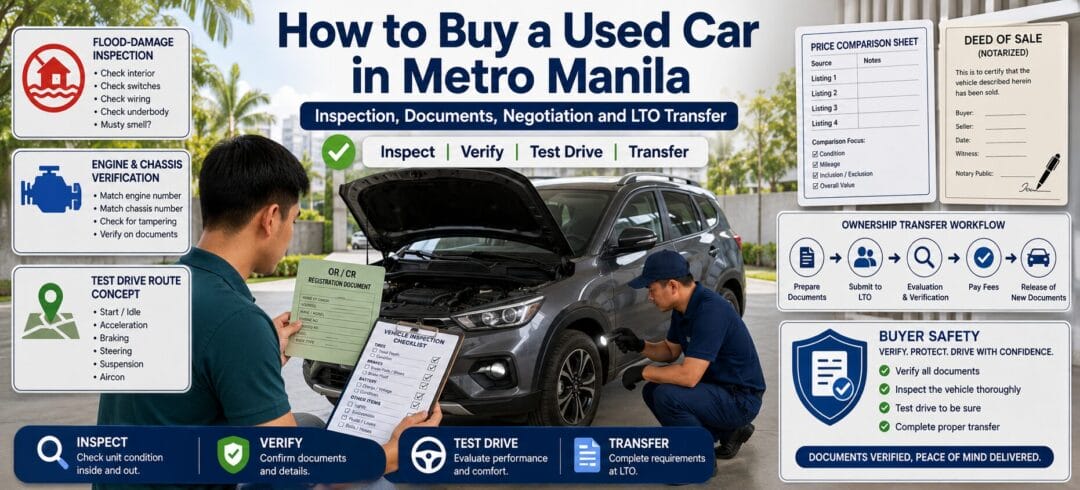
- 11. Conduct a Proper Test Drive
- 12. Verify the Vehicle Documents
- 13. Negotiate Using Facts
- 14. Pay Safely and Complete the Deed of Sale
- 15. Transfer Ownership Promptly
- What to Do Immediately After Buying
- Red Flags That Should Make You Walk Away
- Final Used-Car Buying Checklist
- Frequently Asked Questions
- How much does it cost to transfer a used car in the Philippines?
- What documents do I need to buy a used car in Metro Manila?
- How can I check if a used car has outstanding loans or violations?
- Is it better to buy from a dealer or private seller?
- How do I spot a flood-damaged car?
- Can I test-drive a used car before buying?
- What are the biggest used-car buying red flags?
- How long does an LTO ownership transfer take?
- The Bottom Line
Buying a used car in Metro Manila can save you hundreds of thousands of pesos, but only when you verify the vehicle, inspect it properly and complete the ownership transfer without shortcuts.
The safest process is straightforward: set a realistic all-in budget, compare several vehicles, inspect the car with an independent mechanic, verify the OR/CR and ownership history, complete a notarized deed of sale, secure the required PNP-HPG clearance and transfer the registration through the LTO.
Metro Manila buyers also need to pay particular attention to flood damage, stop-and-go driving wear, overheating, air-conditioning performance and sellers who cannot produce complete original documents. These locally relevant risks are central to the supplied content brief.
Used Car Buying Checklist
| Step | What You Need to Do | Main Risk to Avoid |
|---|---|---|
| 1 | Set an all-in budget | Spending everything on the purchase price |
| 2 | Choose the right vehicle | Buying a model that is expensive to maintain |
| 3 | Compare multiple listings | Overpaying for the first acceptable car |
| 4 | Verify the seller | Dealing with an unauthorized middleman |
| 5 | Inspect the vehicle | Missing flood, accident or mechanical damage |
| 6 | Conduct a proper test drive | Buying a car with hidden driving problems |
| 7 | Verify the documents | Purchasing a stolen, mortgaged or improperly registered car |
| 8 | Negotiate using evidence | Relying on vague verbal promises |
| 9 | Sign a notarized deed of sale | Paying without a complete legal record |
| 10 | Transfer ownership promptly | Remaining legally and administratively tied to the previous owner |
1. Understand the Used Car Market in Metro Manila
Metro Manila has a wide selection of second-hand vehicles sold through franchised dealer programs, independent used-car dealers, online marketplaces, bank repossession channels and private sellers.
Each source has a different balance of price, convenience and risk.
Used-car dealers
Dealers usually offer a more organized buying process. Some provide limited warranties, financing assistance, vehicle inspection reports or help with registration documents.
The trade-off is that dealer prices may be higher because they include operating costs, reconditioning and profit margins.
Do not assume that every vehicle on a dealer lot has been thoroughly inspected. Ask for the inspection checklist, warranty coverage and written exclusions.
Private sellers
A direct owner may offer a better price and more information about the vehicle’s actual history. You may also be able to review maintenance receipts and understand why the car is being sold.
The risk increases when the person meeting you is not the name shown on the Certificate of Registration.
A seller who says the vehicle belongs to a relative, employer, client or friend must be able to present proper authorization and supporting documents. Do not rely on a verbal explanation.
Online marketplaces
Online listings make comparison easier, but photographs and descriptions can hide major defects.
Treat unusually low prices as a reason to investigate, not as proof of a bargain. Common warning signs include:
- A seller demanding a reservation payment before inspection
- Refusal to show the original OR/CR
- A meeting place that changes repeatedly
- Stock photographs or images copied from another listing
- Different names on the listing, identification and registration
- Claims that the deed of sale can be left blank
- Pressure to pay immediately because another buyer is supposedly waiting
- A vehicle that cannot be brought to an independent mechanic
Never send a deposit merely to “hold” a vehicle you have not inspected and verified.
2. Set Your True Used-Car Budget
The advertised price is only the beginning of the expense.
Your total budget should account for the purchase price, ownership transfer, insurance, overdue registration if applicable, immediate maintenance and repairs discovered during inspection.
A practical calculation is:
Maximum car price = total available budget minus transfer, insurance, repairs and emergency reserve
For example, having ₱500,000 available does not mean you should buy a car priced at ₱500,000. A safer purchase ceiling might be lower so you still have funds for tires, fluids, battery replacement, registration and unexpected repairs.
Costs to include
| Expense | What to Check |
|---|---|
| Purchase price | Compare the same model, year, variant and condition |
| Ownership transfer | LTO, PNP-HPG, inspection, notarial and related charges |
| Registration renewal | Check whether registration is current or expired |
| Insurance | CTPL is required for registration; consider comprehensive coverage |
| Preventive maintenance | Oil, filters, fluids, belts and inspection |
| Tires and battery | Verify age, condition and replacement cost |
| Repairs | Use the mechanic’s findings to estimate immediate work |
| Parking and tolls | Important for daily Metro Manila use |
| Fuel consumption | Consider heavy traffic rather than highway-only figures |
Compulsory motor vehicle liability insurance (CTPL) is part of the vehicle-registration framework. Comprehensive motor insurance is separate and provides broader protection depending on the policy — see our breakdown of whether comprehensive car insurance is worth it in the Philippines for how to decide which one fits your car.
Financing a used car
Used-car financing may be offered by banks, financing companies or dealerships. Approval and terms depend on the age of the vehicle, borrower qualifications, down payment and lender policies.
Before accepting financing, compare:
- Cash price versus financed price
- Down payment
- Monthly amortization
- Loan length
- Effective interest or total financing cost
- Chattel mortgage fees
- Insurance requirements
- Processing fees
- Late-payment penalties
- Pre-termination conditions
- Total amount payable over the full term
Do not compare loans using monthly payment alone. A lower monthly amount may simply mean a longer and more expensive loan.
Prepare proof of identity, proof of address, income documents, bank statements and employment or business records. Exact requirements vary, so request a written checklist from the lender.
3. Choose a Car That Fits Metro Manila Driving
A good used car is not merely the newest vehicle you can afford. It must suit your route, parking space, passenger needs and maintenance budget.
Consider:
- Vehicle width and turning radius
- Ground clearance
- Fuel consumption in heavy traffic
- Air-conditioning performance while idling
- Availability and cost of parts
- Number of nearby service centers
- Automatic-transmission condition
- Flood exposure risk
- Parking-space dimensions
- Coding-day implications
- Highway use outside Metro Manila
A compact sedan or hatchback may be easier to park and operate in congested areas. A crossover may offer more ground clearance but can cost more to buy, insure and maintain.
Research the specific generation, engine and transmission rather than relying only on the model name. Two vehicles carrying the same model name can have very different reliability and parts costs depending on the production year and variant.
4. Find Reliable Used Cars
Use several sources so you can compare prices and identify suspicious listings.
Franchised certified pre-owned programs
Some vehicle manufacturers and authorized dealers sell inspected pre-owned units. These may include documented checks, limited warranties or after-sales support.
Ask what “certified” actually covers. The term does not automatically mean accident-free, flood-free or free from future repairs.
Independent used-car dealers
An established dealer may provide a physical location, official receipts and assistance with documents. Verify the business identity, written warranty and return or complaint policy before paying.
An attractive showroom is not a substitute for an independent inspection.
Bank-repossessed vehicles
Repossession listings may offer competitive pricing, but many units are sold on an “as is, where is” basis. Inspection opportunities and test-drive policies may be limited.
Factor in possible storage wear, discharged batteries, flat-spotted tires, overdue maintenance and unknown driving history.
Private listings
Private transactions can deliver strong value when the registered owner is present, records are complete and the seller allows an independent inspection.
Meet in a secure public location during daylight. Bring another person and avoid carrying large amounts of cash to the first meeting.
5. Verify the Seller Before Inspecting the Car
Ask for basic information before spending time on an inspection:
- Full name of the registered owner
- Relationship of the seller to the registered owner
- Vehicle make, model, year and variant
- Plate number
- Current odometer reading
- Registration status
- Reason for selling
- Length of ownership
- Accident or flood history
- Existing loan or mortgage
- Availability of the original OR/CR
- Service records
- Number of keys
- Location where the vehicle is normally parked
The name on the seller’s government-issued identification should be compared with the name on the Certificate of Registration.
Do not accept a chain of open deeds of sale as a normal substitute for a properly transferred registration. It creates uncertainty about ownership, tax, liability and the people involved in prior transfers.
6. Inspect the Exterior in Daylight
Never conduct the main inspection at night or in heavy rain. Water and poor lighting can conceal paint defects, dents and panel inconsistencies.
Walk around the vehicle slowly and inspect it from different angles.
Exterior checklist
Check for:
- Uneven gaps between doors, hood, fenders and trunk
- Different paint shades between adjacent panels
- Overspray on rubber seals or plastic trim
- Ripples, sanding marks or excessive body filler
- Rust around wheel arches, door bottoms and underbody
- Cracked lights or windscreen damage
- Missing clips and loose trim
- Tires with uneven wear
- Mismatched tire brands or sizes
- Damaged wheels
- Oil, coolant or other fluid beneath the vehicle
- Signs that chassis or identification markings were altered
Repainted panels are not automatically a reason to reject a car. The important question is why the panel was repaired and whether structural damage occurred.
7. Look Closely for Flood Damage
Flood exposure is one of the most important risks for a second-hand vehicle in Metro Manila.
A cleaned interior can look acceptable while corrosion and electrical problems remain hidden beneath carpets, inside connectors and behind dashboard panels.
Possible flood-damage warning signs
- Musty or damp odor
- Heavy fragrance intended to cover another smell
- Water lines beneath seats or inside the trunk
- Mud or silt in the spare-tire well
- Rust on seat rails, bolts or brackets
- Corrosion inside electrical connectors
- Damp carpet or padding
- Mismatched or recently replaced interior upholstery
- Condensation inside lamps or instrument panels
- Multiple unexplained electrical faults
- Brittle or discolored wiring
- Rust beneath the dashboard
- Unusually clean engine bay combined with dirty hidden areas
Lift the trunk floor and inspect the spare-tire compartment. Move the front seats forward and backward to expose the rails. Look beneath removable floor mats and inspect accessible wiring connectors.
A single sign may have an innocent explanation. Several signs together should be treated seriously.
Do not rely on the seller’s statement that the car is “not flooded.” Have an independent mechanic inspect hidden areas and diagnostic systems.
8. Inspect the Interior and Electrical Systems
Start the vehicle from cold whenever possible. A seller who warms up the engine before you arrive may be trying to hide a difficult cold start, smoke or unusual noise.
Check every major control:
- Instrument-panel warning lights
- Air conditioner at idle and while driving
- Power windows
- Door locks
- Mirrors
- Headlights
- Brake lights
- Turn signals
- Wipers and washers
- Horn
- Audio system
- Reverse camera and sensors
- Seat adjustments
- Charging ports
- Keyless-entry functions
- Spare key
- Seat belts
- Parking brake
When the ignition is switched on, warning lights should illuminate briefly and then turn off after the engine starts. A warning light that never illuminates may have been disabled.
Check the odometer against the wear on the steering wheel, pedals, driver’s seat and switches. A very low reading paired with heavy interior wear deserves further investigation.
9. Inspect the Engine Bay
You do not need to be a mechanic to notice obvious warning signs, but the final decision should not depend on a visual check alone.
Look for:
- Oil or coolant leaks
- Cracked hoses
- Damaged wiring
- Corroded battery terminals
- Loose or makeshift connections
- Mixed or contaminated fluids
- Engine oil that appears milky
- Coolant contaminated with oil
- Excessive smoke from the exhaust
- Strong fuel or burning smells
- Severe vibration
- Knocking, tapping or grinding noises
- Poorly repaired collision damage around the engine bay
Check that the engine and chassis numbers match the registration documents. Do not attempt to clean, grind or alter these markings.
The PNP Forensic Group’s 2026 process for motor-vehicle clearance includes photographing the vehicle, recording the engine and chassis numbers and conducting macro-etching to verify their authenticity. Possible signs of tampering are referred for further action.
10. Get an Independent Pre-Purchase Inspection
This is one of the best investments you can make when buying a used car.
Choose a mechanic or inspection service that is independent of the seller. Do not accept “our mechanic already checked it” as a replacement.
A proper inspection should cover:
- Engine condition
- Transmission behavior
- Cooling system
- Brakes
- Suspension
- Steering
- Tires
- Battery and charging system
- Air-conditioning system
- Fluid leaks
- Underbody
- Evidence of collision repair
- Diagnostic trouble codes
- Flood or corrosion indicators
- Road-test performance
Ask for written findings and estimated repair priorities.
Separate the findings into:
- Safety-critical repairs
- Immediate maintenance
- Repairs needed within several months
- Cosmetic issues
A clean inspection does not guarantee that nothing will fail, but it sharply reduces your risk of buying a vehicle with obvious hidden problems.
11. Conduct a Proper Test Drive
A five-minute trip around the block is not enough.
The test route should include slow traffic, rough pavement, turns, braking, parking maneuvers and a faster section when safely available.
What to test
Pay attention to:
- Cold-start behavior
- Engine response
- Transmission shifts
- Clutch operation on a manual vehicle
- Steering alignment
- Brake feel
- Suspension noise
- Wheel-bearing hum
- Vibration at different speeds
- Temperature gauge
- Air-conditioning performance in traffic
- Warning lights
- Exhaust smoke
- Unusual odors
Temporarily turn off the audio system so you can hear the vehicle.
Test the car in conditions similar to your normal driving. Metro Manila congestion can expose overheating, weak air conditioning, rough low-speed transmission behavior and poor engine idling that may not appear during a short open-road drive.
The registered owner or authorized seller should accompany you. Confirm insurance and permission before driving.
12. Verify the Vehicle Documents
Do not make full payment until the documents have been checked.
Documents to request
At minimum, examine:
- Original Official Receipt
- Original Certificate of Registration
- Seller’s valid government-issued identification
- Notarized deed of sale or deed of conveyance
- PNP-HPG motor vehicle clearance requirements
- Release or cancellation of chattel mortgage when applicable
- Special Power of Attorney when a representative is acting
- Corporate authorization when a company owns the vehicle
- Relevant registration and inspection documents
The current LTO guidelines list a notarized deed of conveyance and original registration documents among the general transfer requirements. The PNP Forensic Group’s 2026 checklist also requires the OR/CR and deed of absolute sale for the motor-vehicle clearance process. Mortgaged vehicles require the appropriate release, cancellation or assumption document.
Match the details carefully
Compare the following across the vehicle and documents:
- Registered owner
- Plate number
- Make and model
- Color
- Engine number
- Chassis or VIN
- Body type
- Fuel type
- Registration status
Walk away when the engine or chassis number does not match, appears altered or cannot be located reliably.
Check for an existing mortgage
A vehicle purchased through financing may have an encumbrance recorded in its documents.
Require proper evidence that the obligation has been settled and the chattel mortgage has been released or cancelled. A seller’s promise to fix it after payment is not adequate protection.
What to do with incomplete documents
Do not proceed merely because the seller offers a discount.
Missing originals, conflicting names, unexplained alterations, open deeds of sale and absent mortgage releases can delay or prevent transfer. Ask the seller to correct the problem before accepting payment.
13. Negotiate Using Facts
Research asking prices for the same:
- Model
- Production year
- Variant
- Transmission
- Mileage range
- General condition
Listing prices are not the same as completed-sale prices, but they provide a starting range.
Use the inspection report to explain your offer. A useful calculation is:
Reasonable offer = comparable market value minus immediate repairs and a risk allowance
Focus on objective costs, such as tires nearing replacement, overdue maintenance, body repairs or malfunctioning equipment.
Do not invent defects or insult the seller. A calm, evidence-based offer is more credible than aggressive haggling.
Ask the seller to state in writing what is included:
- Spare key
- Tools and jack
- Owner’s manual
- Maintenance records
- Accessories
- Unused spare tire
- Registration assistance
- Agreed repairs
- Warranty, when offered
14. Pay Safely and Complete the Deed of Sale
Never hand over full payment before checking the original documents, confirming the seller’s identity and finalizing the written agreement.
For a significant transaction, a traceable bank payment is generally safer than carrying large amounts of cash.
The deed of sale should accurately identify:
- Buyer and seller
- Vehicle details
- Engine and chassis numbers
- Plate number
- Agreed price
- Date of sale
- Payment terms
- Included accessories
- Known obligations
- Signatures
- Identification details
Do not sign an incomplete or blank deed of sale.
Keep copies of the seller’s identification, signed documents, payment evidence, listing, messages and inspection report.
15. Transfer Ownership Promptly
Ownership transfer should not be treated as an optional step to complete “someday.”
LTO’s 2024 guidelines require the seller to report the sale or transfer within five days. The detailed deadline applicable to the buyer and the supporting process should be confirmed against the current LTO rules for the vehicle type and transaction.
General transfer sequence
- Finalize the notarized deed of sale.
- Gather the original OR/CR and supporting documents.
- Secure the applicable PNP-HPG motor vehicle clearance.
- Complete the required inspection and insurance.
- Submit the transfer application to the appropriate LTO office.
- Pay the assessed government fees.
- Review the updated registration details.
- Keep official receipts and copies of the complete file.
The PNP’s 2026 checklist for transfer-related clearance includes the application form, OR/CR, payment receipt and deed of absolute sale. Additional records are required for mortgaged, company-owned, representative-handled or insurance-company vehicles.
Requirements and processing arrangements can change. Confirm the current checklist with the LTO and the specific PNP-HPG office before visiting.
What to Do Immediately After Buying
Once the transfer is underway or completed:
- Arrange suitable insurance
- Change engine oil and filters when history is uncertain
- Check coolant and brake fluid
- Inspect tires, brakes and battery
- Replace missing safety equipment
- Save digital copies of all documents
- Update emergency contacts
- Learn the vehicle’s maintenance schedule
- Confirm registration expiry
- Schedule repairs identified during inspection
Do not spend your entire reserve on cosmetic upgrades before completing safety and reliability work.
Red Flags That Should Make You Walk Away
Reject or pause the transaction when:
- The seller will not show the original OR/CR
- The registered owner cannot be contacted
- Engine or chassis details do not match
- Identification numbers appear altered
- The seller refuses an independent inspection
- The vehicle shows multiple flood indicators
- The price is far below comparable units without a credible explanation
- The car is mortgaged without proper release documents
- The seller requests payment to an unrelated person
- You are pressured to sign a blank deed of sale
- The vehicle cannot be transferred immediately
- The seller insists that incomplete paperwork is “normal”
A cheap vehicle with defective documents is not a bargain. It is a liability.
Final Used-Car Buying Checklist
Before paying, confirm that you have:
- Compared several similar vehicles
- Calculated the all-in cost
- Verified the seller’s identity
- Matched the vehicle to its OR/CR
- Inspected the car in daylight
- Checked for flood and accident damage
- Conducted a proper test drive
- Obtained an independent mechanical inspection
- Confirmed any mortgage has been released
- Agreed on the final price in writing
- Completed a notarized deed of sale
- Prepared the ownership-transfer requirements
- Retained proof of payment and copies of all records
Frequently Asked Questions
How much does it cost to transfer a used car in the Philippines?
There is no single reliable all-in amount for every transaction. The total may include LTO charges, PNP-HPG clearance-related expenses, inspection, insurance, notarization, penalties, registration renewal and the cancellation of an existing mortgage. Request current assessments from the relevant offices instead of relying on an old online fee table.
What documents do I need to buy a used car in Metro Manila?
The core documents generally include the original OR/CR, the seller’s identification and a notarized deed of sale or conveyance. Transfer processing may also require PNP-HPG clearance, insurance, inspection records and additional documents for mortgaged, company-owned or representative-handled vehicles.
How can I check if a used car has outstanding loans or violations?
Review the registration documents for an encumbrance, require a release or cancellation of chattel mortgage when applicable and verify the vehicle through the relevant LTO and PNP-HPG processes. Do not depend solely on screenshots or documents supplied electronically by the seller.
Is it better to buy from a dealer or private seller?
A dealer may provide a more organized process, financing assistance or limited warranty, while a private seller may offer a lower price and clearer ownership history. The safer choice is the vehicle and seller that pass independent inspection and document verification.
How do I spot a flood-damaged car?
Look for musty odors, rust beneath seats and dashboard components, water lines, silt in hidden compartments, corroded connectors, damp carpet and multiple electrical problems. Have a mechanic inspect the car because professional cleaning can hide visible evidence.
Can I test-drive a used car before buying?
A legitimate seller should normally allow a supervised test drive subject to identification, permission and insurance considerations. Refusal to allow any meaningful test or independent inspection is a major warning sign.
What are the biggest used-car buying red flags?
The most serious red flags are missing original documents, mismatched engine or chassis numbers, an absent registered owner, an unreleased mortgage, flood indicators, refusal of inspection and demands for advance payment.
How long does an LTO ownership transfer take?
Processing time depends on document completeness, clearance, inspection, the office handling the transaction and whether the registration has complications. Do not promise or rely on a fixed number of days until the receiving LTO office has reviewed the case.
The Bottom Line
The best used car is not always the cheapest or the one with the lowest odometer reading. It is the vehicle with a condition you understand, documents you can verify and a total ownership cost you can afford.
Take your time. Inspect more than one car, bring an independent mechanic and walk away from any transaction that depends on excuses or incomplete paperwork. Paying a little more for a clean, transferable vehicle is usually far cheaper than fixing a hidden mechanical or legal problem later.