Online Shopping Scams in the Philippines: 2026 Safety Guide
Online shopping scams in the Philippines usually involve fake sellers, counterfeit listings, phishing links, manipulated payment instructions or packages that never arrive. The safest approach is to keep payment and communication inside a reputable marketplace, verify the seller independently and never send money merely because a seller claims that a deal is about to expire.
If something goes wrong, save your evidence, report the transaction to the platform and immediately contact your bank, card issuer or e-wallet provider. Depending on the situation, you may also file a consumer complaint with the Department of Trade and Industry or report suspected cybercrime to law-enforcement authorities.
High-pressure selling isn’t limited to online marketplaces, either — the same rushed, sign-today tactics show up in person at mall booths and resort presentations. See our guide to vacation club membership red flags in the Philippines for how to tell a legitimate resort points program from an unregistered investment scheme before you commit.
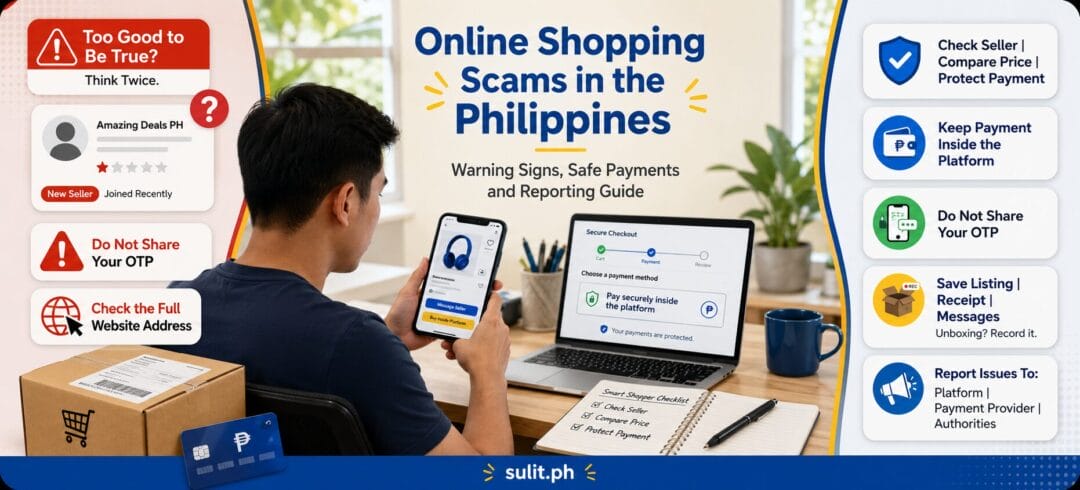
Online Shopping Scam Safety Checklist
| Before paying | Warning sign |
|---|---|
| Check the seller’s history | Account was created recently |
| Compare prices elsewhere | Price is far below normal |
| Keep the transaction inside the platform | Seller asks you to continue through private chat |
| Use a protected payment channel | Payment requested through an unrelated personal account |
| Read the return and refund rules | No return policy or seller information |
| Check the full website address | Misspelled or imitation domain |
| Save the listing and conversation | Seller deletes or frequently changes listings |
| Never share an OTP | Seller or “support agent” requests your OTP |
| Inspect the parcel before confirming receipt | Seller pressures you to mark the order as received |
| Record the unboxing of valuable purchases | Package arrives damaged, empty or incorrect |
What Is an Online Shopping Scam?
An online shopping scam is a deliberate attempt to obtain money, payment credentials or personal information through a dishonest online sale.
The scam may involve:
- A product that does not exist
- A seller who disappears after payment
- A fake store imitating a legitimate retailer
- A counterfeit or materially misrepresented item
- A phishing page pretending to be a checkout or payment portal
- A parcel containing the wrong item, a low-value substitute or nothing useful
- A fake customer-service representative requesting account credentials
- A manipulated refund process designed to steal more money
A scam is different from an ordinary consumer dispute.
A delayed delivery, damaged product or disagreement over a return does not automatically prove fraud. It may still be covered by platform policies and consumer-protection rules, but fraud normally involves intentional deception.
The distinction matters when deciding where to complain. A defective product sold by a registered business may be primarily a consumer complaint. A fake seller using stolen identities and disappearing after payment may require a platform report, financial-provider complaint and cybercrime report.
What Philippine Law Protects Online Buyers?
Republic Act No. 11967, known as the Internet Transactions Act of 2023, established a regulatory framework for internet transactions involving online merchants, e-retailers, digital platforms and consumers. The law aims to build trust in electronic commerce and protect both online consumers and merchants.
The law generally covers business-to-consumer and business-to-business internet transactions connected to the Philippine market. Pure consumer-to-consumer transactions may fall outside parts of the law’s coverage, which is important when buying from individual sellers through social-media marketplaces.
This means a Facebook Marketplace transaction between two individuals may not provide the same protections or complaint pathway as a purchase from an identifiable online business.
Buyers should still retain evidence and report possible fraud. However, the practical remedy may depend on:
- Whether the seller is acting as a business
- Whether the transaction happened inside a marketplace
- How payment was made
- What buyer-protection program applies
- Whether fraud, identity theft or unauthorized access occurred
- Whether the seller can be identified
Most Common Online Shopping Scams in the Philippines
1. Fake seller scams
A fake seller advertises an attractive product, accepts payment and then disappears.
These sellers commonly use:
- Newly created social-media accounts
- Stolen product photographs
- Fake delivery receipts
- Fabricated buyer testimonials
- Comments from related or controlled accounts
- Copied identification documents
- Excuses for avoiding video calls or meetups
- Personal bank or e-wallet accounts with unrelated names
The account may appear active because it contains many posts. Check when those posts were uploaded. A page with dozens of posts published over one or two days may have been built quickly to create the appearance of an established business.
2. Too-good-to-be-true prices
Scammers often advertise popular phones, appliances, gaming devices, shoes, bags and collectibles at prices far below the prevailing market.
The seller then creates urgency with claims such as:
- “Last item”
- “Rush sale”
- “Warehouse clearance”
- “Need cash today”
- “Reserved until payment”
- “Pay within ten minutes”
- “Half price for the first five buyers”
A low price does not prove fraud, but a large unexplained difference should trigger additional verification.
Compare the same model across:
- The manufacturer’s official website
- Authorized retailers
- Established marketplaces
- Several unrelated sellers
Confirm the exact model, storage capacity, condition, warranty, included accessories and delivery terms. Scammers sometimes compare the price of a used, refurbished or incomplete product with that of a new complete unit.
3. Advance-payment scams
The seller requests full payment, a reservation fee or a delivery charge before processing the order. After receiving the money, the seller stops responding or asks for additional payments.
Common follow-up demands include:
- Insurance fee
- Customs charge
- Warehouse release fee
- Refund-processing fee
- Account-verification payment
- Additional shipping fee
- Transfer fee caused by a supposed payment error
Sending more money rarely fixes a fraudulent transaction. Stop when a seller introduces unexpected charges that were not disclosed before payment.
4. Fake online stores
A fake store may copy the name, photographs, product descriptions and visual appearance of a legitimate retailer.
Check the complete web address carefully. Fraudulent websites may use:
- Misspelled brand names
- Added words or hyphens
- Unusual domain extensions
- Subdomains designed to imitate a real domain
- Links shortened to hide the destination
- Social-media advertisements that redirect to imitation pages
A padlock symbol and HTTPS connection only indicate that data is encrypted between your device and the website. They do not prove that the business is legitimate.
5. Phishing checkout and payment pages
A seller or fake customer-service representative may send a link claiming that you need to:
- Confirm your order
- Receive a refund
- Verify your payment
- Pay a delivery fee
- Reactivate your wallet
- Release a held parcel
- Update your account
The page may request card information, online-banking credentials, passwords or an OTP.
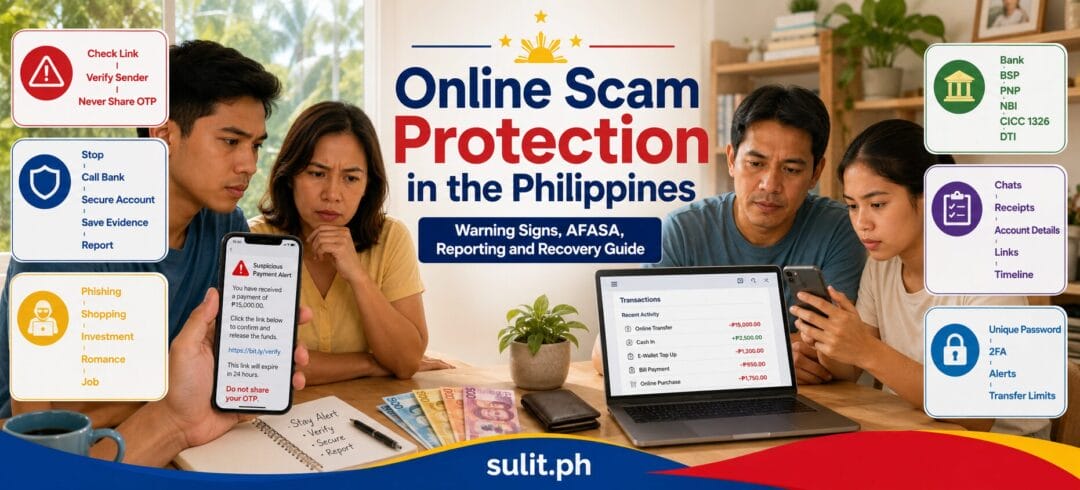
Never provide an OTP to a seller, courier or customer-service agent. An OTP may authorize a payment, account login, password reset or transfer.
6. Counterfeit and materially misrepresented products
The buyer receives something, but it is fake, used, defective, incomplete or substantially different from the listing.
Common examples include:
- Counterfeit branded products
- Low-capacity storage devices relabelled as higher capacity
- Used electronics sold as new
- Refurbished phones sold without disclosure
- Replica shoes and bags presented as authentic
- Incorrect product sizes
- Missing accessories
- Expired or improperly stored goods
- Generic products substituted for branded items
Medicine deserves its own caution here — a fake or unregistered drug sold as a cheap alternative isn’t just a bad deal, it can be a health risk. See our guide on whether generic medicine in the Philippines is really the same as branded for how to tell a legitimate FDA-registered generic from a counterfeit before you buy medicine online or from an unfamiliar seller.
That same registration check applies well beyond medicine — see our guide on how to check FDA, PS Mark, and ICC registration before you buy anything online for the free government tools that cover electronics, appliances, and beauty products too.
Read negative and recent reviews instead of relying only on the average rating.
Also check whether reviews refer to the exact product variation you plan to buy. Some marketplace listings combine multiple products under one review section.
7. Empty, incorrect or low-value parcels
The package arrives, but it contains:
- An empty box
- Scrap material
- A cheap substitute
- The wrong item
- A smaller quantity
- A damaged or incomplete product
For expensive orders, record a continuous unboxing video showing:
- The unopened parcel
- The shipping label
- All sides of the package
- The opening process
- The actual contents
- Serial numbers or identifying marks
- Any damage or missing accessories
The recording does not guarantee a refund, but it can strengthen your platform dispute.
8. Fake delivery and redelivery messages
Scammers send messages claiming that a package cannot be delivered until the buyer pays a small fee or confirms an address through a link.
The requested amount may be small because the real objective is to capture card details, account credentials or personal information.
Check the order directly through the marketplace or courier’s official website. Do not use the link inside an unexpected message.
This specific scam has gotten common enough that J&T Express and PHLPost have both issued public warnings about it. See our full breakdown of fake delivery text scams in the Philippines for the exact red flags, a QR-code version of the same trick, and where to report one.
9. Fake refund representatives
After a buyer complains publicly, another account may pretend to represent the marketplace, bank, e-wallet, courier or seller.
The fake representative may request:
- Your account password
- An OTP
- Screen sharing
- Remote-access installation
- A payment to release the refund
- Transfer of funds to a “safe account”
Use only the support channel shown inside the official application or website.
Warning Signs of an Online Shopping Scam
One warning sign may have an innocent explanation. Several warning signs together justify walking away.
Suspicious seller profile
Be cautious when:
- The account is new
- The name has changed repeatedly
- Comments are disabled
- Reviews use repetitive wording
- The same photographs appear under different seller names
- The seller has no verifiable business information
- The account suddenly changed from unrelated personal posts to selling products
- The seller refuses reasonable verification
Unreasonable price
Treat the offer as high risk when:
- The price is dramatically lower than established sellers
- The seller cannot explain the discount
- The listing omits the exact model or condition
- The seller refuses to provide current photographs
- The price is available only for immediate payment
Pressure and urgency
Scammers try to prevent buyers from thinking, comparing or asking another person for advice.
Pressure tactics include:
- Threatening to sell the item to another buyer
- Claiming that payment must be completed immediately
- Refusing to hold the item while you verify details
- Becoming angry when you ask for proof
- Offering an extra discount for leaving the platform
A legitimate deal will not become safer because you pay faster.
Unsafe payment request
Watch for:
- Direct transfers to unknown personal accounts
- Payment to an account with a different name
- Cryptocurrency-only payment
- Gift cards or prepaid credits
- Requests to split payment across multiple accounts
- QR codes sent without a clear merchant identity
- Payment outside a platform that offers buyer protection
The recipient’s account name is useful evidence, but it does not prove legitimacy. Fraudsters may use borrowed, purchased, compromised or recruited accounts.
Missing business information
For an online business, look for:
- Business or store name
- Physical or service address
- Working contact channel
- Return, exchange and refund policy
- Delivery conditions
- Product description
- Total price and additional charges
- Seller or merchant identity
A DTI business-name registration can help confirm that a name was registered, but registration alone does not guarantee product quality, seller honesty or successful delivery. DTI’s Business Name Registration System states that a registered business name is generally valid for five years, so buyers should also examine the seller’s current operations and transaction terms.
Platform-Specific Risks
Facebook Marketplace
Facebook Marketplace is useful for local discovery, used items and direct seller communication, but many transactions happen directly between individuals.
Risks include:
- Fake profiles
- Stolen listings
- Advance-payment requests
- Fake delivery arrangements
- Counterfeit goods
- Sellers directing buyers to external links
- Limited recourse for off-platform payments
For local high-value purchases, consider meeting in a secure public location where the item can be inspected. Do not go alone when the transaction involves a large amount of money.
Avoid carrying unnecessary cash. Confirm the meetup location, seller identity and item condition before travelling.
Instagram Shops and Social-Media Pages
A polished feed does not establish legitimacy.
Check:
- How long the page has operated
- Whether tagged customer posts appear genuine
- Whether the seller has an identifiable business
- Whether comments are limited or deleted
- Whether product photographs appear elsewhere
- Whether the page has recently changed its name or category
- Whether the return policy is published
Do not rely solely on follower count. Followers, reactions and comments can be purchased or manipulated.
Shopee and Lazada
Major marketplaces usually provide structured ordering, payment, delivery and dispute processes. Those protections become weaker when a seller convinces the buyer to transact outside the platform.
Keep the following inside the marketplace:
- Product selection
- Seller communication
- Payment
- Delivery tracking
- Return request
- Refund dispute
Do not transfer money directly because the seller promises a lower price, faster delivery or an extra item.
Before tapping “order received,” inspect and test the product within the time allowed by the platform. Save screenshots of the listing because descriptions and photographs may later change.
Messaging Applications
A conversation moving to Messenger, Viber, Telegram or WhatsApp does not automatically mean fraud. The risk increases when the move is used to bypass platform records or payment protections.
Keep copies of:
- The seller’s account details
- Username and profile link
- Product listing
- Payment instructions
- Recipient account name
- Transaction reference number
- Delivery promise
- Refund promise
How to Verify an Online Seller in the Philippines
Step 1: Search the seller’s complete name
Search the page name, business name, telephone number, e-wallet number and payment-account name.
Include terms such as:
- Scam
- Fraud
- Complaint
- Fake seller
- Non-delivery
- Counterfeit
Do not treat an absence of complaints as proof that the seller is safe. A scam account may be new.
Step 2: Check the account’s history
Look beyond recent posts.
Review:
- Account creation or page history
- Previous names
- Consistency of products
- Customer interactions
- Frequency and age of posts
- Whether contact information changed
- Whether comments appear natural
Step 3: Reverse-check product photographs
Copied product photographs are common. A reverse-image search may show that the images came from another retailer, foreign marketplace, review site or unrelated seller.
Ask for a fresh photograph showing the product beside a handwritten note containing:
- The current date
- The seller’s username
- A word or code you choose
This is not foolproof, but it is stronger than accepting catalogue photographs.
Step 4: Verify business information
For an online merchant, compare the business name across:
- Its official website
- Social-media page
- Invoice or receipt
- Payment account
- Published contact information
- Government registration where applicable
A registration record should be treated as one verification layer, not a guarantee.
Step 5: Confirm the total transaction cost
Ask for a written breakdown of:
- Item price
- Delivery charge
- Insurance, if legitimately applicable
- Installation or service charge
- Taxes or duties, when relevant
- Return shipping
- Warranty conditions
Do not pay surprise charges introduced after the first payment.
Step 6: Use a payment method with recourse
The safest available method depends on the platform and transaction.
A practical order of preference is:
- Payment inside a reputable marketplace with buyer protection
- Credit card with a formal dispute process
- Platform-supported cash on delivery
- Direct digital payment only after independent seller verification
- Direct bank or e-wallet transfer to an unknown seller as the highest-risk option
Cash on delivery reduces the risk of paying a seller who sends nothing, but it does not guarantee that the package contains the correct product.
How to Protect Yourself While Shopping Online
Use strong, unique passwords
Do not reuse the same password for your shopping account, email and e-wallet.
Your email account is especially important because password-reset links may be sent there.
Enable two-factor authentication
Activate two-factor authentication for:
- Marketplace accounts
- Online banking
- E-wallets
- Social-media accounts
Do not approve an authentication request you did not initiate.
Avoid shopping through public Wi-Fi
Public Wi-Fi can expose users to unsafe networks and imitation login portals.
Use your mobile connection or a trusted private network when entering payment or account information.
Do not trust sponsored listings automatically
A paid advertisement does not prove that the advertiser is legitimate.
Scammers may pay to promote fake stores, counterfeit products or phishing pages.
Check the website address manually
For important transactions, type the official address yourself or use the company’s verified application.
Avoid logging in through links sent by strangers.
Use a separate card or controlled balance
Consider using:
- A card with a manageable limit
- A virtual card supported by your financial provider
- An e-wallet funded only with the amount needed
- Transaction alerts
This limits exposure if payment information is compromised.
Keep evidence before problems arise
Save:
- Listing screenshots
- Product specifications
- Seller profile
- Price
- Delivery promise
- Return policy
- Warranty statement
- Order confirmation
- Receipt
- Payment record
Do this before the listing can be edited or deleted.
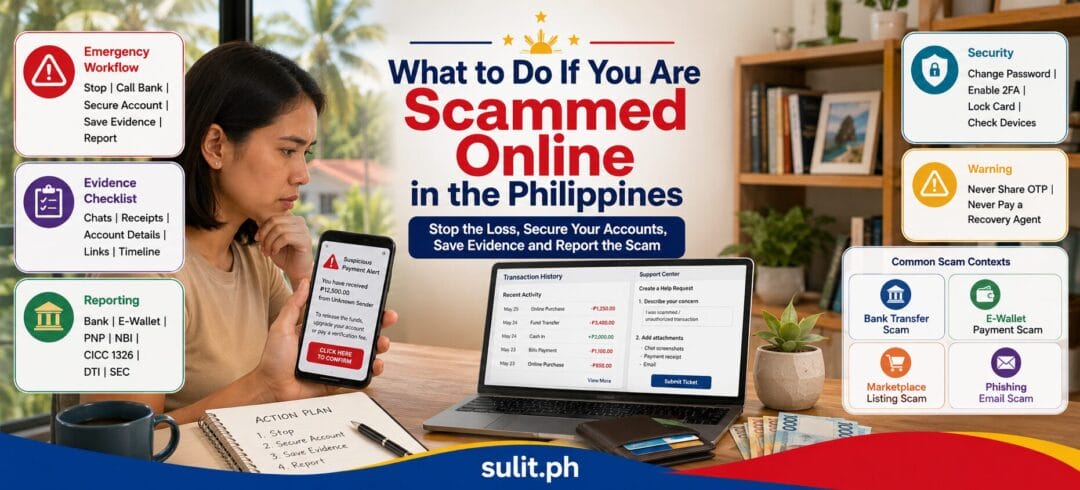
What to Do If You Have Been Scammed
Act quickly. The chance of stopping or recovering funds generally decreases after money is moved through several accounts.
1. Stop sending money
Do not pay:
- Refund fees
- Account-unlocking charges
- Verification deposits
- Recovery fees
- Additional insurance
- Replacement delivery charges
Scammers may continue extracting money from someone who has already paid once.
2. Save all evidence
Collect:
- Screenshots
- Full conversation
- Seller profile link
- Product listing
- Website address
- Email headers
- Phone numbers
- Payment account name
- Account number or e-wallet number
- Transaction reference
- Receipt
- Parcel label
- Unboxing video
- Courier tracking record
Keep the original files. Do not rely only on edited screenshots.
3. Report the seller to the platform
Use the platform’s fraud, return, refund or account-reporting process.
Do not mark the transaction as completed while a valid dispute is unresolved.
4. Contact your financial provider immediately
Report the transaction to your:
- Bank
- Card issuer
- E-wallet provider
- Payment service
- Remittance provider
Ask whether the transaction can be flagged, disputed, reversed or traced.
The Bangko Sentral ng Pilipinas instructs consumers to raise the concern first with the BSP-supervised financial institution involved. When the institution does not resolve the complaint, consumers may elevate it through the BSP’s Consumer Assistance Mechanism.
Do not falsely claim that a payment was unauthorized when you knowingly approved it. Explain exactly how the deception occurred and provide the transaction evidence.
5. File a DTI consumer complaint when applicable
For disputes involving an online merchant or business, consumers may use the DTI Consumer Complaints Assistance and Resolution system. DTI also publishes guidance for complaints against online sellers.
DTI is especially relevant for concerns involving:
- Misrepresentation
- Defective products
- Failure to deliver
- Refund or return disputes
- Unfair sales practices
- Online-merchant obligations
A transaction between two private individuals may require a different pathway.
6. Report suspected cybercrime
The National Bureau of Investigation provides an online complaint channel and investigative assistance for victims of computer-related crimes. Its Cybercrime Division is listed among the bureau’s official divisions.
You may also report suspected cybercrime to the Philippine National Police Anti-Cybercrime Group or your nearest police station.
Bring organized evidence and a clear chronology:
- When you found the listing
- What the seller promised
- When and how you paid
- What happened after payment
- What steps you already took
- How much was lost
- What accounts, numbers and profiles were involved
7. Secure compromised accounts
Change passwords immediately when you disclosed:
- Login credentials
- Email access
- Card details
- Banking information
- Security answers
- Authentication codes
Log out unknown devices and review recent transactions.
If you installed a remote-access application at another person’s request, disconnect the device from the internet, remove the application and have the device checked.
Can You Get Your Money Back?
Recovery is possible in some cases, but it is never guaranteed.
Your chances may be better when:
- The payment is still pending
- You report it immediately
- The marketplace holds the funds
- You paid by a method with buyer protection
- The financial provider can freeze or trace the recipient account
- You have complete documentation
- The seller can be identified
- The product clearly violates the listing or platform policy
Recovery may be more difficult when:
- You voluntarily transferred money outside the marketplace
- The funds were quickly moved or withdrawn
- Cryptocurrency or gift cards were used
- The seller used a compromised or rented account
- Evidence is incomplete
- The account and listing have been deleted
- The transaction was purely between private individuals
Be cautious of people promising guaranteed fund recovery for an advance fee. Recovery scams frequently target people who have already lost money.
Green Flags of a More Credible Online Seller
No individual sign guarantees safety, but stronger sellers usually provide several of the following:
- Consistent business identity
- Established transaction history
- Clear product descriptions
- Published return and refund policy
- Working customer-support channel
- Verifiable address or business information
- Secure checkout
- Official receipts or invoices
- Reasonable pricing
- Clear delivery terms
- Platform-based payment
- Responsive but non-aggressive communication
- Photographs consistent with the actual products
- Willingness to answer reasonable questions
Final Online Shopping Decision Checklist
Before buying, ask:
- Can I verify who is selling the product?
- Is the price believable?
- Does the payment method provide recourse?
- Am I being asked to leave the marketplace?
- Are the product photographs original or verifiable?
- Are return and refund conditions clear?
- Does the seller’s payment name match the stated identity?
- Have I saved the listing and conversation?
- Am I being pressured to pay immediately?
- Can I afford to lose the amount if the transaction fails?
Walk away when too many answers create uncertainty. Missing a bargain is cheaper than sending money to a scammer.
Frequently Asked Questions
What are the common signs of an online shopping scam?
Common signs include an unusually low price, a newly created seller account, copied photographs, pressure to pay immediately, requests for direct transfer and refusal to use a protected marketplace payment system.
How can I verify an online seller in the Philippines?
Search the business and payment details independently, review the account’s history, compare product photographs, check registration information where applicable and confirm that its website, invoice and payment-account identity are consistent.
Is Facebook Marketplace safe in the Philippines?
Facebook Marketplace can be used safely, but transactions between private individuals often provide less protection than marketplace-managed orders. Avoid advance payment to unknown sellers, inspect expensive items and meet only in a secure public location.
What is the safest payment method for online shopping?
A payment processed inside a reputable marketplace with buyer protection usually provides better recourse than a direct transfer. Credit cards may also offer a dispute process. Protection depends on the provider’s terms and the circumstances of the transaction.
Is cash on delivery completely safe?
No. Cash on delivery can reduce the risk of paying for a package that is never shipped, but the parcel may still contain the wrong, damaged, counterfeit or low-value product.
What should I do immediately after an online shopping scam?
Stop further payments, save all evidence, report the account to the platform and contact your bank, card issuer or e-wallet provider immediately. File a DTI complaint or cybercrime report when appropriate.
Can DTI help with a Facebook Marketplace transaction?
DTI may assist when the seller is operating as an online merchant or business and the matter is a consumer dispute. A purely private consumer-to-consumer transaction may require platform action, financial-provider assistance or a report to law enforcement.
Can I recover money sent to a scammer?
It may be possible, particularly when the report is made quickly and the funds are still traceable. Recovery is not guaranteed, especially after a voluntary direct transfer has been withdrawn or moved.