Live Selling on Shopee, Lazada & TikTok Shop: How to Verify a Seller Before You Buy (2026 Guide)
Sulit verdict: Live selling and marketplace shopping on Shopee, Lazada, and TikTok Shop is still generally sulit — return policies are real, and the platforms have gotten more aggressive about pulling counterfeit and predatory listings. But that only holds if you run a quick verification check before you tap “Buy Now,” especially mid-livestream, where urgency is the entire sales pitch. Skip the check and you’re trusting a stranger’s word during a countdown timer.
Live selling has quietly become one of the biggest ways Filipinos shop online — hosts running flash countdowns, “last 3 items” banners, and voucher codes that expire in minutes. It’s genuinely useful when the seller is legit: you get to see the product up close, ask questions in real time, and often catch a better price than the static listing. The problem is that the same format — pressure, urgency, verbal claims you can’t screenshot after the fact — is exactly what a bad-faith seller wants too.
As of September 5, 2026, enforcement against counterfeit and fraudulent online sellers has actually picked up. Between June 2024 and May 2025, the National Committee on Intellectual Property Rights seized ₱18.64 billion worth of counterfeit goods nationwide, and DTI’s E-Commerce Bureau issued 268 takedown orders and 105 compliance orders against online sellers in just the first half of 2026 alone, per Philstar’s coverage of the crackdown. That’s real progress, but it also means there are, by definition, still sellers slipping through — which is where your own 30-second check comes in.
What the Verified Badges Actually Mean (and Don’t)
Shopee Mall, LazMall, and TikTok Shop Mall all signal that a seller went through stricter onboarding than a regular marketplace account — but the badge isn’t a blanket guarantee on every listing under it.
| Badge | What It Usually Means | What It Doesn’t Guarantee |
|---|---|---|
| Shopee Mall | Seller submitted business documentation and, in many cases, proof of a relationship with the brand it’s selling — either the brand itself or a vetted authorized reseller. | That every product detail in every listing is accurate, or that it’s the cheapest price for that item. |
| LazMall | Similar brand-verification requirement; typically pairs with longer return windows and stricter seller service standards. | Guaranteed lowest price — regular sellers on the same platform are often cheaper for the same item. |
| TikTok Shop Mall | Verified brand or authorized-reseller status specific to TikTok Shop’s marketplace, separate from creator-run live selling accounts. | That a livestream host affiliated with the shop is accurately representing the product on camera. |
Sulit Tip: Treat a Mall badge as a trust signal about sourcing, not as an all-clear on price or on what a livestream host says verbally. For anything under a few hundred pesos, a regular seller with thousands of transactions and a rating in the high 90s is often the better value — you’re paying for the badge on Mall listings, and for low-stakes buys that premium isn’t always worth it.
The Red-Flag Checklist Before You Tap “Buy Now”
Most fake or bait-and-switch sellers give themselves away in the same handful of ways, whether you’re looking at a static listing or watching a live selling stream:
- Seller rating under roughly 80–90%, or a rating that looks high but has very few completed transactions to back it up.
- Brand names with odd spacing or symbols (“Ni ke,” “Sam-sung”) — a common trick to dodge platform filters that catch counterfeit listings.
- Single stock photo, no lifestyle shots, no size chart or spec sheet — legitimate sellers, especially Mall accounts, tend to over-document rather than under-document.
- Price that’s dramatically below every other listing for the same item, with no flagship or clearance explanation.
- 1-star reviews mentioning “not as described,” “different from live,” or “wrong item” — read the worst reviews first, not the best ones.
- Checkout that redirects to an external site or asks for a bank transfer instead of staying inside the app’s own payment flow.
Heads Up: Scammers have also started building fake storefronts that copy TikTok Shop’s exact look and feel — including fake “trusted seller” and “secure service” badges that were never actually verified by the platform — then routing traffic there from outside links, sometimes bundling in fraudulent loan or credit offers at checkout, per Malwarebytes’ August 2026 writeup. The fix is simple: only shop TikTok Shop, Shopee, or Lazada through the official app, never through a link someone sends you.
Live Selling Specifically: Why It’s Riskier Than a Normal Listing
A static listing gives you time to compare, screenshot, and read reviews before buying. A livestream is built to remove that pause — countdown timers, “only 2 left in stock” overlays, and a host talking fast about limited-time pricing. None of that is automatically dishonest; plenty of legitimate sellers run real flash promos this way. The risk is that anything the host says out loud — “this is the same formula as the ₱2,000 version,” “official distributor,” “lifetime warranty” — isn’t binding the way a written listing is, and it’s much harder to dispute after the fact if it turns out to be false.
Good to Know: Before buying during a live session, tap through to the seller’s actual shop profile (not just the livestream overlay) and check their rating, registered business name, and return policy the same way you would for a static listing. If the account is brand-new, has no shop reviews outside the livestream, or won’t show a proper product page, that’s your answer.
Worked Scenario: A Skincare Serum on a TikTok Shop Livestream
Say you’re scrolling TikTok and land on a livestream selling a “dermatologist-approved” brightening serum at half the price you’ve seen it in Watsons, with a countdown saying only 8 units are left at that price. Here’s how to actually check it in under a minute: first, tap into the seller’s shop page — is it a TikTok Shop Mall account, or an unverified creator account you’ve never heard of? Second, look at the shop’s review section (not the livestream comments, which can be flooded with bought or copy-paste comments) for mentions of counterfeit or “different from photos.” Third, check whether the product has an FDA Philippines registration number listed — cosmetics and supplements sold legitimately in the Philippines are required to carry one, and its absence on a health/beauty product is a real red flag, not a technicality. If all three check out, the countdown timer is just marketing. If any one of them doesn’t, let the countdown expire — a genuinely good price will still exist tomorrow on a seller you can verify.
What the Law Actually Says
Online sellers in the Philippines aren’t in a legal gray zone just because the transaction happens over livestream instead of in a store. The Internet Transactions Act of 2023 (Republic Act No. 11967) created DTI’s E-Commerce Bureau specifically to regulate online merchants and marketplaces and build consumer trust in digital transactions — which is the office behind the takedown and compliance orders mentioned above. Separately, the protections under the older Consumer Act (RA 7394) — the right to accurate labeling, fair pricing, and safe, quality products — apply to online purchases exactly the same as they do to a physical store, per DTI’s own public guidance reported by the Philippine Information Agency. A seller who can’t produce a DTI-registered business name when asked is already outside the rules the rest of the market plays by.
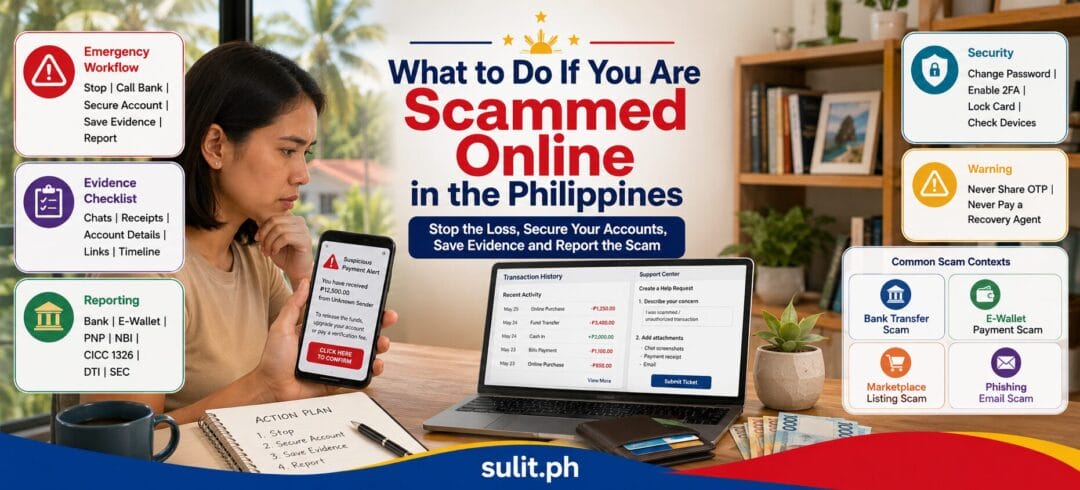
If You Already Got Scammed: Where to Report It
Don’t just eat the loss and move on — reporting is quick and it’s how enforcement numbers like the ones above keep climbing:
- DTI Fair Trade Enforcement Bureau: file online at consumercare.dti.gov.ph, or email a completed complaint form to fteb@dti.gov.ph. Phone: (02) 7215 1165 / 0917 137 3796, weekdays 8am–5pm.
- Hotline 1326: the government’s 24/7 line for reporting online selling scams and other cybercrime, run by the Inter-Agency Response Center in coordination with DICT, PNP’s Anti-Cybercrime Group, and the NBI, per the Philippine Information Agency. You can also file through the eGovPH app.
- The platform itself: Shopee, Lazada, and TikTok Shop all have an in-app dispute/report-seller flow — use it even if you also report to DTI, since platform action (delisting, account suspension) is usually faster than a government case.
If the seller turns out to have no registered DTI business name at all, FTEB refers those cases straight to cybercrime investigators rather than handling them as a standard consumer complaint — which is one more reason checking for a business name up front is worth the extra ten seconds.
Once you’ve confirmed a seller is legit, it’s worth knowing what actually happens if a purchase still goes wrong — see our comparison of Shopee, Lazada, TikTok Shop, Carousell, and Facebook Marketplace’s real buyer protection policies.
Also Worth Checking
This guide focuses on live selling and Mall-badge verification specifically — for the broader scam landscape, our online shopping scams guide and Facebook Marketplace scams guide cover phishing links, fake courier messages, and non-delivery scams in more depth. And if you’re timing a purchase around an actual sale event rather than a random livestream, our Shopee, Lazada & TikTok Shop sale calendar maps out which dates are genuinely worth waiting for. For more of this kind of value-first breakdown, head back to more sulit finds.
Verified Sources Used
Philstar: Confirmed NCIPR’s ₱18.64-billion counterfeit seizure figure (June 2024–May 2025) and DTI E-Commerce Bureau’s takedown/compliance order counts for 2025 and first-half 2026.
Philippine Information Agency: Confirmed DTI’s guidance that Consumer Act (RA 7394) protections extend to online shopping, common complaint patterns (fake identities, unregistered promos), and the DTI FTEB reporting channel and penalty range.
DTI Fair Trade Enforcement Bureau: Confirmed the official complaint channels, contact numbers, and office hours for filing a consumer complaint.
Philippine Information Agency: Confirmed Hotline 1326 as the government’s 24/7 online scam reporting line and the agencies coordinating it.
DTI E-Commerce Bureau: Confirmed the existence and purpose of the Internet Transactions Act (RA 11967) and the E-Commerce Bureau it created.
Malwarebytes: Confirmed the fake TikTok Shop storefront scam pattern, including copied trust badges and bundled loan-offer scams.
Back2Gaming: Confirmed practical red-flag checks for counterfeit listings on Shopee and Lazada, including seller rating thresholds and brand-name spacing tricks.
TipidNation: Confirmed what Shopee Mall verification does and doesn’t guarantee, and scenarios where a regular seller is the better value.