Is GCash’s GInsure Scam Protection Worth It in the Philippines? (2026 Guide)
Sulit verdict: Buy it if you regularly move money peer-to-peer or pay for stuff through GCash and want a fast, no-questions-about-whose-fault-it-was payout. Skip it if you barely transact beyond loading and bills, or if the scam you’re actually worried about is an advance-fee “investment” or fake job offer — because that specific type isn’t covered anyway. The twist most coverage of this product misses: the Philippines’ new anti-scam law, AFASA, already gives every GCash user a free path to reimbursement when the platform’s own systems fail you — but GInsure’s ₱30 pays out even when GCash did nothing wrong and you were simply tricked, which is exactly how most Filipino scams actually work.
GCash has been pushing “GInsure Scam Protection” hard in-app since August 2026: pay ₱30, get up to ₱15,000 back if you fall for hacking, phishing, spoofing, or a fake seller. It sounds like a no-brainer add-on, priced like a snack. But 2026 also happens to be the year the Anti-Financial Account Scamming Act (AFASA) started forcing banks and e-wallets to actually upgrade their fraud defenses — and, per Bangko Sentral ng Pilipinas (BSP), potentially reimburse you for free when they don’t. That raises the real “sulit” question nobody’s answering clearly: if the law already might make GCash pay you back, why pay ₱30 for insurance on top of it?
As of September 2026, here’s what the ₱30 plan actually covers, what AFASA already gives you at no cost, and the specific gap between the two that decides whether this one is worth buying.
What GInsure Scam Protection Actually Covers
The product marketed in-app as GInsure Scam Protection is underwritten by Chubb and sold through GCash’s insurance marketplace. It’s priced and structured the same way as GCash’s earlier Express Send Scam Insurance / Send Money Protect offering, and the current marketing pitch extends it across Send Money, bank transfers via GCash, and unauthorized purchases on connected merchants.
| Detail | What it is |
|---|---|
| Premium | ₱30, one-time payment for a 30-day coverage window |
| Maximum payout | Up to ₱15,000 per approved claim |
| Underwriter | Chubb (Insurance Company of North America – Chubb Company), via GCash’s GInsure marketplace |
| What’s covered | Social engineering (phishing/impersonation scams), account takeover, and online shopping fraud — marketed broadly as covering hacking, phishing, and spoofing across Send Money, bank transfers, and purchases on partner merchants like Lazada, Shopee, and the Play Store |
| Eligibility | 18 years old and up, Filipino citizen or legal Philippine resident, Fully Verified GCash account holder, and the account owner making the transaction yourself |
| How to claim | File a police report and notify GCash within 24 hours of the incident, then submit transaction receipts and communication records through the “My GInsure” tab in the app |
| Processing time | Roughly 5–7 working days once your claim is filed |
Sulit Tip: This is opt-in insurance, not a default setting — you have to actively buy it before something happens, usually right on the Send Money or Express Send screen. Buying it after you’ve already been scammed does nothing; the policy has to be active during the 30-day window the incident occurs in.
The Free Alternative You Already Have: AFASA
Here’s the part GCash’s in-app pitch doesn’t lead with. In July 2024, the Philippines passed Republic Act No. 12010, the Anti-Financial Account Scamming Act (AFASA) — and 2026 is the year its teeth came in. The law explicitly defines “financial account” to include e-wallets, not just bank accounts, which puts GCash squarely under its coverage alongside traditional banks.
AFASA requires BSP-supervised institutions to run real fraud management systems: behavioral anomaly detection, geolocation monitoring, device-change tracking, blacklist screening, a ban on sending customers unsolicited clickable links or QR codes, and the ability to temporarily hold disputed funds for up to 30 days during an investigation. Banks had until June 25, 2026 to have these systems upgraded and running. Critically, when an institution fails to meet those obligations, BSP has signaled it will hold the institution liable for the loss — not just the scammer. BSP General Counsel Roberto Figueroa put it bluntly in comments reported by GMA News: “whatever is the money lost by the victim, by the depositor, that even if the bank is not the scammer, the bank will now be ordered to pay.”
Heads Up: AFASA reimbursement is not an automatic refund button. It hinges on proving the institution itself failed its fraud-prevention duties — not simply that you were scammed. As of this writing, over 500 AFASA cases have been filed with the PNP, mostly criminal cases against scammers themselves rather than completed reimbursement claims against banks or e-wallets, so the practical claims process for an ordinary user is still new and largely untested. Don’t assume a quick, guaranteed payout; treat it as a real but still-forming right, not a substitute for reporting fast and keeping evidence.
Where GInsure’s ₱30 Actually Earns Its Keep
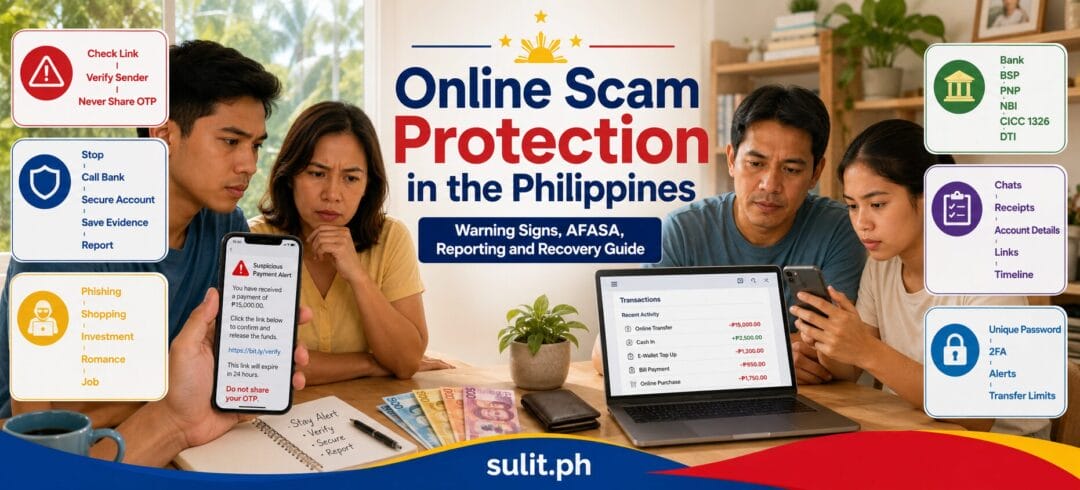
This is the gap that makes the ₱30 worth considering instead of redundant. AFASA’s reimbursement trigger is institutional failure — GCash’s systems didn’t do their job. But the most common scams in the Philippines don’t work that way. Phishing and smishing (fraudulent texts) account for over 80% of reported digital fraud here, and they typically succeed by tricking you into willingly approving a transaction, sharing an OTP with a fake “bank” agent, or clicking a link that hands over your login — not by exploiting a hole in GCash’s security systems. In those cases, GCash’s fraud detection may have technically worked as designed; you were the one who was deceived into acting.
That’s precisely the scenario GInsure’s social-engineering and account-takeover coverage is built for, and it’s a scenario where an AFASA claim against the institution is a much harder case to make, since the “failure” isn’t on GCash’s side. For ₱30, you’re buying a contractual payout that doesn’t require you to prove anyone else was negligent — only that you were a genuine victim who followed the claim steps. Filipino consumers face real exposure here: a 2025 survey found 72% of Filipinos were targeted by digital fraud attempts (versus 53% globally), 38% of those targeted lost money, and malicious link attacks nearly quadrupled year-over-year, per a Gogolook report cited by tech outlets covering the GInsure push.
What’s Excluded — Read This Before You Buy
The fine print is where a lot of buyers get caught out, because it excludes some of the most common scam types Filipinos actually fall for.
| Not covered | Why it matters |
|---|---|
| Wrong-account transfers | Sending money to the wrong number or account yourself isn’t a covered “scam” event |
| Advance-fee scams (fake jobs, investments, loans) | A huge share of Philippine scams — “pay a processing fee to release your loan/job offer” — falls outside this policy entirely |
| Cryptocurrency or jewelry-related claims | Explicitly excluded regardless of how the loss happened |
| Business transactions | Coverage is for personal, individual use only |
| Incidents outside the 30-day policy period | Coverage lapses the moment the window closes — it does not auto-renew |
Good to Know: Don’t confuse this with GInsure’s other checkout-adjacent product, GInsure Online Shopping Protect Insurance — a separate plan (around ₱34, up to ₱20,000 coverage) that protects items bought via GCash Pay Online against damage, non-delivery, or misrepresentation, not against being scammed out of the payment itself. They solve different problems.
Worked Scenario: Two GCash Users, Two Outcomes
Ana gets a text that looks like it’s from her bank, warning of “suspicious activity” and a link to “verify” her account. She clicks it, enters her OTP on the fake page, and ₱12,000 disappears from her GCash-linked account within minutes. She had GInsure Scam Protection active. She files a police report and notifies GCash within 24 hours, submits her screenshots through the My GInsure tab, and gets her ₱12,000 back in about a week — no need to prove GCash’s systems failed, just that she was a genuine phishing victim who followed the steps.
Ben, meanwhile, pays a ₱5,000 “processing fee” to a Facebook page promising a work-from-home job with an upfront salary. He also had GInsure active — but this is an advance-fee scam, explicitly excluded from the policy. His only real options are reporting to the PNP Anti-Cybercrime Group and, if GCash itself is somehow implicated in facilitating the transfer without adequate fraud checks, exploring an AFASA-based complaint — a longer, less certain road with no guaranteed timeline.
The difference isn’t luck. It’s that GInsure was built for Ana’s scenario, not Ben’s.
Who Should Buy This, and Who Should Skip It
It’s worth the ₱30 if you regularly send money to people you don’t personally verify (online sellers, split-bill group chats, “lending” to acquaintances), if you shop frequently through GCash-linked payments on Shopee, Lazada, or similar platforms, or if you simply want a fast, contractual safety net that doesn’t depend on an untested legal process. It’s reasonable to skip if you mostly use GCash for load, bills, and transfers to people already in your contacts and verified before, since your actual exposure to social-engineering scams is lower — or if the scam you’re most worried about is an advance-fee or investment scheme, since those aren’t covered regardless of what you pay.
Also Worth Checking
If you’ve already been scammed and need to act now, our step-by-step guide on what to do if you’re scammed online in the Philippines covers the exact reporting sequence. For the everyday habits that prevent most of this in the first place, see our online scam protection guide. And if you’re weighing other paid-protection-versus-free-legal-right decisions, our breakdown of extended warranties in the Philippines applies the same logic to appliances instead of digital scams. If your GCash wallet is also where remittances from family abroad land, our guide to which remittance method is actually the most sulit in 2026 covers the fees and legitimacy checks on the sending side.
Verified Sources Used
GizGuide: Confirmed GInsure Scam Protection’s ₱30/30-day pricing, ₱15,000 coverage cap, Chubb underwriting, and coverage across Send Money, bank transfers, and unauthorized merchant purchases.
UnGeek: Confirmed GInsure Scam Protection details and cited the statistic that phishing and smishing account for over 80% of reported digital fraud in the Philippines, plus the Gogolook finding on malicious link attacks nearly quadrupling in 2025.
GCash Help Center: Confirmed the official Express Send Scam Insurance policy terms — ₱30 premium, ₱15,000 limit, covered fraud types (social engineering, account takeover, online shopping fraud), eligibility requirements, claims process, and exclusions.
GCash Help Center: Confirmed the separate GInsure Online Shopping Protect Insurance product’s pricing (~₱34), coverage cap (₱20,000), and terms, to distinguish it from Scam Protection.
Tookitaki: Confirmed that AFASA’s definition of “financial account” explicitly includes e-wallets, and detailed the fraud management system requirements imposed on covered institutions.
NDV Law: Confirmed AFASA (RA 12010) covered institutions, the 30-day fund-hold provision, penalty ranges for scam-related offenses, and the law’s July 2024 enactment.
GMA News Online: Confirmed the June 25, 2026 compliance deadline for bank fraud systems, BSP General Counsel Roberto Figueroa’s statement on institutional liability, and the 500+ AFASA cases filed to date.
Philstar / TransUnion: Confirmed the Philippines’ 2025 digital fraud rate (4.1% vs. 3.8% global), the 72% of Filipinos targeted by digital fraud, the 38% who lost money, and the median loss figures.