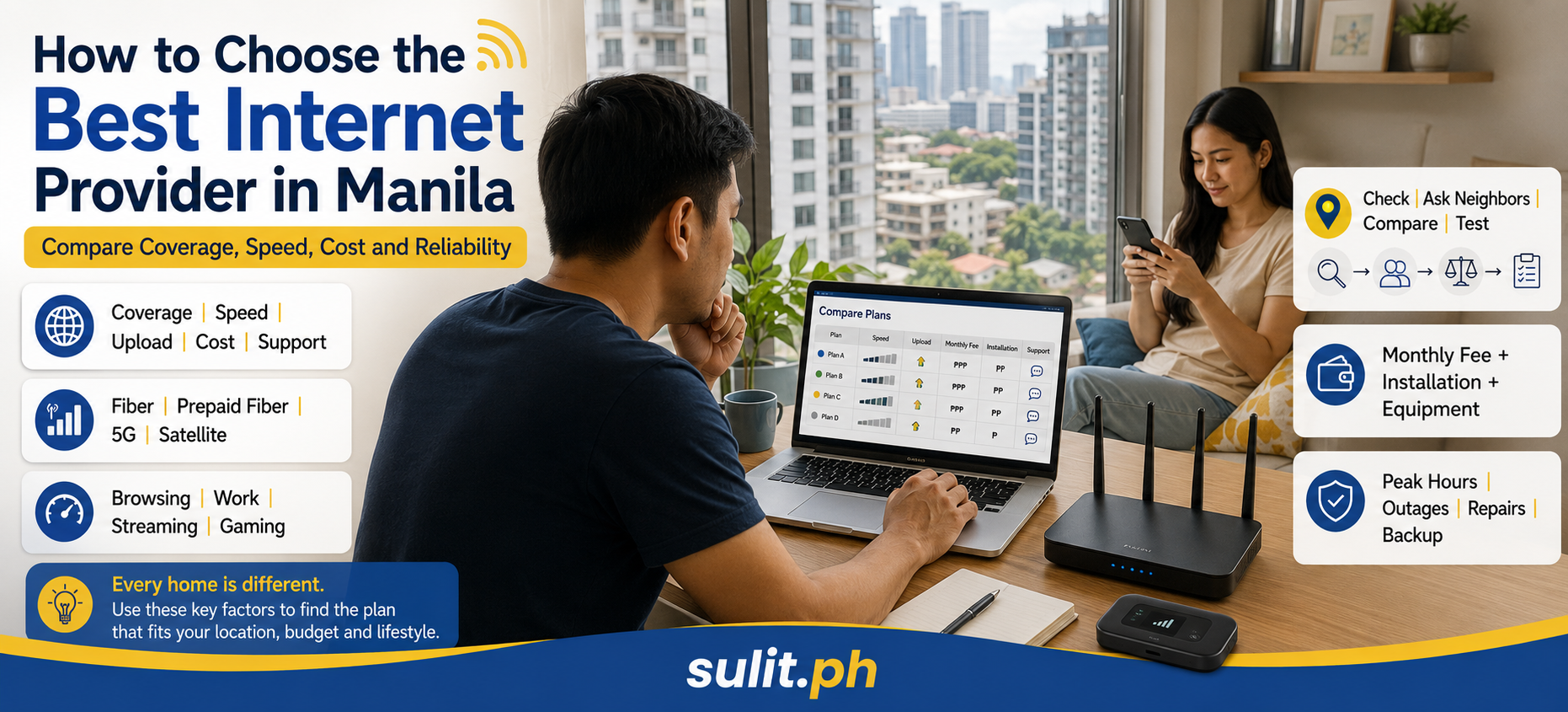

Pocket WiFi vs. Postpaid Home Fiber: Which Is Actually Worth It in the Philippines? (2026 Guide)
Sulit verdict: Skip the 24-36 month lock-in unless you’re certain you’re staying put. If you rent, move often, or just need internet for a few months, prepaid pocket WiFi or prepaid fiber wins even though the per-month math looks worse on paper — because the “cheaper” postpaid unli plan turns expensive fast the moment you need to cancel early. If you own your place, work from home daily, and know you’re not moving for at least two years, the postpaid unli fiber plans are the better long-term buy: same or lower cost per Mbps, and no reload runs at 11 p.m. when you’re mid-download.
Here’s the trap almost every comparison article about internet plans in the Philippines walks right past: they compare the advertised monthly price and stop there. They don’t mention that PLDT, Globe, and Converge’s best “unli” fiber deals all come with a 24 to 36-month lock-in, and that breaking that contract early costs real money — sometimes thousands of pesos, per the providers’ own published terms. Meanwhile, prepaid pocket WiFi and prepaid fiber get dismissed as “for people who can’t get approved for postpaid,” when for a real chunk of Filipino households, no-lock-in is the actual smart move.
As of September 11, 2026, here’s what PLDT, Globe, and Converge actually charge for both postpaid and prepaid options, straight from each provider’s own published rate pages, plus the one government rule that lets you hold any of them accountable for the speed you’re actually paying for.
Real 2026 Pricing: Postpaid Unli Fiber
| Provider & Plan | Speed | Monthly Price | Lock-in |
|---|---|---|---|
| PLDT Home Fibr Unli 1299 | 100 Mbps | ₱1,299/mo + ₱100/mo install fee | 36 months |
| PLDT Home Fibr Unli All 1399 | 200 Mbps | ₱1,399/mo + ₱100/mo install fee | 36 months |
| PLDT Home Fibr Unli 1699 | 500 Mbps | ₱1,699/mo + ₱100/mo install fee | 36 months |
| Converge Super FiberX Play | 200 Mbps | ₱1,349/mo | 24 months |
| Converge Super FiberX Max | 400 Mbps | ₱1,599/mo | 24 months |
| Converge Super FiberX Ultra | 800 Mbps | ₱2,599/mo | 24 months |
| Globe GFiber (300 Mbps–1 Gbps tiers) | 300 Mbps–1 Gbps | Not published — address-based quote | “No lock up” per Globe’s page (lower tiers) |
| Globe GFiber 2.5 Gbps | 2.5 Gbps | ₱4,999/mo | 24 months |
PLDT’s own Home Fibr page is explicit that “no upfront cash-out is required,” but every Unli plan runs on a 36-month contract, and a ₱100 installation fee gets added to your bill every month for the full 36 months regardless of whether you keep the plan that long. Converge’s own terms and conditions spell out a clearer early-exit cost: cancel during the 24-month lock-in and you owe the full remaining months multiplied by your monthly fee, plus your pro-rated final bill and a disconnection fee. Globe advertises “no lock up” on its lower GFiber tiers on its own broadband page, though pricing for those tiers isn’t published upfront and depends on an address-based quote; only the top-tier 2.5 Gbps plan shows a fixed price, and it carries its own 24-month lock-in.
Heads Up: “No lock-in” claims are worth double-checking at the point of application, not just on the marketing page — ask for the exact contract terms in writing before you sign, since promotional pages and the actual service agreement don’t always match line for line.
Real 2026 Pricing: Prepaid Pocket WiFi & Prepaid Fiber
| Provider & Plan | Data / Speed | Validity | Price |
|---|---|---|---|
| PLDT Home Fiber Prepaid | Unlimited, up to 50 Mbps | 30 days | ₱999 (reload from as low as ₱50) |
| Globe At Home FamSURF50 | 5 GB | 3 days | ₱50 |
| Globe At Home FamSURF Extra 199 | 50 GB | 7 days | ₱199 |
| Globe At Home FamSURF Extra 299 | 75 GB | 7 days | ₱299 |
| Globe At Home FamSURF Extra 499 | 120 GB | 15 days | ₱499 |
| Globe At Home FamSURF Extra 999 | 250 GB | 30 days | ₱999 |
This is the real difference people miss: PLDT’s prepaid fiber option is genuinely unlimited data at a capped speed (up to 50 Mbps) for a flat 30-day fee, with zero contract. Globe’s FamSURF prepaid WiFi, by contrast, is data-capped, not unlimited — you’re buying a specific gigabyte allowance that runs out, shareable across up to five devices, per Globe’s own page. If your household streams a lot of video, PLDT’s prepaid unlimited model will stretch further than an equivalent peso amount of FamSURF data.
Sulit Tip: Smart and DITO also sell prepaid pocket WiFi devices and home broadband options, but their specific plan pricing wasn’t verifiable from a stable source at the time of this guide — check current promos directly on their sites or at an authorized dealer before comparing, since pocket WiFi promos change often.
Who Prepaid Actually Makes Sense For
Prepaid pocket WiFi or prepaid fiber is the sulit choice if any of these describe you: you’re renting and might move within a year or two, you’re a student or young professional between more permanent housing, you only need reliable internet for a few months (a work contract, a temporary posting, a house being renovated), or you simply want to try a provider’s actual performance at your address before committing to years of lock-in. The absence of a contract means the absolute worst case is a wasted ₱999 load, not a multi-thousand-peso penalty.
Good to Know: If none of these can actually reach your address — a common story outside Metro Manila and other cities — prepaid pocket WiFi is competing against a cell tower’s coverage gaps, not a better technology. In that case, satellite internet is the real alternative worth pricing out; see our guide to whether Starlink is worth it in the Philippines for the current cost breakdown.
It’s a worse fit if you’re a heavy multi-device household running several video calls, 4K streams, and large uploads at once every single day — the capped speeds and, on Globe’s side, capped data, will show their limits fast under that kind of constant load.
Who the Postpaid Lock-in Is Actually Worth It For
The postpaid unli plans make sense once you can answer “yes” to two questions: do you own the place, or do you have a lease that clearly outlasts the contract length, and is your household’s daily usage heavy enough that you’d otherwise be reloading prepaid data constantly? If both are true, the postpaid math wins on cost-per-Mbps and on not having to think about reloading. Converge and PLDT’s entry-level unli tiers land in a similar ₱1,300–₱1,400 monthly range for 100–200 Mbps, which comfortably out-prices buying the prepaid equivalent in data week after week for a heavy-use household.
The NTC Rule Almost Nobody Checks
Whichever option you pick, you have a right most subscribers don’t know they have. Under the National Telecommunications Commission’s Memorandum Order No. 07-07-2011 on the minimum speed of broadband connections, providers are required to advertise a minimum guaranteed speed — not just an “up to” ceiling number — and to guarantee at least 80% service reliability, measured monthly as the share of time your connection isn’t running below that minimum. The same order requires providers to disclose the minimum speed, the reliability percentage, and the price together, and it states plainly that subscribers have the right to be informed of the quality of the connection they’re being sold.
Good to Know: If your connection is consistently far below what you’re paying for, that NTC order is your basis for a formal complaint to the provider first, and to the NTC itself if the provider doesn’t resolve it — not just a reason to vent online. Keep basic speed-test records with timestamps if you suspect your connection isn’t holding up its end.
Worked Scenario: Cancelling a Lock-in Plan Early
Say you sign up for Converge’s Super FiberX Max plan at ₱1,599 a month, locked in for 24 monthoworking space membership is worth it breaks down what a reliable desk outside the house actually costs in 2026. For more of this kind of value-first breakdown, head back to more sulit finds.
Verified Sources Used
PLDT Home: Confirmed PLDT Home Fibr Unli postpaid plan prices, speeds, and the 36-month contract term with monthly installation fee.
PLDT Home: Confirmed PLDT Fiber Prepaid pricing, unlimited data at up to 50 Mbps, 30-day validity, and no-contract terms.
Globe: Confirmed Globe At Home FamSURF prepaid WiFi pricing, data allowances, and validity periods.
Globe: Confirmed Globe GFiber postpaid speed tiers, the published 2.5 Gbps price and lock-in, and “no lock up” language on lower tiers.
Converge: Confirmed Converge Super FiberX postpaid plan speeds and prices.
Converge: Confirmed the 24-month lock-in period and the pre-termination fee formula for early cancellation.
Supreme Court E-Library (NTC Memorandum Order No. 07-07-2011): Confirmed the NTC’s minimum guaranteed speed disclosure requirement and the 80% monthly service reliability standard for broadband providers.