
Is That Online Listing Legit? How to Check FDA, PS/ICC & DTI Registration Before You Buy (Philippines 2026 Guide)
Sulit verdict: Yes — spend the two minutes before you tap “Buy Now,” especially for anything you plug in, apply to your skin, or swallow. A quick FDA or PS/ICC check costs you nothing and takes less time than reading the seller’s reviews, and it’s the difference between a genuine bargain and a fire hazard or fake medicine sitting in your cart.
Here’s what’s changed in 2026: the government isn’t just posting reminders anymore. The Intellectual Property Office of the Philippines (IPOPHL), the DTI’s E-Commerce Bureau, and the PNP have all opened active crackdowns on counterfeit and unregistered goods sold through Shopee, Lazada, TikTok Shop, and Facebook Marketplace — and the categories they’re flagging (beauty products, medicines, electronics, appliances) are exactly the categories Filipino shoppers buy from these platforms every single day.
The good news is that verifying a listing isn’t complicated once you know where to look. This guide walks through the three government checks that actually matter, how to run them in under two minutes, and what to do if you’ve already bought something that turns out to be fake or unregistered.
Bakit Ito Mahalaga Ngayon (Why This Matters Right Now)
As of September 2026, this isn’t a theoretical risk. On September 2, 2026, Philstar reported that the consumer group Malayang Konsyumer is pushing for an intensified crackdown, citing IPOPHL and DTI E-Commerce Bureau data: 171 Takedown Orders and 67 Compliance Orders were issued against online sellers between June and December 2025, and that jumped to 268 additional Takedown Orders and 105 Compliance Orders in just the first half of 2026. The National Committee on Intellectual Property Rights (NCIPR) seized ₱18.64 billion worth of counterfeit goods between June 2024 and May 2025 alone.
A day later, PNP Chief Gen. Jose Melencio Nartatez Jr. put it plainly, per SunStar’s coverage: “We will not allow online platforms to become a safe haven for counterfeiters.” The PNP’s warning specifically named beauty products, electronics, appliances, medicines, vitamins, and health supplements as high-risk categories — not because they’re expensive, but because a fake version of any of these can actually hurt you, not just disappoint you.
Malayang Konsyumer’s own list of hazards, cited in that same Philstar report, is worth sitting with: fake medicines and vitamins containing undisclosed or toxic ingredients, substandard electronics that create fire and electrocution risk, and counterfeit building materials that can cause structural failure. This is why the “sulit” math on a suspiciously cheap product has to include the downside, not just the sticker price.
The Three Government Checks Before You Click “Buy Now”
Every purchase you’re worried about falls into one of three lanes, and each one has its own free, official verification tool. You don’t need all three for one product — just the one that matches what you’re buying.
| Check | Covers | How to Verify | Official Tool |
|---|---|---|---|
| FDA Registration | Food, drugs, cosmetics, medical devices, vitamins & supplements | Search the establishment or product name in the FDA’s own database | FDA Verification Portal (verification.fda.gov.ph) |
| PS Mark | Locally manufactured electrical, mechanical, building/construction, and chemical & consumer products (74 mandatory-certification categories) | Look for the mark on the product or packaging; call BPS Standards Conformity Division to confirm | DTI-Bureau of Philippine Standards (BPS) |
| ICC Sticker | The same 74 mandatory-certification categories, but for imported goods | Scan the QR code printed on the sticker | ICC Verification System app (Android, Google Play) |
| Counterfeit / IP Violation | Fake branded goods misusing a trademark or design | Report the listing directly through the marketplace’s report tool, or flag it to IPOPHL / DTI’s E-Commerce Bureau | Platform “Report” feature + IPOPHL |
According to DTI-BPS’s own product certification page, the PS Mark and ICC Sticker exist specifically to assure buyers that a covered product “conforms to the relevant Philippine National Standards” — and any of the 74 covered categories must carry one of these marks before it can legally enter the Philippine market, whether it was made here or imported. For big items like TVs, aircon units, and refrigerators where a sticker can’t go directly on the unit, the mark can appear on the box instead — but the original packaging has to still be available if anyone asks to check it.
Sulit Tip: The ICC Verification app is currently Android-only and free to download. If you’re on iOS, or the app doesn’t turn anything up, your fallback is calling the DTI-BPS Standards Conformity Division directly, or checking whether the manufacturer’s own local distributor page lists the product as an authorized import.
For anything health-related — supplements, skincare, over-the-counter medicine — skip the ICC app entirely and go straight to the FDA Verification Portal. Per the portal itself, it lets you check two things: whether the business selling the product holds a valid License to Operate (LTO), and whether the specific product has a Certificate of Product Registration or Notification (CPR/NN). Search using the exact establishment or product name — the portal specifically advises using correct spelling for accurate results, since a slightly different name can return a false negative.
Heads Up: DTI Secretary Ma. Cristina Roque has been direct about why this matters for appliances specifically, telling GMA News that non-compliant appliances “can cause fires and other problems.” Between 2024 and June 2026, DTI issued 238 violation notices to companies for failing to meet mandatory product standards, including missing ICC stickers or PS marks — and the agency says it now actively monitors e-commerce platforms, requiring online merchants to display their business licenses and PS/ICC certifications for covered products.
Worked Scenario: Buying a Power Bank Online
Say you’re eyeing a 20,000mAh power bank on a livestream sale — half the price of the one at the mall, “same specs daw.” Here’s how the check actually plays out before you pay.
A power bank falls under electrical products, one of the 74 mandatory-certification categories, so it needs either a PS Mark (if locally made) or an ICC Sticker (if imported) — there is no legal version of this product without one. Ask the seller for a clear photo of the sticker on the unit or its box before you pay. If they can’t produce one, or send a blurry, cropped, or suspiciously reused-looking image, that’s already your answer. If they do send one with a QR code visible, scan it with the ICC Verification app once the item arrives — before you write a good review or tell friends where you bought it.
If the code doesn’t verify, or the app returns no match, you’re holding an uncertified battery product — the exact category the DTI has flagged for fire risk. At that point, the “savings” you got from the cheaper price no longer make it sulit: an uncertified lithium battery product is a fire-and-electrocution risk, not a bargain.
Good to Know: A product being genuine and FDA/PS/ICC-registered isn’t the same as it being locally warrantied. A parallel-imported gadget can be 100% real and safe but still leave you without local warranty support — that’s a different, purely financial trade-off (see our guide on buying a refurbished phone for that kind of calculation). The registration checks in this guide are about whether the product is legally allowed to be sold and safe to use at all — a separate, more basic question that comes before you even get to the warranty conversation.
What to Do If You Already Bought Something That Turns Out Fake or Unregistered
Don’t panic, but do move quickly, especially if it’s something you’d use on your body or plug into an outlet.
- Stop using it immediately if it’s a consumable, cosmetic, or electrical item and the registration check failed.
- Screenshot everything — the listing, the seller’s profile, your payment confirmation, and your chat history — before the seller has a chance to delete the listing.
- Report the listing to the platform using Shopee’s, Lazada’s, or TikTok Shop’s built-in report tool. Per DTI’s own statements, platforms are now expected to act on these reports as part of their compliance obligations.
- File a complaint with DTI through the 1-DTI hotline if the product falls under PS/ICC-covered categories, or straight to the FDA if it’s a health product.
- Keep the physical item and its packaging — you may need it as evidence for a refund dispute or a formal report.
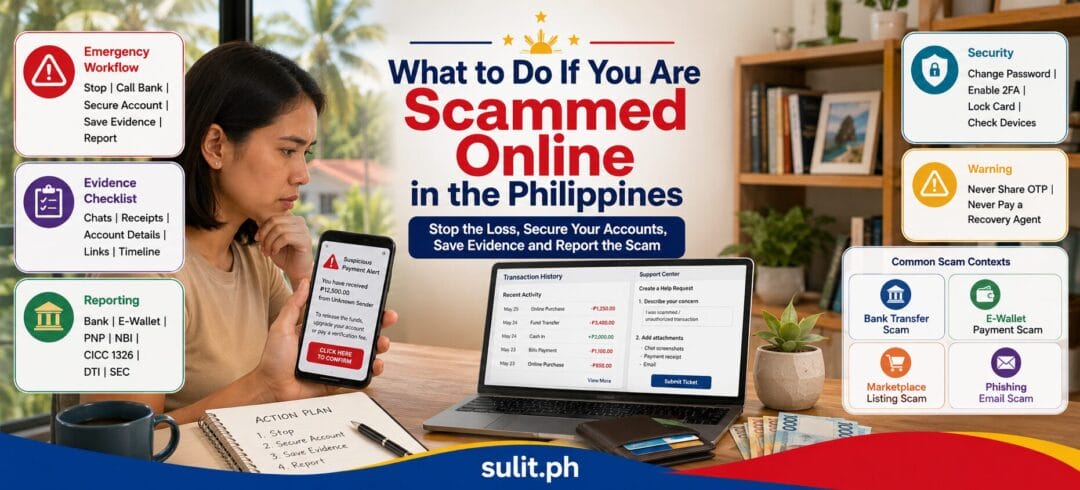
Our full walkthrough on what to do if you’ve been scammed shopping online in the Philippines goes deeper on the platform-dispute and bank-chargeback side of this if money changed hands under false pretenses.
Frequently Asked Questions
Paano malalaman kung may FDA registration ang isang produkto sa Shopee o Lazada?
Buksan ang FDA Verification Portal (verification.fda.gov.ph) at i-search ang eksaktong pangalan ng produkto o ng negosyong nagbebenta nito. Kung walang lalabas na resulta gamit ang tamang spelling, malaking senyales ito na hindi ito rehistrado sa FDA.
Ano ang pagkaiba ng PS Mark sa ICC sticker?
Pareho silang nagpapatunay na sumusunod ang produkto sa Philippine National Standards, pero ang PS Mark ay para sa mga gawang-lokal na produkto, habang ang ICC sticker ay para sa mga imported na produkto sa parehong 74 na kategorya na kailangan ng mandatory certification.
Ilegal ba ang magbenta ng produkto na walang ICC o PS mark sa Pilipinas?
Oo, kung ang produkto ay nasa ilalim ng 74 mandatory-certification categories ng DTI-BPS (kasama ang karamihan ng electrical, appliance, at construction-related na produkto). Ang DTI ay aktibong nagsususpetsa at naglalabas ng violation notices sa mga negosyong hindi sumusunod, kabilang ang mga online seller.
Also Worth Checking
Product registration is just one layer of buying safely online. For the seller-verification side of the equation, see our guide on verifying a live-selling seller on Shopee, Lazada, and TikTok Shop. If medicine specifically is what you’re shopping for, our guide on whether generic medicine is really the same as branded covers the FDA angle for drugs in more depth. And if you’re comparing budget appliance brands where PS/ICC compliance questions come up most often, see are budget appliance brands worth it in the Philippines. For Japan surplus units specifically, see our guide on whether Japan surplus appliances are worth it in the Philippines. If you’re shopping for a home security camera specifically, our guide on whether a home CCTV or security camera is worth it in the Philippines covers the same seller-verification checks before you buy one. If you ride a motorcycle, our guide on spotting a fake ICC or PS sticker on a motorcycle helmet walks through the same QR-code verification process for the one piece of safety gear RA 10054 requires. For the full range of scam patterns to watch for beyond registration issues, our
Verified Sources Used
DTI-Bureau of Philippine Standards: Confirmed what the PS Mark and ICC Sticker certify, which 74 product categories require them, and how each is verified.
FDA Verification Portal: Confirmed the two-part verification system (business License to Operate and product Certificate of Product Registration/Notification) for food, drug, cosmetic, and medical device products.
Philippine News Agency: Confirmed the ICC Verification app functions as a QR-code scanner covering 74 mandatory certification product categories, and is available free on Android.
Philstar: Confirmed 2025–2026 Takedown/Compliance Order statistics from IPOPHL and DTI’s E-Commerce Bureau, and NCIPR’s ₱18.64-billion counterfeit seizure figure.
SunStar: Confirmed the PNP’s September 2026 public warning and the specific high-risk product categories named by the PNP Chief.
GMA News: Confirmed DTI Secretary Ma. Cristina Roque’s statement on appliance fire risk and DTI’s 238 violation notices issued from 2024 through June 2026.