
Shopee vs Lazada vs TikTok Shop vs Carousell vs Facebook Marketplace: Which Is Actually the Most Sulit? (2026 Buyer Protection Guide)
Sulit verdict: For anything you’d actually be upset about losing — a phone, an appliance, a big electronics order — buy it through Shopee, LazMall, or TikTok Shop’s official Mall tier, not a random reseller or a Facebook Marketplace meetup. Those three are the only options here with a platform that will actually step in, hold money, and force a refund when something goes wrong. Carousell and Facebook Marketplace can still be sulit for small, low-risk buys — just go in knowing that once cash changes hands at a meetup, you and the seller are mostly on your own.
Every “best online shopping app” comparison in the Philippines talks about vouchers, free shipping, and flash sale prices. Almost none of them answer the question that actually matters once you’ve clicked “buy”: what happens if the item never arrives, arrives broken, or turns out to be fake? We pulled the actual refund, return, and buyer-protection policies straight from Shopee, Lazada, TikTok Shop, Carousell, and Facebook Marketplace’s own help centers — plus what Philippine law requires regardless of what any app’s terms say — so you can pick the platform that matches how much risk you’re actually willing to take on a given purchase.
As of September 2026, here’s how the five stack up, sourced entirely from each platform’s own policy pages and the relevant Philippine statutes (full list at the bottom).
The Real Difference Isn’t Price — It’s What Happens When Something Goes Wrong
| Platform | Platform-Backed Refund? | Authenticity Guarantee | Return Window (as stated by the platform) | Who Actually Resolves a Dispute |
|---|---|---|---|---|
| Shopee | Yes, for items bought through Shopee’s own checkout | Only explicit for Shopee Mall sellers | 7 days (regular sellers) / 15 days (Shopee Mall) to file a request | Shopee itself; its decision is final |
| Lazada (LazMall) | Yes — LazMall states “100% Authenticity guaranteed” | Yes, LazMall-specific, with a stated 2x money-back remedy for inauthentic items | 30 days (LazMall’s stated policy) | Lazada, clearly documented for LazMall specifically |
| Lazada (regular seller, non-LazMall) | Varies by seller; no fixed day-count confirmed on Lazada’s own help pages | Not guaranteed the way LazMall is | Not publicly fixed the way LazMall’s is | Lazada mediates, but protection is weaker than LazMall |
| TikTok Shop | Yes, for items bought through TikTok Shop checkout | Stronger for Mall sellers | 15 days (Mall) / 6 days (non-Mall) after delivery | TikTok Shop; sellers get 48 hours to respond or it auto-approves |
| Carousell | Only if you use the “Buy Now” protected-checkout flow | None platform-wide | Protection window ends once you confirm receipt; no protection at all on “Make Offer” chat deals | Carousell only for protected checkout; otherwise just you and the seller |
| Facebook Marketplace | Only for items bought via Facebook’s own shipping checkout | None | Not applicable to local pickup/meetup | No one, for local meetups — it’s buyer and seller only |
Sulit Tip: Notice the pattern — every platform’s real protection lives inside its “Mall” or “official checkout” tier. If you’re spending real money on something you can’t easily replace, deliberately filter your search to Shopee Mall, LazMall, or TikTok Shop Mall sellers before you buy. The regular marketplace tier on any of these apps can still be cheaper, but you’re trading price for recourse.
Shopee: The Broadest Everyday Safety Net
Shopee’s own Refunds and Return Policy covers a wide range of situations: the parcel never arrives, it arrives damaged or incomplete, it doesn’t match the listing, or — for Shopee Mall items specifically — it turns out to be counterfeit. You get 7 days to file a request on a regular seller’s item, or 15 days if it’s a Shopee Mall item, measured from delivery (or from the expected delivery date if the parcel never shows up). Once a return is approved, you have 2 days to choose a return method and 5 days to actually ship the item back, and Shopee covers that return shipping through its own logistics partners when it decides the seller was at fault.
Good to Know: Shopee requires photo or video evidence when you file a return request, and once its “Shopee Return Window” closes, the order auto-locks as “Received” — there’s no protection after that point, so don’t sit on a defective item hoping you’ll get to it eventually.
The catch across the board with Shopee — and this applies to every platform on this list — is that Shopee is also the one deciding whether your claim is valid. There’s no independent appeals body built into the app itself; if Shopee sides with the seller, your next step is Philippine law, not the app (more on that below).
Lazada: Excellent Inside LazMall, Murkier Outside It
Lazada’s clearest guarantee is scoped specifically to LazMall, its verified-brand storefront tier. Lazada’s own landing page states it plainly: “100% Authenticity guaranteed. Get 2 times your money back if you receive an inauthentic product from LazMall,” alongside a stated 30-day return window and free shipping on that tier. That’s a genuinely strong, explicit commitment — as long as you’re buying from a LazMall-badged store rather than a regular third-party Lazada seller, where we could not confirm a fixed, published day-count for returns on Lazada’s own help pages the way LazMall spells one out.
Heads Up: Counterfeit risk isn’t evenly spread across platforms. Philippine Intellectual Property Office (IPOPHL) data reported by Inquirer.net found that among reported online IP/counterfeit complaints in a recent measured period, Lazada accounted for the largest share (69%), followed by Facebook (20%) and Shopee (7%). That’s a breakdown of where counterfeit complaints got reported — not a claim that most Lazada sellers are fake — but it’s exactly why sticking to the LazMall badge (not just any Lazada listing) matters more on this platform than on the others.
TikTok Shop: Fast Windows, Automatic Refunds, One Real Catch
TikTok Shop’s Philippines seller-center policy pages lay out some of the most structured timelines of the five: buyers get 15 days after delivery to request a return on Mall purchases, or 6 days on non-Mall purchases. Sellers then have 48 hours to respond to a request — miss that window and it auto-approves in the buyer’s favor. Once a return is approved, the buyer has 10 calendar days to ship the item back, and the seller has up to 14 days to receive and inspect it before an automatic refund kicks in if they don’t act. Cosmetics, intimate apparel, and consumables are excluded from returns but still qualify for a refund without a physical return if they arrive defective.
The real catch with TikTok Shop isn’t the return policy — it’s how a lot of purchases happen in the first place: live-selling. A countdown timer and a host talking fast is a very different buying environment than browsing a static listing, and it’s also where verification tends to slip. If you’re buying through a livestream, our guide to verifying a live-selling seller walks through the checks to run before you tap “buy” mid-stream.
Carousell: Sulit for Bargains, But Read the Fine Print on “Buy Now” vs. “Make Offer”
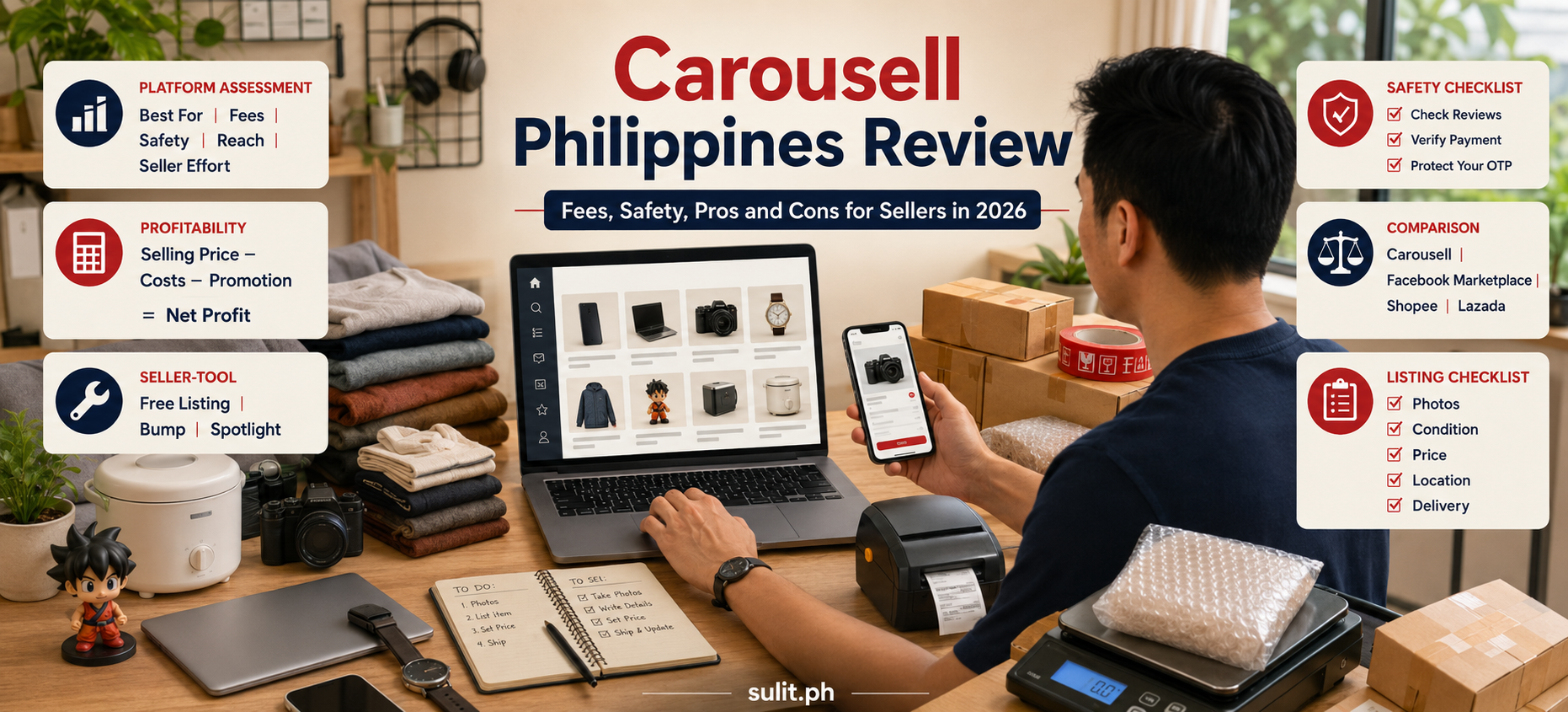
Carousell is the one platform on this list that’s structurally different from the other three. Per its own Help Centre, Carousell does offer an optional “Buyer Protection” feature: when you use the “Buy Now” checkout flow, Carousell holds the payment until you confirm the item arrived as described, and only then releases funds to the seller. That’s a real, platform-backed safety net — but Carousell is explicit that it applies only to that protected checkout flow.
The much more common way people actually transact on Carousell in the Philippines — arranging a price through chat via “Make an Offer,” then meeting up or doing a bank/e-wallet transfer directly — falls entirely outside that protection. Carousell describes itself as “an open community where members have the freedom to conduct transactions in ways which they feel most comfortable,” which is a polite way of saying: if you go the meetup route, there’s no platform refund, no held payment, and no dispute process if the seller ghosts you after you’ve paid. Carousell even has to run a separate help article warning users about scammers who impersonate its own Buyer Protection feature with fake “protected payment” links, which tells you how often that exact con gets tried.
Facebook Marketplace: The Least Protected of the Five
Facebook Marketplace’s Purchase Protection, where Meta offers it at all, is scoped only to items bought and shipped through Facebook’s own checkout — explicitly excluding local pickups, meetups, or arrangements made through outside couriers. In the Philippines, the overwhelming majority of Marketplace activity is local buy-and-meet, which means the overwhelming majority of Marketplace transactions here simply aren’t covered by anything Meta offers. If a seller takes your GCash payment and stops replying, there is no built-in refund mechanism, no held payment, and no formal dispute channel through the platform itself — it is buyer and seller, full stop. Our Facebook Marketplace scams guide covers the specific red flags worth checking before you agree to meet anyone.
What Philippine Law Actually Backs You Up With
None of the five platforms exist in a legal vacuum. The Internet Transactions Act of 2023 (Republic Act No. 11967), which the Department of Trade and Industry confirmed began full enforcement on June 20, 2025 after its transitory compliance period ended, sits on top of whatever any individual app’s terms say. A few provisions matter directly to you as a buyer:
If goods are defective or not as described, the law entitles you to repair, replacement, refund, or another remedy, and to return the item within “a reasonable period” at no cost to you — the law doesn’t fix that at a specific number of days, so don’t expect a universal countdown here the way Shopee or TikTok Shop publish for their own platforms. Online marketplaces are required to vet merchants before letting them list (ID and business registration on file) and must disclose a seller’s business name, address, and contact details. If a marketplace fails to do reasonable due diligence on a seller, or fails to remove illegal or unsafe listings after being notified, it can share liability with that seller — not just wash its hands of the transaction. Before you can escalate a complaint to court or a government agency, you generally have to go through the platform’s own complaint process first — and the law says that process is “deemed exhausted” if it goes seven calendar days without resolution, at which point you’re free to take it further.
DTI has also been rolling out a mandatory “E-Commerce Philippine Trustmark” digital badge under RA 11967’s implementing rules, requiring online sellers and marketplaces to meet disclosure and complaint-handling standards to display it — Shopee and TikTok Shop were both named among early registrants in Philippine news coverage of the rollout. DTI reported receiving more than 13,000 online-transaction-related complaints between January and August 2025 alone, on top of 28,824 such complaints logged in 2023 — context for just how much of DTI’s consumer-protection workload is now e-commerce.
The older Consumer Act of the Philippines (Republic Act No. 7394) still applies too, and separately makes it illegal for any seller — online or offline — to misrepresent a used or reconditioned product as new, or to make false claims about a product’s approval or characteristics.
Good to Know: Practically, this means your first move when a purchase goes wrong should always be the platform’s own return/refund flow, not a DTI complaint straight away — the law expects you to try that route first, and it only counts as “exhausted” after seven days of no resolution.
Worked Scenario: Buying a Secondhand Phone Three Different Ways
Say you’re buying a secondhand iPhone for around the same price on three different platforms — how does the risk actually change?
Route 1 — Facebook Marketplace, local meetup: You message the seller, agree on a price, meet at a mall, inspect the phone, and pay in cash or GCash on the spot. If it dies a week later, or turns out to be locked/blacklisted, you have no platform to appeal to — your only recourse is going back to the seller directly, or a small-claims filing if you can even track them down. The upside: you inspected it in person before paying, which is real protection Marketplace itself doesn’t give you.
Route 2 — Carousell, “Make an Offer” then meetup: Functionally identical risk profile to Route 1, even though it happened inside an app that has a Buyer Protection feature — because you didn’t use the protected “Buy Now” checkout, that feature never applied to your transaction.
Route 3 — Carousell “Buy Now,” or a certified refurbished unit through Shopee Mall/LazMall: Carousell holds your payment until you confirm the item matches; a Mall-tier refurbished listing on Shopee or Lazada carries the platform’s own return window on top of that. You lose the chance to physically inspect the phone before paying, but you gain a real refund path if it’s not as described.
Neither route is universally “correct” — a phone you can personally inspect before paying removes a different kind of risk than a platform guarantee does. The mistake is assuming Carousell protects you just because Carousell has a protection feature, when whether it actually applies depends entirely on which button you tapped to pay.
Frequently Asked Questions
Is LazMall actually safer than a regular Lazada seller?
Yes, based on Lazada’s own published policy. LazMall carries an explicit “100% Authenticity guaranteed” commitment with a stated 2x money-back remedy and a 30-day return window; Lazada does not publish the same fixed guarantee for its regular third-party marketplace sellers.
Does Facebook Marketplace refund me if a seller scams me?
Only if you paid through Facebook’s own shipping checkout. For the local pickup and meetup transactions that make up most Marketplace activity in the Philippines, Meta’s Purchase Protection explicitly does not apply, and there is no other built-in refund mechanism.
What’s the very first thing I should do if an online seller won’t refund me?
File the return/refund request through that platform’s own official process first. Under the Internet Transactions Act, you generally need to let the platform’s complaint process run for at least seven days before escalating to DTI or another agency.
Is Carousell’s Buyer Protection automatic on every purchase?
No. It only applies when you pay through Carousell’s “Buy Now” protected-checkout flow. Deals arranged by chat (“Make an Offer”) and settled outside the app, including in-person meetups, are not covered.
Also Worth Checking
If platform trust is on your mind, a few of our other guides go deeper on specific angles: our online shopping scams guide for the most common tricks sellers use regardless of platform, our guide to verifying a live-selling seller if most of your buying happens through livestreams, and our Shopee, Lazada & TikTok Shop sale calendar if you’re trying to time a purchase around a bigger discount window. For more of this kind of value-first breakdown, head back to more sulit finds.
Verified Sources Used
Shopee Philippines Help Center: Confirmed Shopee’s official return/refund windows (7 days regular, 15 days Shopee Mall) and the return process timeline.
Lazada Philippines (LazMall landing page): Confirmed LazMall’s stated 100% authenticity guarantee, 2x money-back remedy, and 30-day return window.
TikTok Shop Philippines Seller Center: Confirmed TikTok Shop’s 15-day (Mall) / 6-day (non-Mall) return windows, the 48-hour seller response rule, and auto-refund timelines.
Carousell Help Centre: Confirmed Carousell’s Buyer Protection feature is limited to its “Buy Now” checkout flow and does not extend to chat-arranged meetups.
LawPhil — Republic Act No. 11967 (Internet Transactions Act of 2023): Confirmed the seven-day complaint-exhaustion rule, merchant-vetting requirements for marketplaces, and platform liability provisions.
LawPhil — Republic Act No. 7394 (Consumer Act of the Philippines): Confirmed the ban on misrepresenting used/reconditioned goods as new and other deceptive sales practices.
Inquirer.net: Confirmed RA 11967 enforcement began June 20, 2025, and DTI’s 2023 complaint volume (28,824 online-transaction-related complaints).
GMA News: Confirmed DTI’s E-Commerce Trustmark rollout and the 13,000+ online-transaction complaints logged January–August 2025.
Inquirer.net (IPOPHL data): Confirmed the reported online counterfeit-complaint breakdown by platform (Lazada 69%, Facebook 20%, Shopee 7%) for the measured period cited.