Best Marketplace in the Philippines (2026): Shopee vs. Lazada vs. TikTok Shop
What Is the Best Marketplace in the Philippines?
Shopee is currently the best overall marketplace in the Philippines for most new and established sellers. It offers broad consumer reach, integrated payments, nationwide shipping options, advertising tools and a marketplace that Filipino shoppers already use.
Shopee.ph ranked as the most visited e-commerce and shopping website in the Philippines in June 2026, ahead of Lazada, Amazon, Temu and Carousell. That makes Shopee the practical starting point for sellers who want access to an existing national audience.
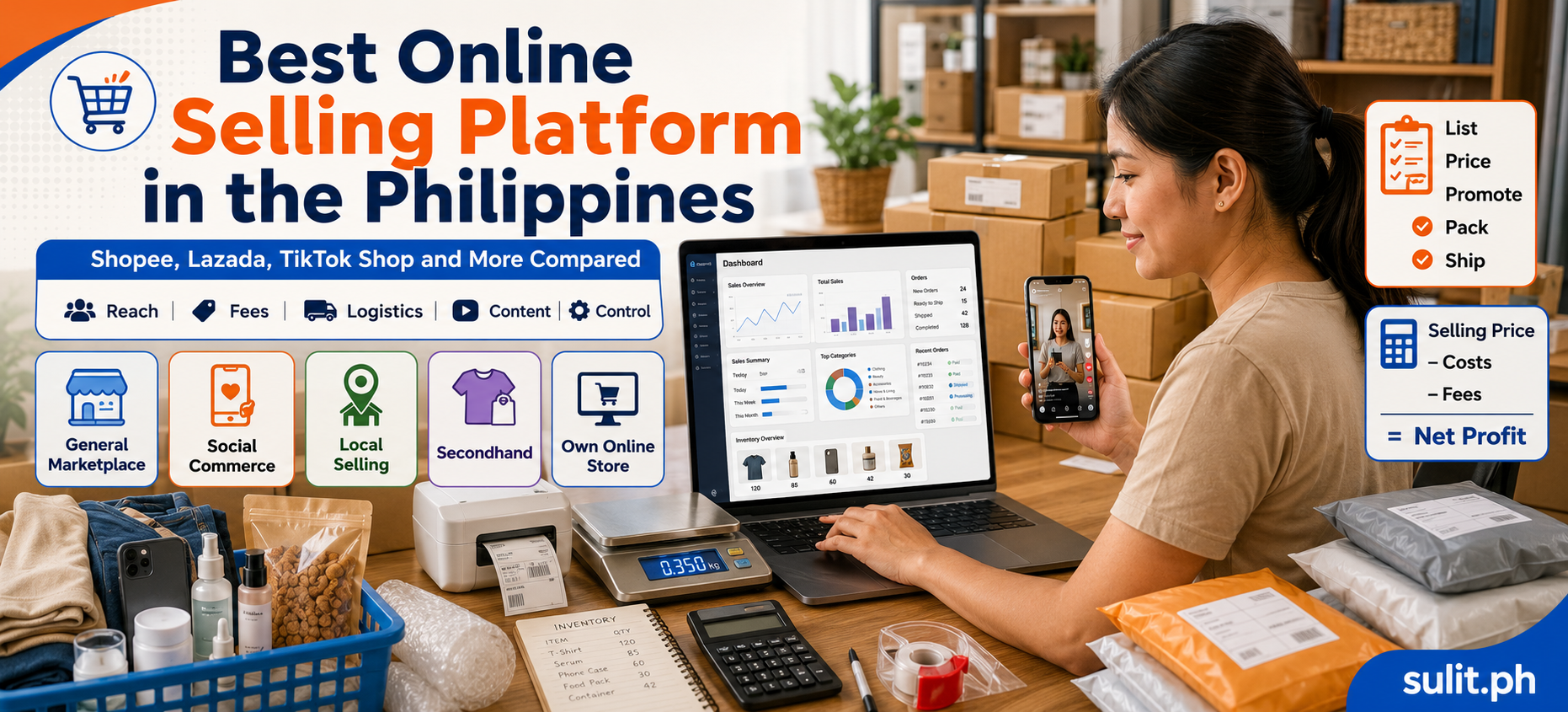
The best platform still depends on what you sell:
- Shopee: Best general marketplace for reaching a broad customer base
- Lazada: Best for structured retail operations, branded products and marketplace campaigns
- TikTok Shop: Best for products that sell well through videos, livestreams and creator promotion
- Facebook Marketplace: Best for local transactions, bulky items and direct buyer conversations
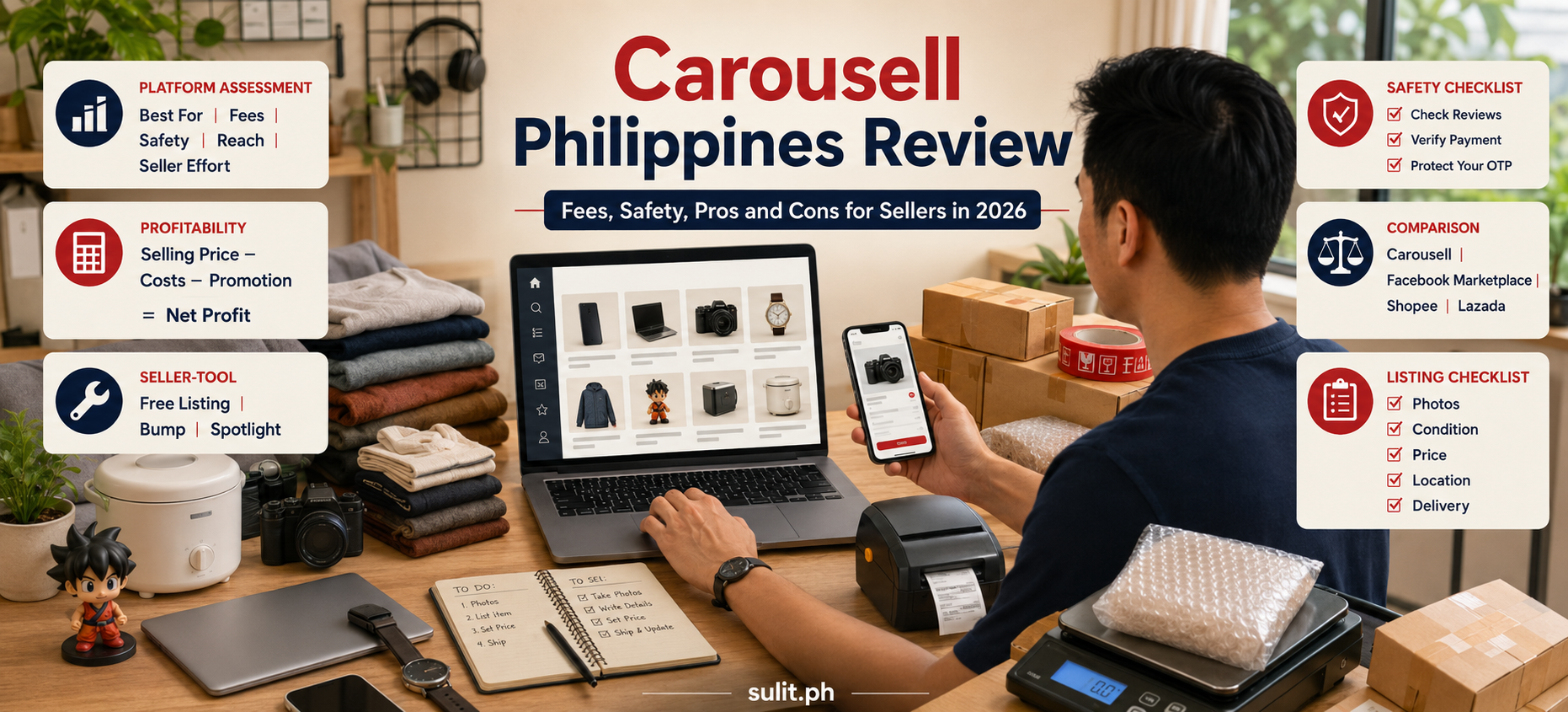
- Carousell: Best for secondhand products, collectibles and individual listings
- Your own online store: Best for brand ownership, customer data and long-term independence
This guide follows the uploaded comparison framework, including platform selection, fees, product categories, setup, legal requirements and sales strategies.
Quick Comparison of Online Selling Platforms
| Platform | Best for | Main advantage | Main limitation |
|---|---|---|---|
| Shopee | General merchandise, beauty, fashion, household goods | Broad marketplace reach and integrated logistics | Strong price competition and several possible seller deductions |
| Lazada | Brands, electronics, appliances and organized retailers | Structured seller tools, campaigns and fulfilment options | Smaller web audience than Shopee based on current Philippine rankings |
| TikTok Shop | Beauty, fashion, food, accessories and demonstration-friendly products | Product discovery through short videos, creators and livestreams | Requires continuous content production |
| Facebook Marketplace | Furniture, appliances, vehicles, local services and pre-owned goods | Direct local reach and no standard marketplace commission for basic listings | Sellers frequently handle inquiries, payment and delivery themselves |
| Carousell | Secondhand items, collectibles, gadgets and personal listings | Simple listing process and strong resale positioning | Less suitable for large catalogues and high-volume retail |
| Standalone store | Established brands and repeat-customer businesses | Control over branding, customer experience and first-party data | Seller must generate traffic and arrange the technology stack |
Understanding Online Selling Platforms in the Philippines
An online selling platform connects merchants with buyers through digital product listings, messaging, checkout, payment or fulfilment tools.
There are three main models.
Online marketplaces
Shopee, Lazada and TikTok Shop bring multiple merchants into one shopping environment. They provide customer traffic, checkout systems, seller dashboards, promotional campaigns and logistics integrations.
The marketplace controls many parts of the transaction. It also sets policies covering product listings, order processing, cancellations, returns, advertising and seller fees.
This model fits beginners because the infrastructure already exists. The trade-off is reduced control over pricing, customer relationships and platform deductions.
Social-commerce platforms
TikTok Shop, Facebook Marketplace and social-media pages combine content, conversation and commerce.
TikTok Shop provides an integrated checkout system. Facebook Marketplace commonly works as a listing and messaging channel, with payment and delivery arranged between the buyer and seller.
Social commerce works particularly well when a product needs to be demonstrated. Makeup, kitchen tools, clothing, food products and small household devices become easier to sell when buyers can watch them being used.
Standalone online stores
A standalone store runs on a seller-controlled website using platforms such as Shopify, WooCommerce or another e-commerce system.
The seller controls:
- Store design
- Product presentation
- Customer information
- Checkout experience
- Promotions
- Analytics
- Email and remarketing campaigns
The difficult part is customer acquisition. A new standalone website does not arrive with Shopee-sized foot traffic humming outside its digital door. The business must attract visitors through search, social media, advertising, content, affiliates or an existing customer base.
Top Online Selling Platforms in the Philippines
1. Shopee
Shopee is the best starting platform for sellers who want the widest practical marketplace reach in the Philippines.
Its marketplace supports product listings, seller vouchers, sponsored advertising, campaign participation, chat, integrated checkout and logistics services. Current traffic rankings place Shopee ahead of other Philippine e-commerce websites.
Shopee is suitable for:
- Clothing and accessories
- Beauty and personal-care products
- Mobile accessories
- Household supplies
- Home organization products
- Toys
- School and office supplies
- Packaged food
- Low- to mid-priced consumer goods
Shopee works best when the seller can compete on the full offer, not price alone. Buyers also examine ratings, reviews, shipping speed, vouchers, product photos and shop response rates.
Main challenge
Marketplace visibility is competitive. A product can disappear beneath hundreds of near-identical listings unless the seller improves the title, product data, images, price, reviews and fulfilment performance.
2. Lazada
Lazada is a strong option for businesses that want a structured marketplace presence, particularly brands, distributors and sellers of electronics, appliances and higher-value consumer products.
Lazada University currently advertises onboarding benefits for eligible new sellers, including temporary commission or programme incentives. These offers have eligibility conditions and can change, so sellers should confirm the current terms during registration.
Lazada is suitable for:
- Branded electronics
- Mobile devices and accessories
- Home appliances
- Beauty brands
- Fashion brands
- Authorized distributors
- Businesses with larger catalogues
- Sellers capable of joining major campaigns
Lazada can complement Shopee rather than replace it. A business can use Shopee for broad marketplace reach and Lazada for customers who prefer more structured brand storefronts.
3. TikTok Shop
TikTok Shop is the strongest option for sellers whose products can capture attention in a few seconds.
The platform combines entertainment, product discovery, creator promotion, livestreaming and checkout. Sellers can reach buyers before those buyers actively search for the product.
TikTok Shop’s Philippine seller documentation states that its transaction fee is 2.24% inclusive of VAT. Separate commission and programme-related charges can also apply, depending on category, seller type and participation.
TikTok Shop is suitable for:
- Cosmetics and skincare
- Fashion accessories
- Clothing
- Food and beverage products
- Household tools
- Novelty items
- Demonstration products
- Low-cost impulse purchases
- Products promoted by creators
A seller does not need a large personal following simply to register. TikTok Shop currently promotes seller registration without a minimum follower requirement, subject to its onboarding conditions.
Main challenge
TikTok Shop is a content engine wearing a checkout button. Sellers need videos, hooks, demonstrations, livestreams or creator relationships. Uploading a catalogue and waiting quietly rarely produces strong discovery.
4. Facebook Marketplace
Facebook Marketplace works well for local sales and direct buyer-to-seller transactions.
It is particularly useful when shipping through a national marketplace is impractical.
Facebook Marketplace is suitable for:
- Furniture
- Used appliances
- Vehicles and parts
- Home equipment
- Secondhand goods
- Locally delivered food
- Rental listings
- Community-based services
- Products requiring inspection before payment
Its basic listing model provides flexibility, but the seller must manage more of the transaction. This can include answering repetitive inquiries, screening buyers, arranging meetups, confirming payments and organizing delivery.
For safety, avoid releasing an item based only on screenshots of a payment. Confirm that funds have entered the correct account before completing the transaction.
5. Carousell
Carousell is designed around classified-style and resale listings. It suits sellers who want to sell individual items without building a full marketplace shop.
Carousell is suitable for:
- Pre-owned gadgets
- Cameras
- Collectibles
- Sneakers
- Designer items
- Books
- Hobby equipment
- Furniture
- Personal decluttering
Carousell can also support small specialist sellers, but it is less practical for businesses managing hundreds of fast-moving products.
6. A Standalone Online Store
A standalone store is the best long-term option for a business that wants to build a brand instead of permanently renting space inside another company’s marketplace.
It lets the business control:
- Brand presentation
- Product bundles
- Customer accounts
- Email subscriptions
- Loyalty programmes
- Analytics
- Checkout design
- Upselling
- Content
- Search visibility
The strongest strategy for many businesses is a hybrid setup:
- Use marketplaces to acquire new customers.
- Use social platforms to create demand.
- Use a standalone website to build the brand and serve repeat customers.
- Keep customer communications and marketing compliant with privacy and platform rules.
How to Choose the Right Selling Platform
Choosing a platform starts with the product, customer and operating model.
Choose Shopee when:
- You are a beginner selling widely purchased consumer products.
- Your customers compare several sellers before buying.
- You need integrated payment and shipping tools.
- You can maintain competitive pricing and fulfil orders consistently.
- You want access to an established marketplace audience.
Choose Lazada when:
- You sell branded, technical or higher-value goods.
- You operate as an authorized distributor or established retailer.
- You maintain accurate inventory and structured product data.
- You intend to participate in platform campaigns.
- You want another large marketplace channel alongside Shopee.
Choose TikTok Shop when:
- Your product creates a visible result.
- A demonstration can explain the benefit quickly.
- You can produce videos or work with creators.
- Your target buyers respond to trends and social recommendations.
- Your margins can support creator commissions, campaigns and platform fees.
Choose Facebook Marketplace when:
- Your buyers are located nearby.
- The product is large, heavy or difficult to ship.
- Buyers need to inspect the item.
- You prefer direct negotiation.
- You can manage payment and delivery arrangements securely.
Choose Carousell when:
- You sell secondhand goods or individual items.
- Your customers search for specific brands, models or collectibles.
- You do not need a large integrated retail operation.
- Direct buyer communication fits your selling process.
Choose a standalone store when:
- You already have customers or a recognizable brand.
- Repeat purchases matter.
- You want control over customer experience.
- You plan to build organic search traffic.
- You want less dependence on marketplace algorithms.
Platform Fees and Selling Costs
There is no honest single answer to “Which platform has the lowest fees?” because marketplace deductions depend on several moving parts.
A seller’s total cost can include:
- Commission fee
- Transaction or payment-processing fee
- Shipping programme fee
- Voucher contribution
- Campaign service fee
- Advertising cost
- Creator or affiliate commission
- Return or refund cost
- Packaging
- Withholding tax
- Value-added tax treatment
- Seller-funded discounts
Shopee and Lazada fees can differ by seller programme, product category and campaign participation. TikTok Shop also applies category commissions and optional programme charges in addition to its published transaction fee. Sellers should check the applicable seller-centre fee table before setting prices.
Sample profitability calculation
Assume a product sells for ₱1,000.
| Item | Sample amount |
|---|---|
| Selling price | ₱1,000 |
| Product cost | ₱450 |
| Packaging | ₱40 |
| Platform and transaction charges | ₱120 |
| Seller-funded discount | ₱50 |
| Advertising cost attributed to the order | ₱80 |
| Estimated contribution before tax and overhead | ₱260 |
The correct question is not simply, “How much is the commission?”
Ask:
How much money remains after every cost required to produce, acquire and fulfil the order?
Use this formula:
Net contribution = Selling price − product cost − platform deductions − seller discounts − packaging − advertising − fulfilment costs − return allowance
A product with high sales but almost no remaining margin is a busy treadmill. It creates motion without carrying the business forward.
Before setting a selling price
Create a spreadsheet containing:
- Product cost
- Marketplace commission
- Transaction fee
- Programme fees
- Seller voucher
- Affiliate commission
- Ad cost per order
- Packaging cost
- Return rate
- Tax
- Target profit
Update the spreadsheet whenever the marketplace changes its fee structure.
Best Platform by Product Category
| Product category | Recommended primary platform | Useful secondary channel |
|---|---|---|
| Fashion and accessories | Shopee or TikTok Shop | Lazada |
| Beauty and skincare | TikTok Shop | Shopee |
| Electronics and gadgets | Lazada or Shopee | Standalone store |
| Home appliances | Lazada | Facebook Marketplace |
| Furniture | Facebook Marketplace | Standalone store |
| Packaged food | Shopee or TikTok Shop | |
| Handmade products | TikTok Shop or standalone store | Shopee |
| Secondhand goods | Carousell | Facebook Marketplace |
| Collectibles | Carousell | Facebook groups or standalone store |
| Digital-first brand | Standalone store | Shopee, Lazada or TikTok Shop |
| Local services | Standalone website | |
| Specialty products | Standalone store | Marketplace selected by customer profile |
What Do Filipinos Commonly Buy Online?
Large marketplace catalogues show strong activity across fashion, beauty, household goods, electronics, food, personal care and mobile accessories.
However, category popularity does not guarantee profitability. A product category can attract many buyers and even more sellers.
A better product-selection test examines:
- Demand: Are buyers actively looking for the product?
- Margin: Is enough profit left after all costs?
- Competition: Can the listing offer a clear advantage?
- Shipping: Can the product survive delivery at a reasonable cost?
- Repeat purchase: Can one customer generate several future orders?
- Content potential: Can the product be demonstrated or explained visually?
- Return risk: Do size, compatibility or quality issues create frequent returns?
Setting Up an Online Store in the Philippines
Step 1: Register the business
Online sellers are not exempt from business and tax requirements simply because transactions happen through an app.
BIR Revenue Regulations No. 7-2024 state that online sellers and merchants must register with the BIR on or before commencing business through an e-marketplace platform. BIR rules also require covered online merchants to display proof of registration on their website, marketplace page or selling platform.
Depending on the business structure and location, registration can involve:
- DTI registration for a sole proprietorship
- SEC registration for a corporation or partnership
- Cooperative Development Authority registration for a cooperative
- Barangay clearance
- Mayor’s or business permit
- BIR registration
- Books of accounts
- Authority to issue invoices
- Industry-specific permits
Confirm the exact requirements with the relevant government agencies and local government unit.
Step 2: Prepare the platform documents
Marketplace onboarding commonly requires:
- Valid government-issued identification
- Mobile number
- Email address
- Bank or payment account
- Business registration details for registered businesses
- Tax information
- Store name
- Pickup address
- Return address
The platform can request additional verification based on seller type, category or sales activity.
Step 3: Select a focused starting catalogue
Do not upload every available product on the first day.
Start with products that have:
- Stable inventory
- Clear demand
- Sufficient margin
- Low damage risk
- Accurate specifications
- Reliable suppliers
- Easy-to-produce photos and videos
A smaller, well-maintained catalogue is easier to price, fulfil and improve.
Step 4: Create complete product listings
Each listing should include:
- Clear product title
- Correct category
- Relevant attributes
- Accurate dimensions
- Materials
- Inclusions
- Compatibility details
- Variations
- Delivery limitations
- Warranty information when applicable
- Original photographs
- A concise demonstration video when useful
Avoid stuffing the title with repeated keywords. Write for a buyer comparing products on a small phone screen.
Weak title
BEST CHEAP ORIGINAL HIGH QUALITY TUMBLER SALE NEW
Better title
750 ml Stainless Steel Insulated Tumbler with Lid and Straw
The second title identifies the product, capacity, material and inclusions without confetti-cannon wording.
Step 5: Configure shipping and fulfilment
Confirm:
- Pickup schedule
- Courier availability
- Packing requirements
- Maximum parcel dimensions
- Restricted products
- Return address
- Order-processing time
- Cut-off times
- Inventory availability
Late fulfilment, cancellations and incorrect stock levels can damage seller performance.
Step 6: Publish store policies
Explain:
- Processing time
- Product inclusions
- Warranty coverage
- Return conditions
- Customization rules
- Pre-order lead times
- Customer-support channels
Policies should be consistent with Philippine law and the marketplace’s own buyer-protection rules.
The Internet Transactions Act of 2023 provides the national framework for protecting online consumers and merchants. Its implementing rules cover responsibilities within internet transactions and e-marketplaces.
How to Increase Sales on Your Chosen Platform
Improve product relevance
Marketplace search systems need complete and accurate product information.
Use:
- A precise title
- The correct category
- Complete attributes
- Searchable specifications
- Clear variations
- Accurate stock
- Useful descriptions
- Product photos showing scale and details
A listing for a phone case should identify the compatible model. “Phone case, assorted” forces both the buyer and the algorithm to squint through fog.
Improve the offer
Marketplace performance depends on the entire offer:
- Price
- Shipping cost
- Delivery speed
- Voucher availability
- Product rating
- Seller rating
- Review volume
- Return risk
- Listing quality
Lowering the price is only one lever. Better bundles, clearer inclusions, faster fulfilment and stronger photography can improve conversion without crushing the margin.
Build reviews ethically
Positive reviews come from fulfilled expectations.
Focus on:
- Accurate product descriptions
- Secure packaging
- Correct variations
- Prompt shipping
- Helpful responses
- Clear instructions
- Consistent quality
Do not fabricate reviews or pressure customers to hide legitimate complaints.
Use advertising with a profit limit
Advertising should be measured against contribution margin.
For example:
- Contribution before advertising: ₱200
- Target remaining contribution: ₱120
- Maximum affordable ad cost per order: ₱80
Spending ₱150 to generate a sale that produces only ₱100 before advertising creates a loss, even when the dashboard celebrates the conversion.
Track:
- Ad spend
- Revenue
- Orders
- Cost per order
- Conversion rate
- Return rate
- Net contribution
Use short-form video for demonstration products
Video works when it answers a buyer’s question quickly.
Useful formats include:
- Before-and-after demonstration
- Product assembly
- Size comparison
- What is included
- Problem-and-solution format
- Three ways to use the product
- Packing an actual order
- Frequently asked question
- Customer use case without fabricated testimonials
Join campaigns selectively
Campaigns can increase traffic, but they can also stack several costs onto one order.
Before joining, calculate:
- Required discount
- Platform fee
- Voucher contribution
- Advertising support
- Affiliate commission
- Remaining margin
Join only when the expected volume, customer acquisition or inventory objective justifies the reduced margin.
Can You Sell on Several Platforms at Once?
Yes. Selling on Shopee, Lazada, TikTok Shop, Facebook and a standalone website at the same time is possible.
Multi-platform selling reduces dependence on one channel and reaches buyers with different shopping habits.
The main risk is inventory mismatch. A product can sell on two platforms before the seller updates the remaining stock.
Use:
- A central inventory sheet
- Unique stock-keeping units
- Daily stock reconciliation
- Reserved safety stock
- Inventory-management software when order volume grows
- One person or process responsible for stock accuracy
Start with one primary platform and one secondary platform. Add more channels after fulfilment, pricing and stock control are stable.
Which Platform Should a Beginner Choose?
For most beginners, the practical sequence is:
- Start with Shopee for broad marketplace reach.
- Add TikTok Shop when the product has strong video potential.
- Add Lazada when inventory and fulfilment processes are stable.
- Use Facebook Marketplace for local or bulky products.
- Build a standalone website as the brand and customer base grow.
This sequence is not a rigid ladder. A furniture seller could begin with Facebook Marketplace. A skincare creator could begin with TikTok Shop. An established appliance distributor could prioritize Lazada.
The product and customer should choose the platform, not the platform’s loudest promotional banner.
Frequently Asked Questions
What are the top online selling platforms in the Philippines?
The main platforms include Shopee, Lazada, TikTok Shop, Facebook Marketplace, Carousell and standalone e-commerce stores. Other channels serve specialized categories, international buyers and social-media communities.
What is the most used online shopping platform in the Philippines?
Shopee is currently the leading Philippine e-commerce website based on June 2026 web-traffic rankings. It ranks ahead of Lazada and other shopping websites.
What is the number-one selling app in the Philippines?
Shopee is the strongest all-around answer based on marketplace reach and current web-traffic leadership. TikTok Shop has become a major product-discovery and social-commerce channel, particularly for video-friendly categories.
Is it better to sell on Shopee or Lazada?
Shopee is the stronger general starting point for broad reach. Lazada fits structured retailers, brands, electronics sellers and businesses seeking a second large marketplace channel. Many established merchants use both.
Which platform has the lowest seller fees?
Facebook Marketplace can have the lowest direct platform cost for basic local listings because sellers commonly arrange the transaction themselves. Marketplace fees on Shopee, Lazada and TikTok Shop depend on category, programme participation and other charges. Compare total deductions, not commission alone.
Do I need a business permit to sell online?
Online businesses are subject to applicable registration, permit and tax requirements. BIR rules require online sellers to register before commencing business through an e-marketplace. Local permit requirements depend on the business structure, activity and location.
Does TikTok Shop require a minimum number of followers?
TikTok Shop’s Philippine seller-registration page states that no minimum follower count is required for seller registration. Other eligibility, verification and programme requirements still apply.
Is it safe to depend on one marketplace?
Depending on one platform creates operational risk. Fee changes, account restrictions, traffic changes or policy updates can immediately affect sales. A stronger business develops several acquisition channels and maintains its own customer-facing website when practical.
Final Recommendation
Choose Shopee as the primary selling platform when you are starting a general online retail business in the Philippines. It currently offers the strongest combination of marketplace traffic, buyer familiarity, logistics integration and seller tools.
Choose TikTok Shop when content drives the purchase. Choose Lazada for structured retail and brand-led operations. Choose Facebook Marketplace for local and bulky transactions. Choose Carousell for secondhand and collectible products.
The durable strategy is multi-channel:
Marketplace reach + social discovery + an owned online store.
That combination turns marketplace traffic into a business with more control, stronger customer retention and fewer single-platform risks.