What Does CTTO Mean Online? Filipino Internet Acronym Guide
CTTO means “Credit to the Owner.” Filipinos commonly add it to Facebook posts, photos, memes, videos and copied captions when the original creator is unknown.
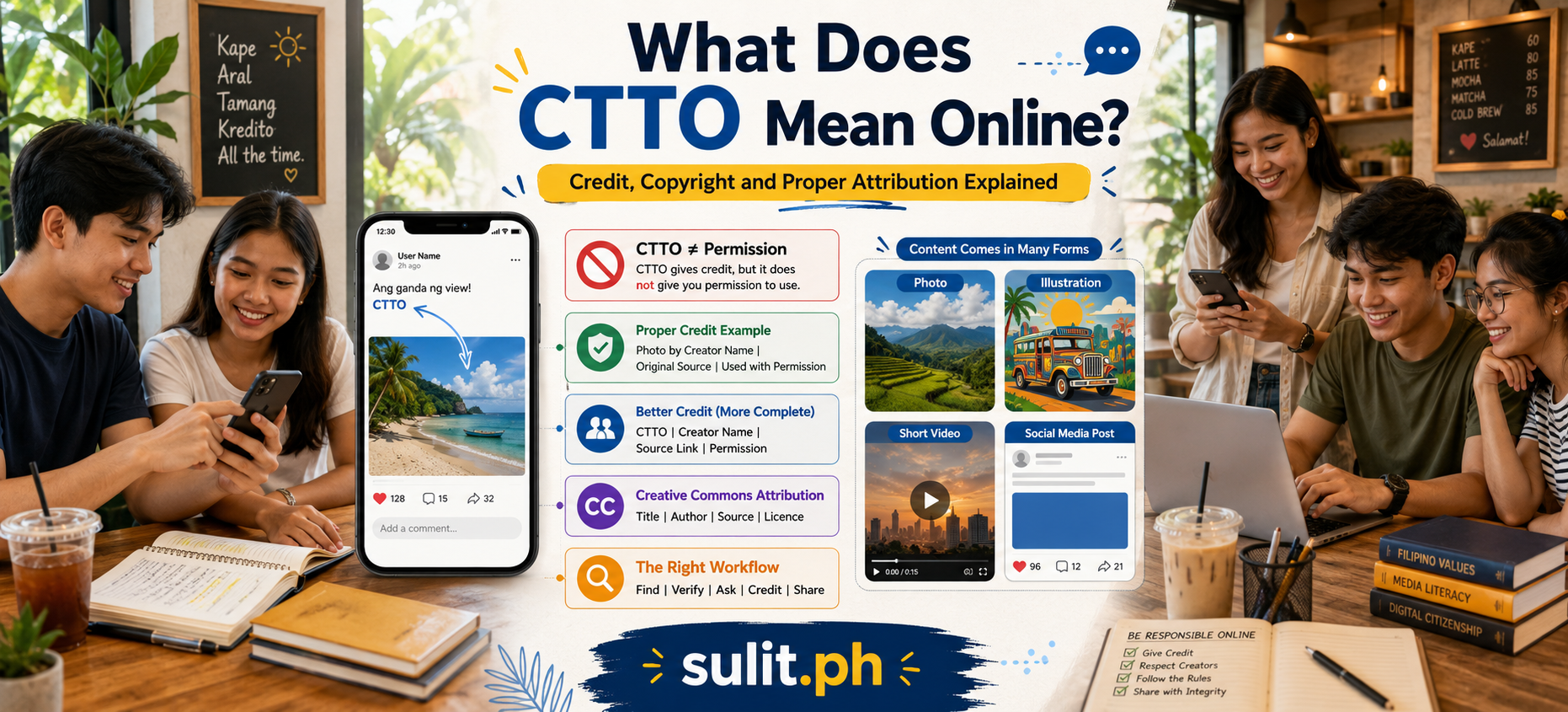
The intention is usually to acknowledge that the person reposting the material did not create it. However, writing CTTO does not identify the creator, obtain permission or automatically protect the person sharing the content from a copyright complaint.
The better approach is simple: identify the creator, ask permission when required, name and tag them clearly, link to the original post and follow any licensing conditions attached to the work.
| Term | Meaning | Is it proper credit? |
|---|---|---|
| CTTO | Credit to the Owner | No, because the owner is not identified |
| CCTO | Credits to the Owner | No, it has the same problem |
| Photo by Juan Dela Cruz | Names the photographer | Better, provided the name is correct |
| Source: original post | Links readers to the source | Better when combined with the creator’s name |
| Used with permission | Confirms permission was requested | Recommended when permission is required |
| CC BY attribution | Credits work under a Creative Commons licence | Acceptable when all licence conditions are followed |
The uploaded content brief recommends treating CTTO as both a Filipino internet-language topic and a digital-ethics issue, with practical alternatives for people sharing content online.
What Does CTTO Stand For and Mean Online?
CTTO stands for Credit to the Owner. You will normally find it at the end of a social-media caption, beneath a photograph or beside a reposted quotation.
Examples include:
“Sharing this because it is helpful. CTTO.”
“Ang ganda ng photo. CTTO sa owner.”
“For awareness only. CCTO.”
The expression is particularly familiar in Filipino online communities, where users regularly share screenshots, announcements, jokes, inspirational quotations, recipes, photographs and videos across Facebook groups, Messenger conversations and other social platforms.
CTTO functions as a compact disclaimer. The person sharing the material is effectively saying:
“I did not create this, and the material belongs to somebody else.”
That statement can show honest intent, but it leaves one enormous blank space: Who is the owner?
A proper credit should help readers identify and locate the creator. CTTO points toward an unnamed person somewhere in the digital fog. It is a signpost with no destination.
What does CCTO mean?
CCTO usually means “Credits to the Owner” or “Credit to the Owner.” It is simply another version of CTTO.
Adding another letter does not make the attribution more complete. The creator still needs to be named or linked.
Why Do People Use CTTO When Sharing Content?
Most people who use CTTO are not deliberately trying to steal somebody’s work. They use it because it feels like a quick, polite and familiar way to acknowledge ownership.
The original creator is difficult to find
A photo can travel through group chats, Facebook pages and reposting accounts until the original caption disappears. The person who receives it may have no idea where it came from.
Adding CTTO feels safer than presenting the content without any acknowledgement.
It has become a social-media habit
CTTO has been repeated so frequently in Filipino online spaces that many users assume it is an accepted attribution format. New users see other people using it and copy the practice.
The acronym becomes a cultural shortcut, even when it does not provide meaningful credit.
People think it prevents copyright problems
Some users treat CTTO as a legal disclaimer similar to:
“No copyright infringement intended.”
Neither statement automatically creates permission or removes the rights of the copyright holder. Meta itself advises users that the safest way to avoid infringing copyright is to post material they created themselves.
Sharing feels harmless
Users sometimes assume that reposting is acceptable when:
- The post is educational.
- No money is being earned.
- The content is already viral.
- The account is small.
- The creator receives “exposure.”
- CTTO has been added.
Those circumstances do not automatically authorize copying or reposting.
Is It Okay to Use CTTO?
CTTO can acknowledge that you are not the creator, but it is not adequate attribution and does not replace permission.
There are two separate questions to answer before sharing somebody else’s work:
- Am I allowed to use this content?
- How must I credit the creator?
Permission answers the first question. Attribution answers the second.
You can name a creator correctly and still use the work without permission. You can also receive permission and then fail to provide the credit required by the creator or licence.
CTTO does not identify the creator
“Credit to the owner” provides no name, username, profile, publication, original post or source link.
Compare these captions:
Incomplete
CTTO
More useful
Photo by Maria Santos, originally posted on @MariaSantosPhotography. Shared with permission.
The second version tells readers who created the work, where it came from and whether sharing was authorized.
Copyright owners control important uses of their work
The Intellectual Property Office of the Philippines explains that copyright holders can authorize or prohibit activities such as reproduction, public communication, broadcasting, translation and adaptation of protected works.
Reposting a complete photo, illustration or video can involve reproducing or communicating that work to another audience. Adding CTTO does not remove those rights.
Philippine law recognizes an author’s moral rights
Under the Intellectual Property Code of the Philippines, an author has moral rights connected with authorship, including the right to require that the work be attributed to them and that their name be indicated prominently when practicable.
A generic CTTO caption does not properly identify that author.
Attribution is not permission
Suppose a photographer posts an original image and states:
“Do not repost without written permission.”
Another account reposts the image and writes:
“CTTO to the photographer.”
The credit does not override the photographer’s condition. The account still needs permission unless a legal exception or valid licence applies.
“No copyright infringement intended” is not a shield
Copyright questions depend on the work, the rights involved, the licence, the nature of the use and any applicable legal limitations or exceptions.
A caption cannot unilaterally erase another person’s rights.
Good to Know: CTTO is better understood as an admission that the material belongs to somebody else, not as proof that the use is authorized.
How to Properly Credit Content Owners and Creators
Proper attribution starts before the repost button is pressed.
1. Find the earliest available source
Open the original-looking post and inspect:
- The publication date
- The creator’s username
- Visible watermarks
- Names included in the caption
- Links to a website or portfolio
- Comments identifying the creator
Do not assume that the account from which you downloaded the content is the original owner. Reposting pages frequently copy from other reposting pages.
2. Use reverse-image or visual search
For a photograph or illustration, use an image-search tool to locate earlier copies.
Compare publication dates and look for:
- A photographer’s portfolio
- An artist’s website
- A news organization
- A government source
- A verified business page
- A stock-image library
- A Creative Commons source page
A watermark can also provide the creator’s name or account handle.
3. Check whether the work has a licence
Some creators publish work under a Creative Commons licence. These licences allow specified forms of reuse when the user follows the conditions.
Creative Commons recommends the TASL attribution method:
- Title
- Author
- Source
- Licence
A licence can also restrict commercial use, modifications or redistribution. Read the exact licence attached to the work.
4. Ask the creator for permission
Send a direct and specific request:
Hi, may I repost your photo on our Facebook page? We will identify and tag you as the photographer, link to the original post and make no changes to the image.
State:
- Where the content will appear
- Whether it will be edited
- Whether it will be used commercially
- Whether it will appear in advertising
- How the creator will be credited
Keep the creator’s written response.
5. Follow the creator’s instructions
A creator may approve the repost only when:
- Their full name is included.
- Their account is tagged.
- The original post is linked.
- The image remains unedited.
- A watermark is preserved.
- The use is non-commercial.
- The post is removed after a campaign.
Permission is not a blank cheque. Follow the conditions provided.
6. Place the credit where people can see it
Credit should appear in the caption, article, video description or another prominent location.
Avoid hiding it among dozens of hashtags or placing it in a comment that readers are unlikely to notice.
Proper Attribution Examples for Social Media
Here are practical templates you can adapt.
Facebook photo
Photo by [Creator’s full name] via [original page or website]. Shared with permission. Original post: [link]
Facebook’s built-in share function is often preferable to downloading and uploading another person’s post because it preserves a direct connection to the source.
Instagram image
Photography: @[creatorhandle]
Originally posted at: [source]
Reposted with permission.
Tag the creator in the image and caption when requested. Do not crop out signatures or watermarks.
TikTok video
Original video by @[creatorhandle]. Used with permission.
Use official repost, duet or stitch features when they are available and appropriate. These tools provide a clearer route back to the original account than downloading and reuploading the video.
Website or blog image
“Title of Work” by Creator Name, available from Source, licensed under CC BY 4.0. Cropped from the original.
For Creative Commons material, include the applicable licence and indicate whether changes were made. Creative Commons states that proper credit should include the creator, a licence link and an indication of modifications when required.
News or government information
According to the [name of agency or publication], [short paraphrase of the information]. Source: [link to the original page]
Link to the original report instead of copying an entire article, infographic or announcement.
Alternatives to CTTO
Use one of these clearer formats instead of leaving the owner unnamed.
| Situation | Better attribution |
|---|---|
| You know the creator | “Created by [name], @[username].” |
| You have permission | “Shared with permission from [name].” |
| The material has a source page | “Source: [publication and direct link].” |
| It uses a CC licence | Use Title, Author, Source and Licence |
| You modified the work | Name the creator and describe the change |
| You cannot find the owner | Do not repost the complete work |
| You only want to share the information | Write your own summary and link to the original |
| It is a social-media post | Use the platform’s official sharing or reposting feature |
Use licensed stock content
For business pages, advertisements and monetized websites, licensed stock photographs, original graphics and commissioned content reduce uncertainty.
Check:
- Whether commercial use is allowed
- Whether editorial use is required
- Whether attribution is mandatory
- Whether modifications are permitted
- Whether the licence covers social-media advertising
“Free to download” does not always mean free for every possible use.
Create your own version
You can discuss an idea without copying another person’s exact creative expression.
Instead of downloading somebody’s infographic:
- Verify the underlying facts.
- Consult the original sources.
- Write your own explanation.
- Design a new visual.
- Cite the factual sources you used.
That process produces something genuinely useful instead of sending another photocopy through the internet’s washing machine.
Common CTTO Mistakes and Misconceptions
“CTTO protects me from copyright claims”
It does not.
Facebook and Instagram provide copyright-reporting procedures for rights holders who believe their work has been used without permission.
A post can still be reported, restricted or removed even when CTTO appears in its caption.
“The owner should be thankful for the exposure”
Exposure is not a substitute for consent.
Creators decide how their work is distributed, presented and monetized. Unrequested exposure can separate the work from the creator, remove context and direct attention toward the reposting account instead.
“It is okay because everybody is sharing it”
A viral work still has a creator.
The number of unauthorized copies does not turn the content into public property.
“It is fair use because I added CTTO”
CTTO and fair use are different concepts.
Attribution alone does not determine whether a particular use falls under an exception or limitation to copyright. The answer depends on the specific circumstances and applicable law. A legal professional should review high-risk, disputed or commercial uses.
“I did not make money from it”
Non-commercial use can affect the analysis in certain situations, but it does not create automatic permission to copy any work.
Some Creative Commons licences allow non-commercial reuse. Others allow commercial use. The licence must be checked before reuse.
“I found it on Google”
Google, Facebook, Instagram, Pinterest and TikTok help people discover content. Finding a work through a platform does not mean the platform granted permission to reproduce it.
What Should You Do When the Original Creator Cannot Be Found?
Do not use CTTO as a substitute for a missing source.
Choose one of these options:
- Share a link to the page where you found the content.
- Use the platform’s native share function.
- Describe the information in your own words.
- Find an alternative image with a clear licence.
- Create an original visual.
- Wait until the creator can be verified.
- Do not publish the material.
For casual personal sharing, this can feel strict. For a brand, publisher, influencer, organization or monetized page, an unknown source is a bright red warning light.
What to Do If Someone Uses CTTO for Your Content
Finding your work reposted under “CTTO” can be frustrating, especially when the copied post receives more attention than the original.
Save evidence
Before contacting the account, record:
- Screenshots of the post
- The account name
- The post URL
- Publication date
- Visible engagement
- Your original file or project record
- Your original publication URL
- Earlier drafts or creation dates
Preserve the evidence before the post is edited or removed.
Contact the person or page
Send a clear request:
Hello. I am the creator of the photograph used in your post. “CTTO” does not identify me or confirm permission. Please remove the post, or contact me to discuss authorized use and proper credit.
Stay factual. State what you want: removal, correction, payment, attribution or another remedy.
Use the platform’s reporting process
Meta provides copyright-reporting options for Facebook and Instagram. Rights holders can submit a report when they believe their copyrighted material is being used without authorization.
Use official reporting tools and provide accurate ownership information.
Strengthen future protection
Creators can make ownership easier to verify by:
- Publishing work first on a controlled website or portfolio
- Keeping original files and drafts
- Using consistent creator names
- Adding unobtrusive watermarks
- Including reuse terms
- Providing a licensing contact
- Keeping dated project records
- Registering or recording works when appropriate
IPOPHL provides information for authors and copyright holders, including copyright recordation and deposit services.
Frequently Asked Questions
Is it okay to use CTTO?
CTTO can show that you know the work belongs to somebody else, but it is not proper attribution. Identify the creator, link to the original source and obtain permission when required.
What is the purpose of using CTTO?
People use CTTO to acknowledge that they did not create the material they are sharing. It is commonly used when the original creator is unknown.
How do I credit the owner of a photo?
Include the photographer’s name, account or website, a link to the original source and a statement confirming permission when permission is required.
Does CTTO protect me from copyright claims?
No. CTTO does not grant permission, transfer rights or prevent the copyright holder from reporting the post.
What is the difference between CTTO and proper attribution?
CTTO refers to an unnamed owner. Proper attribution identifies the creator and source, follows the applicable licence and describes modifications when required.
Can I still get in trouble for copyright infringement if I use CTTO?
Yes. Adding CTTO does not automatically make unauthorized copying legal. Copyright liability depends on the facts, the applicable law, any licence and any relevant exception.
The Bottom Line
CTTO means “Credit to the Owner,” but it does not provide proper credit by itself.
A responsible repost should answer four questions:
- Who created the material?
- Where was it originally published?
- Do I have permission or a licence to use it?
- What credit or conditions does the creator require?
When the owner cannot be found, the safest choice is to avoid reuploading the content. Share the original post, use a licensed alternative or create something new.
Proper attribution gives readers a real path back to the creator. CTTO merely gestures into the crowd.