
Airbnb vs. Hotel in the Philippines: Which Is Actually Worth It for Your Trip?
Sulit verdict: It depends on your headcount, not your destination. Traveling solo or as a couple for one or two nights? A hotel usually wins once you account for Airbnb’s layered fees. Traveling as a barkada or family of four-plus, or staying somewhere for several nights where a kitchen actually saves you money on food? A whole-house Airbnb usually pulls ahead — split five or six ways, the math flips fast. The one thing that’s non-negotiable either way: never pay outside the platform, because that’s exactly the scam the PNP flagged by name.
Every “sulit or not” trip question we get boils down to the same thing: people compare the headline nightly rate on Airbnb against the headline nightly rate on a hotel booking site, pick whichever number is smaller, and get surprised at checkout. That’s the wrong comparison. Airbnb and a hotel room don’t just differ in price — they differ in how the final price gets built, who’s liable if something goes wrong, and what happens if your “listing” turns out not to exist at all.
This guide breaks down what you’re actually paying for on each side, who each option is genuinely built for, the 2025 tax change that quietly touches your Airbnb bill now, and the specific scam the Philippine National Police put a name to last year — so you can book with your eyes open instead of chasing the lower sticker price.
The Real Cost Stack: What You’re Actually Paying For
A hotel’s quoted rate and an Airbnb’s quoted nightly rate are not built the same way. Here’s what typically stacks on top of each one:
| Cost Layer | Hotel | Airbnb |
|---|---|---|
| Base price shown | Room rate (usually already VAT-inclusive) | Nightly rate set by the host |
| Government VAT | 12% standard VAT, almost always folded into the rate you see | The platform’s own service fee has been subject to 12% VAT since Republic Act No. 12023 took effect for digital service providers in 2025 — see Heads Up below |
| Service charge | Many hotels add one (commonly cited around 10%, though the law doesn’t fix a rate — see below) | No equivalent, but a separate cleaning fee almost always applies |
| Platform fee | Usually none if you book direct; OTAs may bundle their margin into the rate instead of itemizing it | A guest-side and/or host-side service fee, layered on top of the nightly rate and cleaning fee |
| Cancellation cost | Often free up to 24–48 hours out on standard rates | Set per listing — can range from flexible to strict, non-refundable |
Sulit Tip: On both platforms, stop comparing the first number you see. Add everything to your cart (or click through to the booking summary) before you compare — that’s the only number that’s actually sulit to compare. Airbnb in particular has been restructuring how it displays its service fees across markets in 2026, so the breakdown you see today may look different from what a friend saw a few months ago. Always check the live total at checkout rather than going off someone else’s screenshot.
On the service charge line: Republic Act No. 11360 (the Service Charge Law) requires hotels and restaurants to distribute 100% of whatever service charge they collect to their rank-and-file staff — but the law governs distribution, not the rate itself. Individual properties set their own percentage, so don’t assume it’s a fixed national number; check the rate breakdown on your specific booking.
Who Airbnb Actually Wins For
Split the cost per head, not per booking, and Airbnb’s case gets a lot stronger for specific situations:
Groups of four or more. A whole-house or whole-condo listing splits across everyone staying in it. A 6-person barkada renting one unit is paying for one cleaning fee and one service fee total — divided six ways, that often beats six people each contributing toward multiple hotel rooms.
Stays of three nights or longer. A kitchen means you’re not paying restaurant or delivery prices for every meal, and Airbnb’s cleaning fee is a flat, one-time cost regardless of how many nights you stay — so it gets diluted the longer you book.
Destinations with thin hotel inventory. Smaller islands, countryside barangays, and some newer residential pockets of secondary cities simply have more vacation-rental listings than branded hotel rooms. If you want a specific neighborhood or a specific view, Airbnb’s inventory is often just bigger there.
Wanting laundry, a full kitchen, or more than one bathroom. A family staying a week doesn’t want to live out of a suitcase and wash clothes by hand — a rental house solves that in a way almost no mid-range hotel room does.
Who the Hotel Actually Wins For
Solo travelers and couples, one or two nights. Airbnb’s cleaning fee and service fee are largely flat costs — they don’t shrink much whether you’re staying one night or four, and when there’s no one to split them with, they eat a bigger share of a short, solo trip.
Anyone who wants a real cancellation safety net. Hotel rates — especially non-promo, flexible rates — commonly let you cancel close to the date penalty-free. Airbnb cancellation policies are set by the individual host, and a “strict” policy can mean losing most of what you paid if your plans change.
Anyone who wants a staffed front desk if something goes wrong. Locked out at 2 AM, aircon dead, need an extra towel — a hotel has a 24-hour desk. An Airbnb has a host who may or may not answer quickly, and may not be in the same city as the property.
Anyone who wants the accreditation paper trail. Under the Tourism Act (Republic Act No. 9593), the DILG has directed local government units to issue business permits to tourism enterprises only where they hold DOT accreditation — meaning an accredited hotel sits inside a regulatory framework that a private host’s spare room or vacation condo typically does not.
Heads Up: The 2025 Tax Most Travelers Don’t Notice
In October 2024, the Philippines signed Republic Act No. 12023, which brought non-resident digital service providers — companies that operate online platforms, marketplaces, cloud services, and similar digital services but have no local office — under a 12% VAT once that service is consumed here. The VAT obligation for these providers took effect in mid-2025, per the Bureau of Internal Revenue’s own implementation timeline.
The law doesn’t name Airbnb, Agoda, Booking.com, or any specific accommodation platform directly — it defines broad categories like “online marketplace or e-marketplace” and “online platform.” Whether and how each individual platform is itemizing that VAT on your Philippine booking isn’t something either Airbnb or the BIR has spelled out in plain language for consumers as of this writing. The honest, checkable takeaway: don’t be surprised if you see a VAT line item on an international booking platform’s receipt that you didn’t see a couple of years ago — it’s not necessarily a mistake or a scam add-on, it may be this law showing up at checkout. If a specific charge looks wrong, check the line-item breakdown the platform shows you at the point of payment rather than guessing.
Before You Book: The Airbnb Scam Check
This part matters more than the pricing math. In October 2025, during the Undas (All Saints’/All Souls’) travel season, the Philippine National Police and the Department of the Interior and Local Government publicly warned the public about fraudulent Airbnb listings and a parallel vehicle-rental scam locals call “rent-tangay.” PNP spokesperson Brigadier General Randulf Tuaño’s advice doubles as the single best filter for any too-cheap listing you find: “Kapag ito ay too good to be true, it is probably is.”
Practical checks before you send a single peso:
Never pay outside the app. A host asking you to pay via GCash, bank transfer, or any channel outside Airbnb’s own payment system — “para walang fees,” they’ll say — is the single biggest red flag. It also means Airbnb’s own guest protections no longer apply to your booking at all.
Check the review history, not just the star rating. A handful of five-star reviews posted within the same week, or a brand-new listing with zero stays, deserves more scrutiny than an older listing with a long, varied review history.
Reverse-image-search the photos if a listing looks unusually polished for its price. Lifted professional photos from a real estate listing or another platform are a common tell.
Message the host with a specific question about the property before booking — vague, delayed, or copy-pasted-sounding answers are worth walking away from.
Good to Know: the same “too good to be true” instinct applies to hotel bookings sourced from unofficial Facebook pages or random links sent in group chats, not just Airbnb. Book through the hotel’s own site or a platform you recognize, the same way you’d verify a Facebook Marketplace seller before sending a deposit.
Worked Scenario: A Barkada of Six Heading to Tagaytay for Two Nights
Say six of you are splitting a weekend trip. Book two or three hotel rooms and you’re each still paying close to a full individual share of each room’s rate, tax, and service charge — rooms don’t split cleanly six ways. Book one Airbnb house with enough bedrooms instead, and the nightly rate, the one-time cleaning fee, and the service fee all divide across six people instead of multiplying by room count.
Our own budget staycation breakdown found solid Metro Manila hotel rooms running roughly ₱1,500–₱3,000 a night before tax and service charge — useful context for what a single room costs on the hotel side of this math. Run an Airbnb’s full-house rate through the same per-head exercise before you decide, cleaning and service fees included, not just the headline nightly number. For a two-night, six-person trip, the house usually comes out ahead — for the same two nights solo, it usually doesn’t.
Sulit Tip: whichever way you book, request the final, all-in total in writing (a booking confirmation, not a verbal quote) before you commit, so there’s no “ay, additional na pala” surprise at check-in.
Quick Answers
Is Airbnb cheaper than a hotel in the Philippines?
Not automatically. Airbnb tends to win on a per-head basis for larger groups and longer stays once you divide the nightly rate, cleaning fee, and service fee across everyone. For a solo traveler or a short one- or two-night stay, a hotel’s all-in rate is often lower once Airbnb’s flat fees are factored in.
Do I pay VAT on Airbnb bookings in the Philippines?
Republic Act No. 12023 brought non-resident digital platforms under a 12% VAT on the services they provide here, effective in 2025. Whether and how that shows up as a line item on your specific Airbnb receipt depends on the platform’s own billing setup — check the breakdown shown at checkout rather than assuming either way.
How do I know if an Airbnb listing in the Philippines is legit?
Never pay outside the Airbnb app itself, check the full review history rather than just the star rating, be suspicious of a price that’s dramatically below comparable listings nearby, and message the host a specific question before booking. The PNP and DILG publicly warned about fake Airbnb listings during the 2025 Undas travel season for exactly this reason.
Is a hotel or an Airbnb better for a family trip?
For a family that wants a kitchen, laundry access, and more space to spread out over several nights, a rental house usually wins. For a short trip where you mainly need a clean room, a pool, and a front desk that can help if something goes wrong, a hotel usually wins.
Also Worth Checking
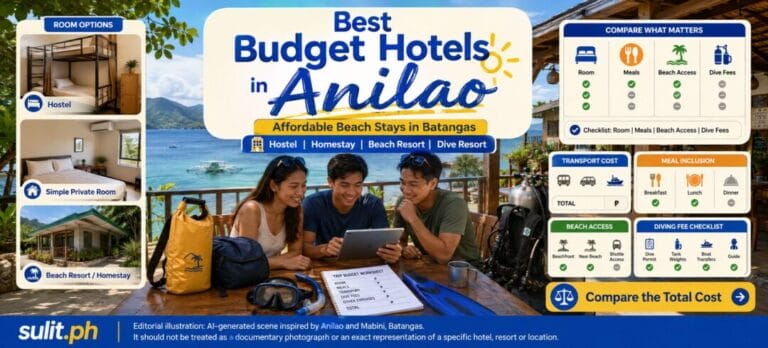
If Metro Manila hotel pricing is what you actually need next, our budget staycations near Manila guide has three verified picks under ₱3,000 a night. Heading somewhere with a beach instead, our budget hotels in Anilao roundup covers that ground. If your trip involves a flight, it’s worth also checking whether travel insurance is worth it for your specific trip before you book anything non-refundable. And if the “too good to be true” instinct in this guide was useful, our Facebook Marketplace scams guide covers the same red flags applied to buying and selling instead of booking a stay. For more of this kind of value-first breakdown, head back to more sulit finds.
Verified Sources Used
Republic Act No. 12023, via LawPhil: Confirmed the law brings non-resident digital service providers — including online marketplace and online platform categories — under a 12% VAT on services consumed in the Philippines, signed October 2, 2024.
Republic Act No. 11360, via LawPhil: Confirmed the Service Charge Law requires 100% distribution of collected service charges to covered hotel and restaurant employees, and that the law governs distribution rather than fixing the charge’s rate.
DILG Region IV-A (CALABARZON): Confirmed the PNP and DILG’s October 2025 public warning about fraudulent Airbnb listings and “rent-tangay” vehicle rental scams during the Undas travel season, including the PNP spokesperson’s quoted advice.
PwC Philippines: Confirmed the 12% VAT on digital services under Republic Act No. 12023 took effect for covered providers in June 2025.