
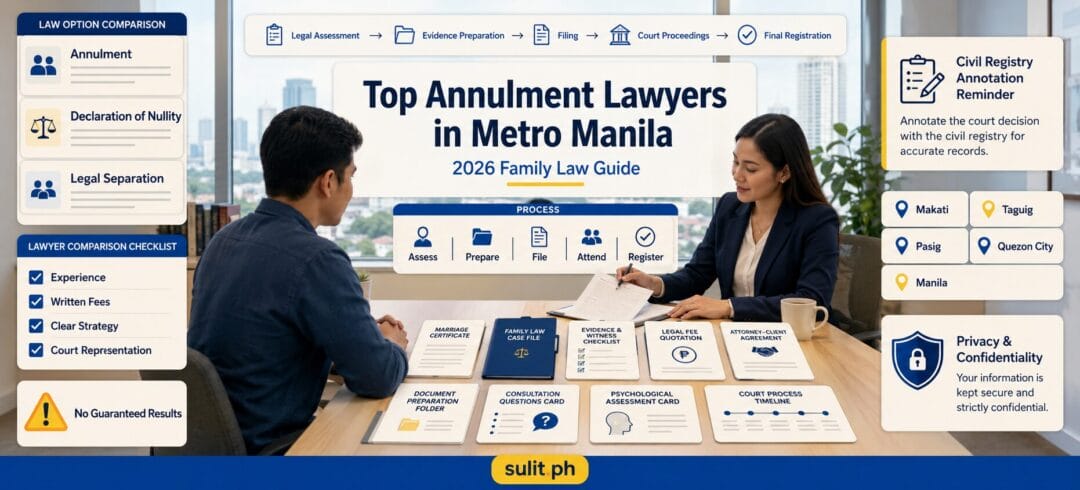
Top Annulment Lawyers and Family Law Firms in Metro Manila: 2026 Guide
Finding the right annulment lawyer in Metro Manila means choosing a lawyer who understands Philippine family law, can identify the correct legal remedy, explains the evidence required and provides a written breakdown of legal fees. No lawyer can ethically guarantee that an annulment or declaration of nullity will be granted because the final decision belongs to the court.
This guide presents Metro Manila law firms with publicly documented family-law or annulment services. The firms are listed for comparison, not ranked by success rate, reviews or number of cases won. Verified success-rate data for individual Philippine annulment lawyers is generally not publicly available.
The article follows the directory, cost, selection and process topics identified in the supplied content brief. It also applies the verification, link and editorial safeguards in the Sulit.ph publishing prompt.
Legal disclaimer: This guide provides general information and is not a substitute for advice from a Philippine lawyer who has reviewed your circumstances and documents.
Annulment lawyers in Metro Manila at a glance
| Law firm | Office area | Publicly listed family-law services | Useful for |
|---|---|---|---|
| Duran & Duran-Schulze Law | BGC, Taguig | Annulment, declaration of nullity, legal separation, child custody, child support and foreign divorce recognition | Clients seeking a firm that prominently publishes family-law guidance |
| Nicolas & De Vega Law Offices | Ortigas Center, Pasig | Family law, estate planning, succession and civil litigation | Cases that may involve family law, property, succession or related civil issues |
| DivinaLaw | Makati | Annulment, declaration of nullity, domestic relations, custody and property settlements | Cases needing access to a larger full-service litigation team |
Important: Confirm the assigned lawyer, legal strategy, fees, inclusions and current office schedule directly with the firm before signing an engagement agreement.
Understanding annulment law in the Philippines
The word annulment is commonly used to describe several different court proceedings that affect a marriage. Legally, however, annulment and declaration of nullity are not the same.
Annulment of a voidable marriage
A voidable marriage is considered valid unless and until a court annuls it. Article 45 of the Family Code provides grounds that must have existed at the time of marriage, including:
- Lack of required parental consent for a party aged 18 to below 21 at the time of marriage
- Unsoundness of mind
- Consent obtained through fraud
- Consent obtained through force, intimidation or undue influence
- Physical incapacity to consummate the marriage that appears incurable
- A serious and apparently incurable sexually transmissible disease
These grounds, their prescriptive periods and the person entitled to file must be carefully assessed by a lawyer. The complete rules are found in the Philippine Family Code.
Declaration of absolute nullity
A declaration of nullity concerns a marriage that was void from the beginning. One commonly invoked ground is psychological incapacity under Article 36 of the Family Code.
The Supreme Court’s decision in Tan-Andal v. Andal clarified that psychological incapacity is a legal concept and does not have to be proven as a medically diagnosed personality disorder. The petitioner must still establish the incapacity through clear and convincing evidence and show that it is grave, enduring and rooted in the spouse’s personality structure.
Psychological incapacity is not simply:
- Infidelity
- Incompatibility
- Abandonment
- Refusal to provide support
- Frequent arguments
- A long period of separation
- Failure of the marriage
Those facts may form part of the evidence, but the lawyer must connect them to the legal requirements under Article 36.
Legal separation
Legal separation permits spouses to live separately and may affect property relations, but it does not dissolve the marriage bond. A legally separated person cannot remarry while the marriage remains legally existing.
Church annulment
A Catholic Church declaration of nullity concerns the sacramental or canonical status of the marriage. It does not automatically change a person’s civil status in Philippine government records.
A civil court judgment and the required registration process are still needed to update the civil marriage record.
Metro Manila annulment and family-law firms to compare
1. Duran & Duran-Schulze Law
Duran & Duran-Schulze Law is a BGC-based law firm that publicly lists annulment, declaration of nullity, legal separation, foreign divorce recognition, child custody and child support among its family-law services. Its website contains dedicated guides concerning annulment requirements, procedure, appearances and estimated costs.
Office: Unit 1006, One World Place, 32nd Street, Bonifacio Global City, Taguig City
Published contact numbers: (02) 8478 5826 and +63 917 194 0482
Email: info@duranschulze.com
Published office hours: Monday to Friday, 8:00 a.m. to 5:00 p.m.
Links
What to ask during consultation
Ask whether the quoted fee covers:
- Initial case evaluation
- Drafting and filing the petition
- Court appearances
- Pre-trial and trial preparation
- Witness preparation
- Coordination with a psychologist, when relevant
- Publication or service expenses
- Registration of the final judgment and decree
- Property, custody and support issues
A dedicated family-law practice can be useful when the case involves several connected issues, but you should still confirm which lawyer will personally handle your hearings.
2. Nicolas & De Vega Law Offices
Nicolas & De Vega Law Offices is a full-service law firm in Ortigas Center, Pasig. Its published practice areas include family law, estate planning, wills, succession and civil litigation. The firm also maintains an extensive collection of Philippine legal articles, including material on annulment and related family-law questions.
Office: 16th Floor, Suite 1607, AIC Burgundy Empire Tower, ADB Avenue, Ortigas Center, Pasig City
Main published telephone: (02) 8470 6126
Email: info@ndvlaw.com
Published office hours: Monday to Friday, 8:30 a.m. to 5:30 p.m.
Links
Who may consider this firm
The firm may be relevant when an annulment or nullity case overlaps with:
- Property liquidation
- Inheritance or succession questions
- Estate planning
- Child support
- Custody
- Other civil litigation
Ask whether a specific family-law or litigation lawyer will be assigned and whether the quoted fee includes property and custody disputes.
3. DivinaLaw
DivinaLaw is a full-service law firm with a principal office in Makati. Its litigation practice publicly identifies family-law services involving domestic violence, protective orders, legal separation, annulment, declaration of nullity, property settlements, adoption, paternity, filiation and custody.
Office: 8th Floor, Pacific Star Building, Makati Avenue corner Gil Puyat Avenue, Makati City
Published telephone: (02) 8822 0808
Links
Who may consider this firm
A larger full-service firm may be worth considering when a family-law dispute includes:
- Significant property holdings
- Business interests
- Complex custody issues
- Protective orders
- Related civil or criminal proceedings
- Estate and succession concerns
Larger firms may assign different lawyers to research, pleading preparation and hearings. Ask who will be the primary lawyer and how communication will be handled.
How were these law firms selected?
The firms were included because current public information showed several of the following:
- A Metro Manila office
- A functioning official website
- Published contact information
- A visible family-law, annulment or litigation practice
- Publicly accessible educational material
- An official or verifiable Facebook presence
- A specific office location that can be checked on Google Maps
The list is not a claim that these are the only qualified lawyers in Metro Manila. It is also not based on undisclosed referral fees, claimed success rates or unverified online ratings.
A competent solo practitioner or smaller family-law office may provide more direct attention and a lower fee than a larger firm. The proper choice depends on your case, budget and level of complexity.
How much does an annulment lawyer cost in Metro Manila?
One BGC law firm’s July 2026 cost guide estimates that annulment expenses commonly fall between ₱300,000 and ₱500,000, with complicated, contested or high-value cases potentially exceeding ₱1 million. The same published guide states that attorney acceptance fees may begin around ₱150,000 and increase substantially depending on the firm and complexity. These are published planning estimates from one firm, not regulated or universal Philippine rates.
Possible components of the total cost
| Expense | What it may cover |
|---|---|
| Consultation fee | Initial review of facts, documents and possible legal grounds |
| Acceptance fee | Engagement of the lawyer and initial case preparation |
| Pleading preparation | Drafting the petition, affidavits and related submissions |
| Filing and court fees | Official fees assessed when the case is filed |
| Appearance fees | Lawyer’s attendance during hearings |
| Psychological assessment | Evaluation, report and possible expert testimony when relevant |
| Publication expenses | Publication when ordered or procedurally required |
| Service and mailing | Delivery, summons, notices and document transmission |
| Documentary expenses | Certified copies, notarisation and civil-registry records |
| Post-judgment registration | Recording the decision and decree with relevant civil registries |
| Property or custody litigation | Additional work involving assets, children or support |
Request a written quotation
Do not rely on a verbal “package price.” Ask for a written engagement letter stating:
- The acceptance fee.
- The payment schedule.
- The number of included hearings.
- The appearance fee after the included hearings.
- Whether psychological-evaluation expenses are included.
- Whether publication, filing, transportation and mailing are included.
- Whether appeals are included.
- Whether property, custody and support issues are included.
- Whether post-judgment registration is included.
- What happens to paid fees if you discontinue the case.
A suspiciously low price may exclude most court appearances or essential expenses.
Can the Public Attorney’s Office handle an annulment case?
The Public Attorney’s Office may provide legal assistance to qualified indigent or otherwise eligible clients, subject to its merit and indigency requirements, conflict checks, staffing and current operating rules.
Applicants should prepare proof of income or indigency and personally ask the appropriate PAO district office whether the case falls within its services. The Supreme Court’s Unified Legal Aid Service also supports access to legal assistance for people who cannot afford private representation.
Do not assume that a certificate of indigency automatically guarantees representation. The office must still evaluate eligibility, legal merit and possible conflicts.
Possible alternatives include:
- PAO district offices
- Integrated Bar of the Philippines legal-aid programmes
- Law-school legal-aid clinics
- Supreme Court Unified Legal Aid Service initiatives
- Local government legal-assistance programmes
How to choose the right annulment lawyer
1. Start with the correct legal remedy
A lawyer should first determine whether the facts point to:
- Annulment of a voidable marriage
- Declaration of nullity
- Legal separation
- Recognition of a foreign divorce
- Correction or cancellation of a civil-registry entry
- A custody, support or property case
- No presently available ground
Be careful with anyone who labels every case as “psychological incapacity” before reviewing the history and evidence.
2. Ask about actual family-court experience
Useful questions include:
- How frequently do you handle annulment or nullity cases?
- Who will appear in court?
- Have you handled cases in the court where the petition may be filed?
- How do you determine whether Article 36 applies?
- What witnesses may be needed?
- What evidence is currently missing?
- What weaknesses do you see in my case?
- Could the court dismiss or deny the petition?
- What happens if my spouse contests the case?
- How will property, custody and support be handled?
The lawyer should be willing to discuss weaknesses, not merely promise a positive result.
3. Evaluate communication
Choose someone who explains:
- The proposed legal ground
- The evidence needed
- The expected steps
- The risks
- The fees
- The possible timeline
- Your responsibilities as the client
You should know whether updates will come directly from the lawyer, an associate, a secretary or a case-management team.
4. Confirm the lawyer’s identity
Before paying:
- Request the lawyer’s complete name.
- Check that the lawyer is authorised to practise.
- Contact the firm using details on its official website.
- Avoid transferring money to an unrelated personal account.
- Request an official receipt or acknowledgement.
- Read the engagement letter carefully.
- Keep copies of payments and communications.
5. Compare at least two consultations
A second opinion is especially useful when:
- The proposed grounds differ
- The lawyer guarantees approval
- The fee quotation is unclear
- A large upfront payment is demanded immediately
- The lawyer advises you to invent facts or witnesses
- The case involves substantial property or child-custody issues
Red flags when hiring an annulment lawyer
Walk away from a lawyer, fixer or agent who:
- Guarantees a successful decision
- Claims to control the judge, prosecutor or court staff
- Promises a secret “non-appearance” process
- Encourages false testimony
- Offers fabricated psychological reports
- Refuses to identify the responsible lawyer
- Will not provide an engagement agreement
- Demands payment without a receipt
- Uses only a personal social-media account
- Claims that prolonged separation alone guarantees annulment
- Promises an unrealistically fast result
- Advises you to use a false address to choose a supposedly favourable court
The Supreme Court’s rules impose residency and venue requirements. A petition should not be filed in a location chosen merely because someone believes its judges are more likely to grant the case.
What to prepare for the first consultation
Bring available copies of:
- PSA Certificate of Marriage
- Birth certificates of the spouses
- Birth certificates of the children
- Government-issued identification
- Proof of current residence
- A chronological history of the relationship
- Details of the courtship and circumstances before marriage
- Medical or psychological records, when legally relevant
- Messages, emails, letters or photographs that may support the history
- Police, barangay or medical records involving violence or abuse
- Financial and property records
- Previous legal documents or protection orders
- Information about witnesses
- Details of any foreign citizenship or foreign divorce
- A list of questions and desired outcomes
Do not secretly edit, fabricate or manipulate evidence. Give your lawyer the complete story, including facts that may weaken your case.
What happens during an annulment or nullity case?
The exact procedure depends on the remedy and circumstances, but a case usually involves the following stages.
1. Legal assessment
The lawyer reviews the facts, dates, documents, residence, witnesses and possible legal grounds.
2. Evidence preparation
The petitioner works with counsel to organise the marital history and supporting evidence. A psychological assessment may be considered in an Article 36 case, depending on the legal strategy and available evidence.
3. Drafting and filing
The petition is prepared and filed in the proper Regional Trial Court acting as a Family Court.
Since 2025, the Supreme Court has required electronic filing and service for annulment and nullity cases under the expanded electronic-filing rules.
4. Summons and participation of government counsel
The respondent must be served according to procedural rules. The public prosecutor investigates whether the spouses are colluding to obtain a judgment improperly.
The Office of the Solicitor General may also participate to protect the State’s interest in marriage.
5. Pre-trial
The court identifies the issues, evidence and witnesses and establishes how the trial will proceed.
6. Trial and testimony
The petitioner and relevant witnesses present evidence. The respondent may contest the petition. Expert testimony may be presented when necessary.
A petitioner should expect to participate personally. A law firm’s published guidance notes that court testimony is generally required, though an overseas petitioner may ask the court about authorised remote or consular arrangements when legally available.
7. Court decision
The judge assesses whether the legal ground has been proven under the required standard.
No amount paid to a lawyer guarantees approval.
8. Finality and decree
A favourable decision must become final. The appropriate decree and other required documents must then be issued and registered.
9. Civil-registry annotation
The judgment and decree must be registered with the Local Civil Registrar and processed for annotation in Philippine Statistics Authority records. PSA advises applicants to coordinate with the local civil registry where the marriage was registered and confirm that the supporting documents have been forwarded for annotation.
Do not assume that a favourable decision alone has completed the process. Confirm that your PSA marriage record has been properly annotated before relying on your updated civil status.
How long does the process take?
There is no guaranteed Metro Manila timeline.
A law firm’s updated public guidance estimates that cases may take approximately two to four years, with some straightforward cases potentially concluding sooner. Court congestion, service problems, contested facts, witness availability, psychological evidence, changes of counsel, appeals and registration delays can extend the process.
Treat any promised completion date as an estimate, not a guarantee.
Ask the lawyer for:
- The expected filing date
- The usual interval between hearings
- Known court-calendar conditions
- Possible service problems
- The effect of a contest
- The expected post-decision registration period
How to strengthen a legitimate case
There is no lawful shortcut or guaranteed “winning strategy.” A properly prepared case normally depends on:
Consistent and truthful testimony
Contradictions between the petition, affidavits, testimony and documents can damage credibility.
Evidence connected to the legal ground
The lawyer must show how facts satisfy the specific legal elements. General proof of an unhappy or failed marriage is not always enough.
Reliable witnesses
Witnesses should have direct knowledge of relevant behaviour or circumstances. A witness who only learned information from the petitioner may carry less evidentiary value.
Proper venue and residency evidence
The filing location must comply with court rules. Residency certifications and supporting documents may be required.
Full disclosure to counsel
Tell your lawyer about:
- Previous cases
- Other relationships
- Property transfers
- Foreign citizenship
- Children
- Agreements with your spouse
- Communication that contradicts your claims
- Facts the respondent may use against you
A surprise during trial can be more damaging than a difficult fact addressed during preparation.
Frequently asked questions
Can a spouse stop an annulment by refusing to sign?
A spouse’s refusal to agree does not automatically stop a court case. Annulment and nullity are judicial proceedings, not private contracts requiring both spouses’ consent. The respondent must still receive proper notice and may contest the petition.
Is infidelity a ground for annulment?
Infidelity by itself is not automatically an Article 45 ground for annulment or sufficient proof of psychological incapacity. It may be relevant evidence depending on the complete facts and legal theory.
Is five or ten years of separation enough?
No. Lengthy separation does not independently dissolve a Philippine marriage and does not automatically establish a statutory ground.
Is a psychological report always required?
Not necessarily in every case. Under modern Article 36 jurisprudence, psychological incapacity is a legal concept rather than a medical diagnosis. The evidence required depends on the case. A lawyer should explain why expert evaluation or testimony would materially assist the petition.
Can I file without a lawyer?
A person may theoretically represent themselves, but annulment and nullity proceedings involve substantive family law, venue rules, specialised pleadings, evidence and trial procedure. Legal representation is strongly advisable.
Can the process be completed without appearing in court?
Do not assume so. The petitioner will ordinarily need to testify and participate. Any remote-hearing request must be approved under applicable court rules.
Are children made illegitimate after annulment?
The effect on children depends on the legal ground and applicable Family Code provisions. Do not rely on a general online answer. Ask counsel to explain the consequences for legitimacy, custody, support and inheritance in your specific proceeding.
Can I remarry immediately after receiving the decision?
No. Confirm that the judgment is final, the required decree has been issued and the civil-registry and PSA annotation requirements have been completed.
Do annulment lawyers provide free consultations?
Some lawyers offer brief introductory calls, while others charge consultation fees. Confirm the fee, duration and scope before the appointment.
What is the success rate of annulment cases?
No dependable public database was found showing lawyer-by-lawyer success rates for Metro Manila. Treat advertised percentages cautiously unless the firm explains the data source, time period, case definition and total sample.
Final checklist before choosing a lawyer
Choose a lawyer only after you can answer yes to these questions:
- Is the lawyer’s identity verified?
- Does the lawyer regularly handle family-court cases?
- Has the lawyer explained the correct remedy?
- Has the lawyer discussed weaknesses and risks?
- Is the fee structure written and understandable?
- Are appearance and expert fees clearly stated?
- Do you know who will personally handle the case?
- Is there a realistic communication and update system?
- Have you received a formal engagement agreement?
- Have you compared at least one other qualified lawyer?
The most suitable lawyer is not automatically the biggest firm, the cheapest lawyer or the first person who promises a fast result. Choose the lawyer who gives you the clearest legal assessment, the most transparent fee arrangement and the most credible plan for presenting truthful evidence.