What Is Philippine Standard Time? PST and UTC+8 Guide
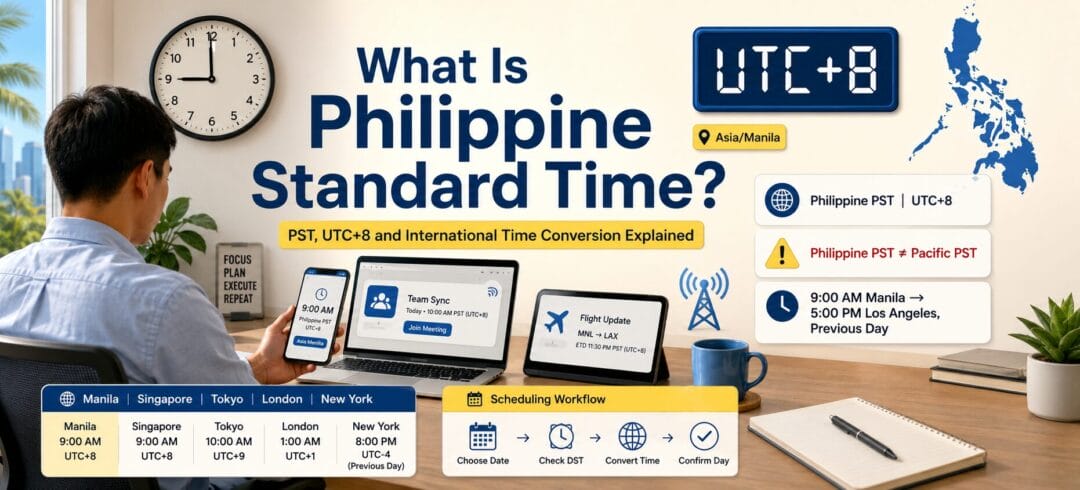
Philippine Standard Time is the official time used throughout the Philippines. It is eight hours ahead of Coordinated Universal Time, written as UTC+8. The country follows one national time zone across Luzon, Visayas, and Mindanao and does not currently change its clocks for daylight saving time.
PST can be confusing because the same abbreviation is also used for Pacific Standard Time in North America. When communicating internationally, use Philippine Standard Time, PhST, PHT, UTC+8, or Asia/Manila to make the intended time zone clear.
Philippine Standard Time at a Glance
| Question | Answer |
|---|---|
| What does PST mean in the Philippines? | Philippine Standard Time |
| What is its UTC offset? | UTC+08:00 |
| How far ahead is it from GMT? | Eight hours |
| Does the Philippines use daylight saving time? | No |
| Who maintains the official time? | PAGASA |
| Does the entire country use the same time? | Yes |
| What computer time-zone identifier is commonly used? | Asia/Manila |
| Is it the same as Pacific Standard Time? | No |
Republic Act No. 10535 established Philippine Standard Time for official sources throughout the country. It requires government agencies and television and radio stations to synchronize their timekeeping with the official national standard maintained through the Department of Science and Technology and PAGASA.
Understanding Philippine Standard Time
Philippine Standard Time is the national clock reference used for government transactions, business schedules, transport departures, school hours, broadcasts, online services, and everyday activities in the Philippines.
Its offset is written as:
Philippine Standard Time = UTC + 8 hours
When it is 12:00 noon in UTC, it is 8:00 p.m. in the Philippines.
When it is 12:00 midnight in the Philippines, it is 4:00 p.m. UTC on the previous calendar day.
The entire Philippine archipelago uses this single time zone. Manila, Cebu, Davao, Baguio, Iloilo, Zamboanga, Iligan, Palawan, Batanes, and other parts of the country display the same official clock time.
Why UTC+8?
The Philippines is geographically located east of the prime meridian in a region suited to a time offset close to eight hours ahead of UTC. Using UTC+8 also places the country on the same civil time as several major East and Southeast Asian economies.
Locations that use UTC+8 for all or part of the year include:
- Singapore
- Malaysia
- Brunei
- Hong Kong
- Macau
- Taiwan
- China
- Parts of Indonesia
- Western Australia
Sharing the same clock time does not mean these locations have identical sunrise, sunset, business, or holiday schedules. Their legal systems and operating hours remain separate.
Why Does the Philippines Use One Time Zone?
The Philippines spans many islands and several degrees of longitude, but the geographic difference is not large enough to justify multiple civil time zones.
A single national time zone provides several practical advantages:
- Government offices can coordinate using one clock.
- Airlines, ferries, buses, schools, and banks can publish nationwide schedules consistently.
- National television and radio programs can operate without regional time conversions.
- Businesses can coordinate branches in Luzon, Visayas, and Mindanao more easily.
- Emergency alerts and public announcements can use a single national timestamp.
Solar noon does not occur at precisely the same moment in the easternmost and westernmost parts of the Philippines. Civil time is a shared national standard, not a separate measurement of the Sun’s position in each locality.
History of Timekeeping in the Philippines
Philippine timekeeping has changed alongside the country’s trade relationships, government systems, and technology.
Local solar time before national standardization
Before standardized time zones became common, communities set clocks according to the local position of the Sun. Places at different longitudes could therefore have slightly different local times.
This system became difficult as railways, shipping, telecommunications, government administration, and international trade required synchronized schedules.
The Philippines skipped December 31, 1844
During much of the Spanish colonial period, the Philippines followed the American side of the calendar because of its historical administrative and trading relationship with Mexico.
Governor-General Narciso Clavería ordered the country to align its calendar with neighboring Asian territories. Monday, December 30, 1844, was followed directly by Wednesday, January 1, 1845. December 31, 1844, did not occur in the Philippine calendar.
This was a calendar adjustment of one full day. It was not the same as the modern one-hour changes associated with daylight saving time.
Standard time and daylight-saving experiments
The Philippines eventually adopted a standardized national time close to its present UTC+8 offset.
The country has also experimented with advancing clocks by one hour during selected periods. Historical applications included periods in:
- 1936 to 1937
- 1954
- 1978
- 1990
In 1990, daylight saving time was introduced as part of an emergency energy-conservation program. Executive Order No. 415 later ended the program effective July 28, 1990, directing clocks to be adjusted one hour earlier.
These were temporary government measures. They did not become an annual seasonal system comparable to the clock changes still used in parts of North America and Europe.
The Philippine Standard Time Act of 2013
Republic Act No. 10535, known as the Philippine Standard Time Act of 2013, was signed on May 15, 2013.
The law established Philippine Standard Time for official sources and directed government offices to display and follow the national standard. It also covered synchronization by television and radio stations and declared the first week of every year as National Time Consciousness Week.
The law was designed to reduce inconsistent timekeeping across official institutions and promote punctuality in government, broadcasting, business, and public life.
How Philippine Standard Time Works
Modern time zones are expressed as offsets from Coordinated Universal Time, or UTC.
UTC is the global reference used to synchronize clocks, telecommunications systems, computers, navigation systems, and scientific operations.
Philippine Standard Time uses a fixed offset:
UTC time + 8 hours = Philippine Standard TimeBasic conversion examples
| UTC | Philippine time |
|---|---|
| 12:00 a.m. | 8:00 a.m. |
| 4:00 a.m. | 12:00 noon |
| 8:00 a.m. | 4:00 p.m. |
| 12:00 noon | 8:00 p.m. |
| 4:00 p.m. | 12:00 midnight the next day |
| 8:00 p.m. | 4:00 a.m. the next day |
The calendar date matters when converting late-afternoon or evening UTC times because the Philippine date can already be one day ahead.
How PAGASA maintains official time
The Philippine Atmospheric, Geophysical and Astronomical Services Administration maintains and disseminates the national time through its astronomical and timekeeping facilities.
PAGASA’s time-scale system supports Philippine Standard Time and can distribute synchronized time through Network Time Protocol. NTP allows computers and connected devices to synchronize their clocks through a network.
For most users, a phone or computer set to automatic time obtains synchronized information from its mobile network, operating system, or internet time server.
Philippine PST vs Pacific PST
The abbreviation PST has two common meanings:
| Abbreviation | Full name | UTC offset |
|---|---|---|
| PST in the Philippines | Philippine Standard Time | UTC+8 |
| PST in North America | Pacific Standard Time | UTC−8 |
These two time zones are 16 hours apart when the west coast of North America is observing Pacific Standard Time.
For example:
- 9:00 a.m. Philippine time is 5:00 p.m. Pacific Standard Time on the previous day.
- 9:00 a.m. Pacific Standard Time is 1:00 a.m. Philippine time on the following day.
The difference changes to 15 hours when places such as California observe Pacific Daylight Time, which is UTC−7.
How to avoid the abbreviation problem
For international invitations, contracts, webinars, ticket sales, or online events, use:
9:00 a.m. Philippine Standard Time9:00 a.m. PhST9:00 a.m. PHT9:00 a.m. UTC+89:00 a.m. Asia/Manila
Using only “PST” can cause someone in North America to interpret the schedule as Pacific time.
Philippine Time Compared With Major Time Zones
The following differences apply when the other location is observing the stated standard time.
| Time zone or city | Standard UTC offset | Philippines is |
|---|---|---|
| UTC or GMT | UTC+0 | 8 hours ahead |
| London during GMT | UTC+0 | 8 hours ahead |
| Central European Time | UTC+1 | 7 hours ahead |
| Eastern Standard Time | UTC−5 | 13 hours ahead |
| Central Standard Time | UTC−6 | 14 hours ahead |
| Mountain Standard Time | UTC−7 | 15 hours ahead |
| Pacific Standard Time | UTC−8 | 16 hours ahead |
| India Standard Time | UTC+5:30 | 2 hours 30 minutes ahead |
| Thailand | UTC+7 | 1 hour ahead |
| Vietnam | UTC+7 | 1 hour ahead |
| Singapore | UTC+8 | Same time |
| Kuala Lumpur | UTC+8 | Same time |
| Hong Kong | UTC+8 | Same time |
| Tokyo | UTC+9 | 1 hour behind |
| Seoul | UTC+9 | 1 hour behind |
Some countries change their clocks during the year. Always check the date when converting between Philippine time and cities in the United States, Canada, Europe, Australia, or New Zealand.
Sample international meeting conversions
| Meeting in Manila | Corresponding standard time |
|---|---|
| 8:00 a.m. | 12:00 midnight UTC |
| 9:00 a.m. | 8:00 a.m. Bangkok |
| 10:00 a.m. | 11:00 a.m. Tokyo |
| 1:00 p.m. | 5:00 a.m. London during GMT |
| 9:00 p.m. | 8:00 a.m. New York during EST |
| 10:00 p.m. | 6:00 a.m. Los Angeles during PST |
For recurring meetings, do not assume that the time difference will remain fixed. Manila stays on UTC+8, but the overseas participant’s location can move into or out of daylight saving time.
Why the Philippines Does Not Regularly Use Daylight Saving Time
Daylight saving time moves clocks forward to shift an hour of daylight from the morning to the evening.
The system is most relevant in places where the length of daylight changes considerably between winter and summer. The Philippines is located near the equator, where seasonal daylight variation is smaller than in countries farther north or south.
That reduces the practical reason for changing the national clock twice each year.
The Philippines currently remains on UTC+8 throughout the year. Current time-zone records show that clocks do not change seasonally, though the country used temporary daylight-saving arrangements in the past.
Maintaining a fixed time also avoids:
- Missed appointments during clock changes
- Transport and broadcast scheduling errors
- Software and server timestamp problems
- Confusion involving international meetings
- Disruption to sleep and household routines
A future change would require a clear government directive. It should never be assumed from daylight-saving changes announced in another country.
Practical Uses of Philippine Standard Time
Scheduling remote work
For remote teams, save the Philippine time zone as Asia/Manila in the calendar platform.
A useful meeting invitation should show:
Project Meeting
July 20, 2026
9:00 a.m. Asia/Manila
UTC+8
Calendar systems can then convert the event for each participant based on location and date.
Coordinating with US clients
Philippine evening hours frequently overlap with morning business hours in North America.
For example, a Manila-based worker handling a US account can begin an evening shift as the client’s workday begins. The exact overlap changes when the US enters or leaves daylight saving time.
Create separate calendar schedules for:
- US standard time
- US daylight time
- Transition weeks when the offset changes
Planning international travel
Before flying, compare:
- Departure time zone
- Arrival time zone
- Flight duration
- Arrival date
- Local hotel check-in time
A flight can depart on one date and arrive on the next date even when its duration is less than 24 hours.
Set your phone to automatic date and time after arrival, but keep the original departure time visible until all connections are completed.
Managing websites and digital campaigns
Website publishing systems, analytics platforms, advertising accounts, and e-commerce stores do not always use the same time zone.
Check the account setting before interpreting:
- Daily traffic reports
- Campaign start and end times
- Flash-sale schedules
- Order timestamps
- Social-media publishing times
- Server logs
- Webinar registrations
A campaign scheduled for midnight UTC begins at 8:00 a.m. in the Philippines.
Booking flights, buses, and events
Domestic transport and event times are normally displayed in local Philippine time unless the operator states otherwise.
For an international booking, confirm:
- Whether the displayed time is local to the departure city
- Whether the arrival time is local to the destination
- Whether daylight saving time applies
- Whether the calendar date changes during the trip
Official Time vs “Filipino Time”
Philippine Standard Time is an official national time standard. “Filipino time” is a cultural expression associated with arriving later than the announced schedule.
They are not interchangeable concepts.
A meeting announced for 2:00 p.m. Philippine Standard Time is officially scheduled for 2:00 p.m. Delayed attendance does not create another time zone or change the meaning of PST.
Republic Act No. 10535 and National Time Consciousness Week support synchronized timekeeping and punctuality in official and public settings.
Common Philippine Time Mistakes
Writing PST without context
Someone in the United States can read PST as Pacific Standard Time. Add “Philippine,” “UTC+8,” or “Asia/Manila.”
Forgetting the date difference
When it is morning in Manila, it can still be the previous calendar day in the Americas.
Assuming all countries change clocks together
Daylight-saving dates differ by country. Some locations do not change clocks at all.
Manually setting a phone clock
Manual clocks can drift or remain incorrect after travel. Use automatic network-provided time when possible.
Converting a recurring meeting only once
An overseas location’s daylight-saving transition can shift the meeting by one hour even though Philippine time remains unchanged.
Frequently Asked Questions
What does PST stand for in the Philippines?
PST stands for Philippine Standard Time. To avoid confusion with Pacific Standard Time, the abbreviations PhST, PHT, or the label UTC+8 can also be used.
Is Philippine Standard Time the same as Pacific Standard Time?
No. Philippine Standard Time is UTC+8. Pacific Standard Time is UTC−8. They are 16 hours apart when Pacific Standard Time is active.
Does the Philippines change time zones during the year?
No. The Philippines currently follows UTC+8 throughout the year and does not make annual daylight-saving clock changes.
What countries have the same time as the Philippines?
Singapore, Malaysia, Brunei, China, Taiwan, and several other locations use UTC+8. Some countries contain several time zones, so the rule does not cover every part of each country.
How many hours ahead is Philippine time from GMT?
Philippine Standard Time is eight hours ahead of GMT when GMT is being used as UTC+0.
Why does the Philippines use only one time zone?
Its geographic east-to-west span does not require several civil time zones. One national time keeps government, business, transport, school, and broadcast schedules consistent.
Is Manila time the same as Philippine time?
Yes. Manila uses the same UTC+8 time observed throughout the Philippines.
What should I select on my phone or computer?
Select Philippines, Manila, Asia/Manila, PHT, or UTC+8, depending on the available choices.
Is Philippine Standard Time always eight hours ahead of London?
It is eight hours ahead when London uses GMT or UTC+0. It is seven hours ahead when London observes British Summer Time at UTC+1.
What is the clearest way to publish a Philippine event time?
Use the full date, time and zone:
July 20, 2026, at 3:00 p.m. Philippine Standard Time (UTC+8)
This format reduces confusion for international readers.
Final Time-Conversion Checklist
Before confirming an international schedule:
- Write the complete date.
- Label Philippine time as UTC+8 or Asia/Manila.
- Check whether the other location observes daylight saving time.
- Confirm whether the converted time falls on the previous or next day.
- Use a calendar system that converts time zones automatically.
- Recheck recurring meetings when another country changes its clocks.
Philippine Standard Time provides one consistent clock for the entire country. The most important rule for international communication is simple: do not rely on “PST” alone. Write Philippine Standard Time, UTC+8, or Asia/Manila.