Learning gay lingo a starter guide
Most Common Gay Lingo Words in the Philippines
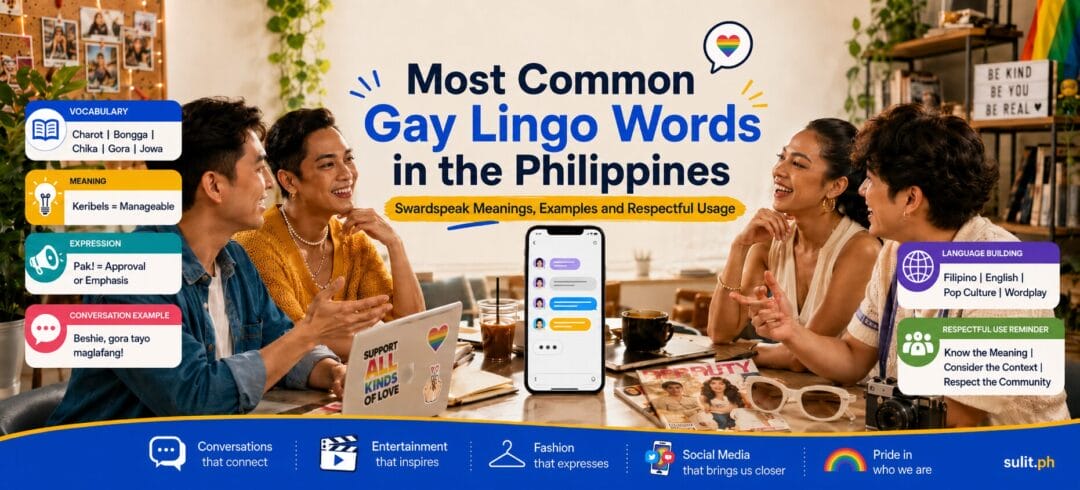
Filipino gay lingo, commonly called Swardspeak, gayspeak, bekimon, or salitang beki, is a creative and constantly changing form of speech associated with LGBTQ+ communities in the Philippines. Common expressions include charot for “just kidding,” bongga for something fabulous, gora for “go,” jowa for a romantic partner, lafang for eating, and chika for news or gossip.
Many of these words have moved beyond LGBTQ+ circles and are now heard in everyday conversations, entertainment, workplaces, group chats, and social media. Their wider popularity does not erase where they came from. Understanding that cultural origin helps people use the language with greater accuracy and respect.
Swardspeak combines Filipino languages with English, Spanish, Japanese, popular culture, celebrity names, sound changes, abbreviations, invented suffixes, and playful word associations. Researchers describe relationship-building, concealment, identity, and self-expression as some of the reasons people use it.
Quick Guide to Common Filipino Gay Lingo
Meanings can change according to tone, generation, location, and friend group. This table gives the most widely recognized everyday interpretations.
| Gay lingo word | Common meaning | Simple example |
|---|---|---|
| Beki | Gay person or gay friend; sometimes gay speech | “Marunong ka bang mag-beki?” |
| Beshie | Best friend or close friend | “Beshie, nasaan ka?” |
| Bongga | Fabulous, extravagant or impressive | “Bongga ang outfit mo.” |
| Charot | Just kidding or not entirely serious | “Ako ang pinakamaganda, charot!” |
| Chika | Story, news, conversation or gossip | “Ano ang latest chika?” |
| Chos | Kidding; similar to charot | “Mayaman na ako, chos.” |
| Gora | Go, leave or proceed | “Gora na tayo.” |
| Jowa | Romantic partner | “Kasama niya ang jowa niya.” |
| Keribels | Manageable; can be handled | “Keribels ko ang workload.” |
| Lafang | Eat or food consumption | “Lafang muna tayo.” |
| Pak | Expression of approval or emphasis | “Pak! Ang ganda!” |
| Awra | Presence, confidence or projected image | “Malakas ang awra niya.” |
| Shokot | Afraid or frightened | “Mashokot ako sa dilim.” |
| Wit | No, not or none | “Wit akong budget ngayon.” |
| Junakis | Child or children | “Kasama niya ang mga junakis.” |
| Mudra | Mother | “Dumating na si mudra.” |
| Fudra | Father | “Kausap ko si fudra.” |
| Anda | Money | “Wit na akong anda.” |
| Kalurkey | Shocking, overwhelming or unbelievable | “Kalurkey ang nangyari!” |
| Shunga | Foolish, confused or silly | “Shunga moment ko iyon.” |
| Eme | Filler, playful claim or “whatever” | “May meeting daw, eme.” |
| Ganern | Like that, that way or an emphatic ending | “Dapat ganern!” |
| Kyeme | Pretence, filler or unserious talk | “Drama lang iyon, kyeme.” |
| Jontis | Pregnant | “Jontis ang character sa show.” |
| Boylet | Boy, boyfriend or attractive young man | “Sino ang bagong boylet?” |
What Is Filipino Gay Lingo or Swardspeak?
Swardspeak is a Filipino social variety of language associated historically with gay men and other LGBTQ+ speakers. It is not a separate standardized language with one official dictionary or fixed grammar. It is better understood as a flexible and creative vocabulary layered onto Filipino, English, Taglish, Cebuano, and other languages used in the Philippines.
The word Swardspeak became associated with the language in the 1970s, when sward was a common label for a gay man. Research on Philippine media and LGBTQ+ history shows that Swardspeak provided speakers with a form of group identification and linguistic distinction during that period.
Its roots and vocabulary are broader than one decade. Academic discussions describe it as a coded form of expression that allowed gay communities to communicate freely, develop social bonds, affirm identity, and resist exclusion.
Swardspeak creates words through several techniques:
- Changing the first or final sound of an existing word
- Adding playful suffixes such as -ness, -els, -ora or -ification
- Combining Filipino and English
- Replacing words with celebrity names
- Using brands, places or public personalities through sound association
- Clipping words and adding new syllables
- Assigning an existing word a completely different meaning
A 2024 study of college students identified sound substitution, suffix addition, clipping, code-switching, imagery, and eponymy as recurring ways Swardspeak words are formed. The same research found its use in public places, texting, and social media, but less frequently in formal academic communication.
Essential Filipino Gay Lingo Words for Beginners
Beki
Beki commonly refers to a gay person, a member of the gay community, or the language associated with that community.
Pronunciation: BEH-kee
Examples:
- “Beki language ba iyon?”
- “Hello, mga beki!”
- “Marunong siyang magsalita ng bekimon.”
Use it carefully when referring to another person. Some LGBTQ+ Filipinos use beki comfortably and affectionately. Others prefer gay, queer, bakla, or a more specific identity label.
Beshie
Beshie means a close friend or best friend. Variations include besh, bes, beshiewap, and other extensions invented within a friend group.
Pronunciation: BEH-shee
“Beshie, may chika ako.”
The word is now common far beyond LGBTQ+ circles. It remains strongly associated with affectionate, informal conversation.
Charot
Charot signals that a statement is a joke, exaggeration, playful tease, or something the speaker does not want taken completely seriously.
Pronunciation: cha-ROT
“Ako talaga ang pinakamagaling dito, charot!”
People also use char, chos, chour, and chariz in similar ways. Tone matters. A softly delivered charot can make a statement playful, while a sharp delivery can make it sound sarcastic.
Bongga
Bongga describes something glamorous, elaborate, impressive, excessive, or attention-grabbing.
Pronunciation: BONG-gah
“Bongga ang birthday setup nila.”
It can praise a dress, event, performance, hairstyle, achievement, meal, or dramatic entrance.
Chika
Chika means conversation, news, story, update, or gossip.
Pronunciation: CHEE-kah
Common forms include:
- Makipagchikahan: to talk or catch up
- Chikahan: a conversation
- Chika minute: a quick update
- Latest chika: the latest news or gossip
“Beshie, ano ang latest chika?”
Gora
Gora means to go, leave, proceed, or start an activity.
Pronunciation: GOH-rah
“Ready na kami. Gora na!”
Related forms include gorabels, gorabells, and gorabelita. These extensions add personality but do not substantially change the meaning.
Jowa
Jowa means a boyfriend, girlfriend, spouse, romantic partner, or person someone is dating.
Pronunciation: JOH-wah
“May jowa ka na ba?”
The word has become mainstream Filipino slang and is used across different genders and sexual orientations. It does not tell you the gender of the partner.
Lafang
Lafang means to eat, have a meal, or consume food.
Pronunciation: LAH-fang
“Pagkatapos ng meeting, maglafang tayo.”
The word can function as a verb or as a playful reference to eating.
Keribels
Keribels comes from carry and means something is manageable, possible, tolerable, or within one’s ability.
Pronunciation: KEH-ree-bels
“Kaya mo ba ang deadline?”
“Keribels!”
Other forms include keri, carry, and keri lang.
Wit
Wit means no, not, none, or without. Some speakers use witit, wittiz, or witchelles.
Pronunciation: weet
“May pera ka pa?”
“Wit na.”
The exact grammatical role depends on the sentence. It can replace hindi, wala, or another negative response.
Shokot
Shokot means afraid, nervous, or frightened.
Pronunciation: SHOH-kot
“Mashokot ako sa result.”
A common form is mashokot, meaning “to feel afraid.”
Awra
Awra refers to someone’s projected image, presence, confidence, mood, style, or energy.
Pronunciation: OW-rah
“Awra muna bago picture.”
To umawra means to pose, display confidence, make an entrance, or present oneself with intention. The word is related to the English word aura, but its everyday Filipino use has developed a broader performative meaning.
Pak
Pak is an expression of approval, emphasis, success, or impact.
Pronunciation: pak
“Pak! Naipasa mo ang exam.”
It can work like “Yes!”, “Perfect!”, “That’s it!” or “You did that!”
Kalurkey
Kalurkey expresses shock, disbelief, amusement, frustration, or emotional overload.
Pronunciation: kah-LUR-key
“Kalurkey ang presyo!”
The speaker’s tone tells you whether the reaction is positive, negative, or playful.
Eme
Eme can mean nonsense, pretence, filler, vague activity, exaggeration, or something the speaker does not want to explain fully.
Pronunciation: EH-meh
“May project-projectan at presentation eme kami.”
It can replace an unknown word or deliberately make a statement less serious.
Gay Lingo for People, Relationships and Appearance
Descriptions of people require extra care because some terms can be affectionate among friends but insulting when used by strangers.
| Term | Common meaning | Usage note |
|---|---|---|
| Jowa | Romantic partner | Gender-neutral in many conversations |
| Boylet | Boyfriend, boy or attractive younger man | Informal and sometimes objectifying |
| Beshie | Close friend | Affectionate |
| Mudra | Mother | Playful and informal |
| Fudra | Father | Playful and informal |
| Junakis | Child or children | Usually humorous or affectionate |
| Kikay | Feminine, stylish or interested in beauty | Meaning depends on tone |
| Pa-boy | Presenting or behaving in a masculine way | Can refer to style or manner |
| Shunga | Silly, foolish or confused | Can sound insulting |
| Jubis | Fat or having gained weight | Avoid using about another person without consent |
| Chaka | Unattractive, poorly made or disappointing | Can be hurtful when aimed at a person |
| Gandara | Beautiful or attractive | Playful praise |
| Dyosa | Goddess; exceptionally beautiful or confident person | Usually complimentary |
Terms involving appearance, weight, gender presentation, sexual role or age can cross from playful teasing into humiliation. Familiarity does not automatically equal permission.
A useful rule is simple: describe yourself however you choose, but be careful when assigning labels to someone else.
Celebrity-Inspired Filipino Gay Lingo
One of Swardspeak’s most recognizable features is the use of celebrity names as substitutes for unrelated words.
The replacement can come from:
- A similar sound
- A rhyme
- A syllable hidden inside the name
- A cultural association
- An inside joke understood by a particular generation
Two commonly cited older-style examples are:
| Expression | Intended meaning | Possible connection |
|---|---|---|
| Tom Jones | Hungry or gutom | Playful sound association with tom |
| Carmi Martin | Karma | The name begins with a similar sound |
These expressions demonstrate the creative process, but they do not form a permanent dictionary. A celebrity reference can become outdated when younger speakers no longer recognize the person. Another name can replace it after a television moment, meme, film scene, interview, or viral clip enters popular culture.
This is why learning Swardspeak requires more than memorizing definitions. Speakers also need to understand the reference behind the word.
Researchers classify this kind of name-based word formation as eponymy, where a person’s name is turned into a new expression.
How Filipino Gay Lingo Changes Words
Adding or replacing sounds
Some words add a j, sh, or another opening sound:
- Ikaw becomes jikaw
- Tanga becomes shunga
- Asawa can contribute to forms such as jowa
Adding expressive endings
A short word can grow into a more dramatic version:
- Gora → gorabels
- Jowa → jowabels
- Chika → chikaness
- Feel → feelingness
- Give → givesung
The extension can create humor, rhythm or emphasis without changing the central meaning.
Mixing Filipino and English
Swardspeak comfortably moves between languages:
- “Wit ko na-carry ang stress.”
- “Gora tayo after ng meeting.”
- “May chika ako about your jowa.”
The result reflects the multilingual environment in which many Filipinos already communicate.
Changing meaning through context
A word can mean different things depending on delivery:
- Pak can show approval, success or emphasis.
- Eme can mean filler, nonsense or deliberate vagueness.
- Chika can mean harmless conversation or sensitive gossip.
- Awra can refer to confidence, appearance or posing for a photo.
There is no universal formula that guarantees a correct interpretation.
Everyday Conversations Using Filipino Gay Lingo
Greeting a friend
Regular Filipino:
“Kaibigan, kumusta ka? Ang ganda ng suot mo.”
With gay lingo:
“Beshie, kumusta? Bongga ng outfit mo. Pak!”
Inviting someone to eat
Regular Filipino:
“Kain tayo bago umalis.”
With gay lingo:
“Lafang muna tayo bago gumora.”
Asking for an update
Regular Filipino:
“Ano ang nangyari sa lakad ninyo?”
With gay lingo:
“Beshie, ano ang chika sa ganap ninyo?”
Responding to a difficult task
Regular Filipino:
“Kaya ko naman, pero mahirap.”
With gay lingo:
“Keribels naman, pero kalurkey ang workload.”
Saying you have no money
Regular Filipino:
“Wala na akong pera.”
With gay lingo:
“Wit na akong anda.”
Reacting to surprising news
Regular Filipino:
“Nakakagulat naman iyon.”
With gay lingo:
“Kalurkey naman ang chika na iyan!”
Making a playful boast
“Ako ang star ng event, charot!”
The word charot tells the listener that the statement is playful and should not be interpreted as a serious claim.
Regional and Generational Differences
Swardspeak is not limited to Metro Manila or Tagalog-speaking communities. Speakers adapt it to Cebuano, Hiligaynon, Waray, Bicolano, Kapampangan, Pangasinan, and other local languages. It can therefore sound different in Cebu, Davao, Iloilo, Bacolod, Baguio, Iligan, Cagayan de Oro, and other Philippine cities.
Regional Swardspeak can combine:
- A local root word
- Filipino or Tagalog affixes
- English vocabulary
- A local celebrity or landmark reference
- A joke understood only within that community
A term familiar in Manila can sound dated elsewhere. A word used by Cebuano-speaking LGBTQ+ friends might be completely unknown to someone who learned Swardspeak from Manila-based television.
Age also matters. Older speakers can recognize celebrity-based expressions that younger Filipinos have never encountered. Younger users draw heavily from TikTok, memes, reality television, fandoms, online gaming, drag culture, and viral audio.
This constant reinvention is a defining part of the language. It keeps Swardspeak responsive to the people and communities using it.
How to Use Filipino Gay Lingo Respectfully
Straight and non-LGBTQ+ people can use widely shared Filipino gay lingo, but context, relationship, tone, and respect matter.
Recognize where the language came from
Words such as charot, beshie, bongga, and jowa have become mainstream. They still emerged from or were popularized through communities whose language was shaped partly by exclusion, coded communication, identity, and social connection.
Using the words is different from claiming ownership of the culture.
Do not imitate LGBTQ+ people as a joke
Using an exaggerated voice, gesture or stereotype to mock gay people turns the language into a costume. The problem is not simply the vocabulary. The problem is using a community’s mannerisms as entertainment at that community’s expense.
Learn what a word means before repeating it
Some terms refer to sex, bodies, gender presentation, age, class or appearance. A word that sounds funny can carry an insulting or highly personal meaning.
Match the setting
Swardspeak works naturally in:
- Friendly conversations
- Group chats
- Entertainment
- Social media
- Informal workplaces
- Creative communities
It is less appropriate in:
- Legal documents
- Academic submissions
- Medical instructions
- Government forms
- Formal business correspondence
- Situations where the listener does not understand it
Research among students similarly found greater use in public spaces, social media, texting, and conversations with friends than in formal classroom writing and recitation.
Do not force labels onto people
Not every gay Filipino calls themselves beki or bakla. Not every transgender woman identifies as gay. Sexual orientation, gender identity, gender expression, and linguistic style are related in some social settings but are not interchangeable.
Use the terms people choose for themselves.
Accept correction without becoming defensive
A word can have a local, generational or community-specific meaning you did not know. When a speaker tells you that your usage is inaccurate or uncomfortable, listen and adjust.
The Evolution and Future of Swardspeak
Swardspeak has moved from a more private, community-coded vocabulary into mainstream Philippine speech. Television, films, comedy, beauty pageants, salons, fashion, radio, online fandoms, drag performance, and social media all contributed to its spread.
Contemporary research confirms that people of different genders and sexual orientations now use Swardspeak, particularly in public conversation, texting, and online spaces. Its social functions continue to include building relationships, expressing identity and sometimes concealing meaning from outsiders.
Mainstream acceptance creates both opportunity and tension.
Wider usage makes LGBTQ+ linguistic creativity more visible. It also creates a risk that society will enjoy the language while ignoring the people, history, discrimination, and struggles behind it.
The future of Swardspeak will not be decided by a dictionary. It will be shaped by the speakers who keep inventing words, adapting old expressions, discarding outdated references, mixing regional languages, and turning daily Philippine life into new forms of verbal play.
Frequently Asked Questions
What are the most common gay lingo terms in the Philippines?
Common terms include beki, beshie, charot, chika, bongga, gora, jowa, lafang, keribels, wit, awra, pak, shokot, kalurkey, and eme. Meanings and usage can differ according to context and community.
What does “top” mean in gay lingo?
In LGBTQ+ dating and sexual conversations, top commonly refers to a person who takes the insertive role during sex. It can also be used more loosely to describe someone perceived as dominant, but that assumption is not always accurate. A person’s appearance or personality does not reliably reveal their preferred sexual role.
The term is international LGBTQ+ vocabulary and is not unique to Filipino Swardspeak.
What are gay Filipinos called?
Some use gay, bakla, beki, bading, queer, or another self-chosen identity. These words are not perfect synonyms. Bakla, for example, has a complex cultural history and can relate to sexuality, gender expression, or a broader Filipino social identity depending on the speaker.
The respectful choice is to use the term a person uses for themselves.
What is the difference between Swardspeak and ordinary Tagalog?
Tagalog has an established vocabulary and grammatical structure. Swardspeak draws from Tagalog and other languages but changes sounds, meanings, names and word endings for humor, identity, social connection or coded communication.
A Swardspeak sentence can still follow ordinary Filipino or Taglish grammar while replacing several words with gay lingo.
Is it acceptable for straight people to use gay lingo?
Yes, many widely shared terms are used by Filipinos of different orientations. Respectful usage means understanding the term, avoiding stereotypes, considering the setting, and recognizing the LGBTQ+ communities that developed and popularized the language.
Where did Swardspeak originate?
Swardspeak developed within Filipino gay communities and became particularly associated with urban gay culture during the second half of the twentieth century. The label Swardspeak became prominent in the 1970s, but community-based coded and creative language existed earlier.
How can I learn Filipino gay lingo?
Listen to how trusted speakers use each word, study complete sentences rather than isolated definitions, and pay attention to tone and context. Filipino films, interviews, drag content, queer creators, group conversations and social media provide real examples.
Treat every list as a starting point. Swardspeak changes too quickly for any glossary to remain complete.
Final Takeaway
Filipino gay lingo is one of the country’s most creative forms of everyday expression. It can turn an ordinary statement into something funny, dramatic, affectionate, coded, or memorable.
Learning words such as charot, bongga, gora, lafang, and keribels is easy. Learning when to use them requires attention to people, relationships, setting, tone, and cultural origin.
Use the language to connect, not to ridicule. That is what keeps the conversation truly sulit.